Pulled Apart
by Ron Edgecomb
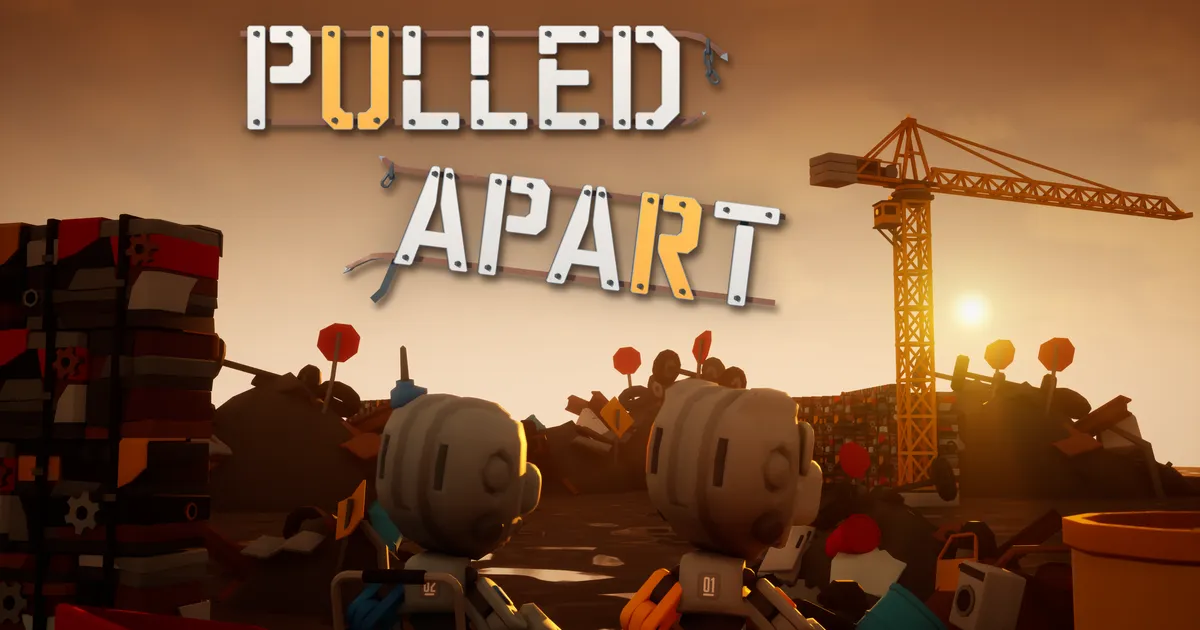
Pulled Apart is a puzzle game about two robots trying to escape a scrapyard. One can send its hands, feet, and head off to do jobs its body can’t. The other has no legs and gets around in a little blue cart. Getting out takes both of them.
I worked on it with my dad, Ron Edgecomb II, and my brother, Jacob Edgecomb, as Edgecomb Labs. We made the game in Unreal Engine over four days for MegaJam, with the three of us directing and AI agents doing the building. This devlog follows that process, from choosing the idea to the final build, including the things that went wrong along the way.
You can watch the gameplay video on YouTube. The full story, including the ending, is below.
In this devlog
The idea
The theme was DIRECTOR’S CUT. We worked through ideas with an AI agent and rejected its first two rounds. The first focused on film sets and cutting-room floors, which felt too literal. The second focused on cutting and directing as mechanics, but we still felt it was too tied to cutting.
For the next round, we had the agent look at what last year’s winners had in common. One of the ideas it proposed was Spare Parts, our working title for a game about a robot whose hands, feet, and head all come off. A thrown hand can hold a lever. A foot left on a pressure plate can keep a door open while you hop through on the other one. The head can fit through gaps the body can’t. Each room asks you to decide which parts you can do without.
On Thursday, the first day of the jam, the parts were working and we needed to decide who this robot was and where it was going. Most of the first story ideas returned to the theme too directly. We saw DIRECTOR’S CUT as permission to choose our own story. Sending parts off to do jobs already connected the mechanics to the theme; we wanted the story to give us a reason to care about the robot.
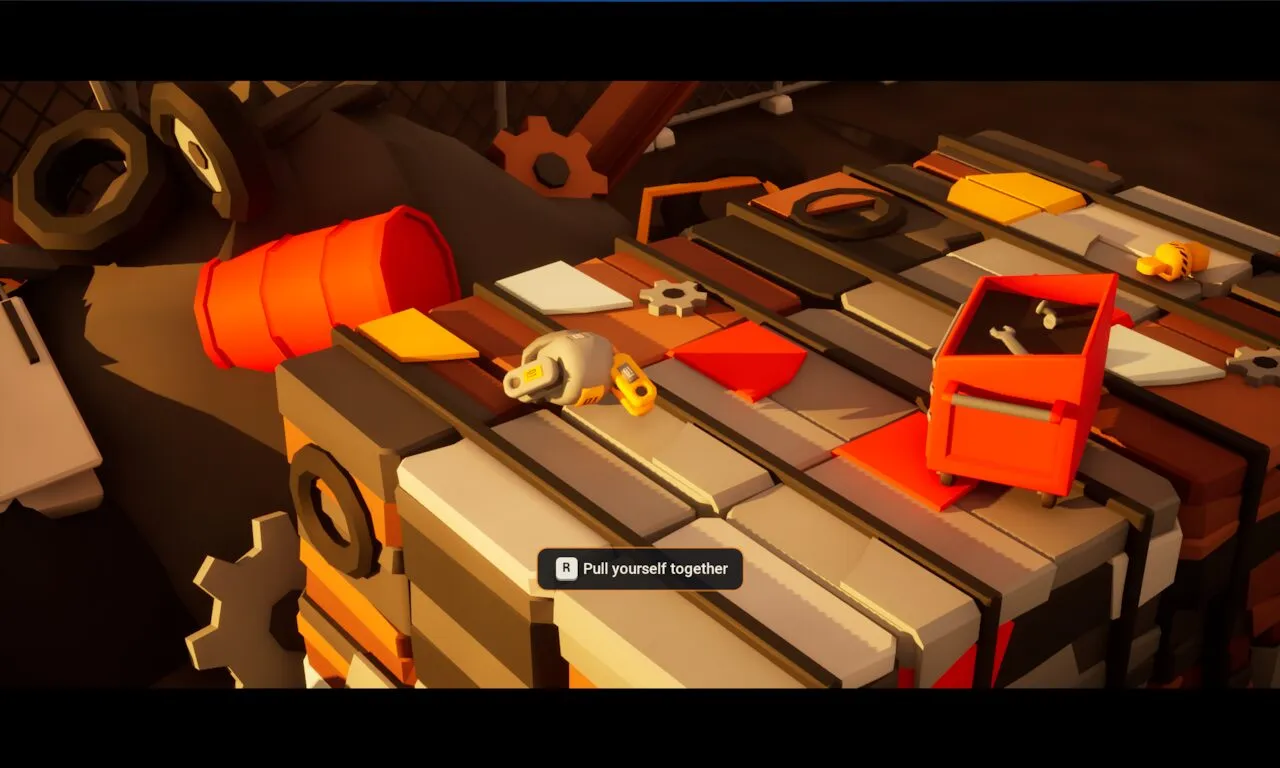
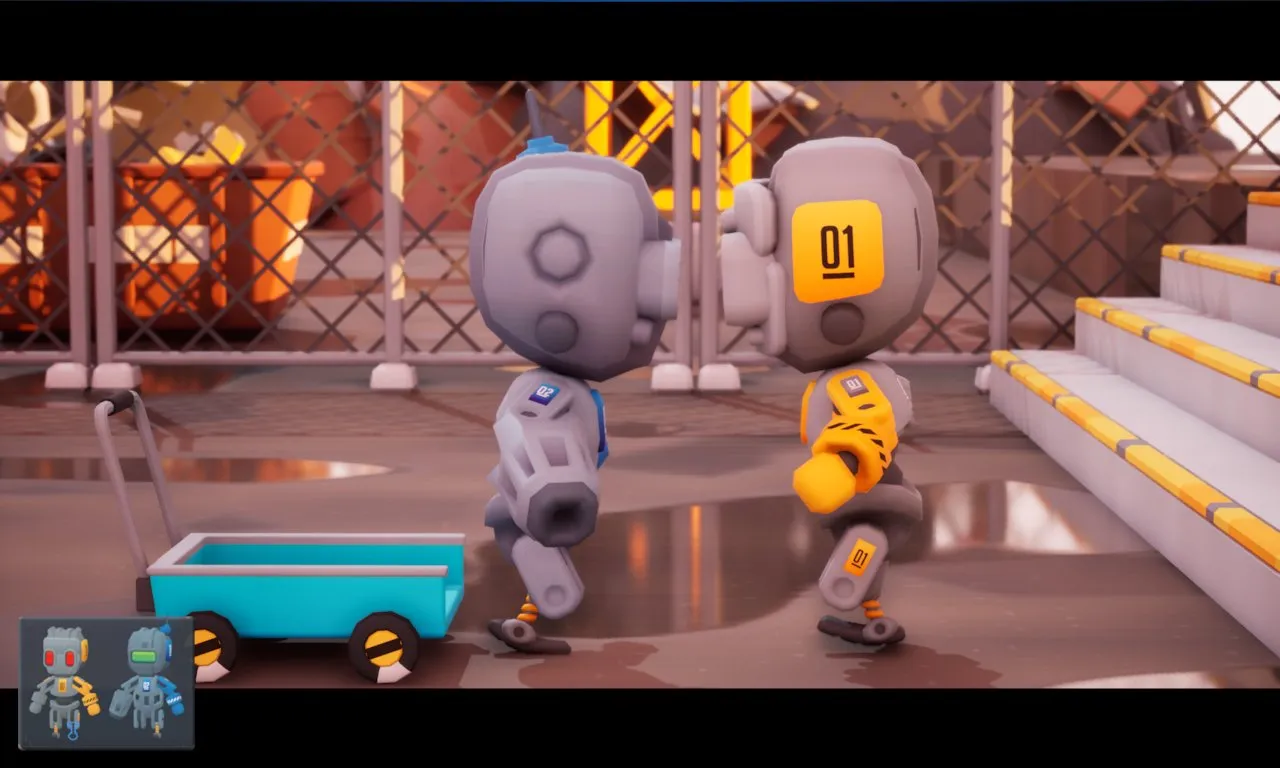
The story we chose follows two robots living in a scrapyard. 02 lost its legs long ago, and 01 has been pushing it around in a little blue cart ever since. One evening, the yard’s magnet crane takes 02, cart and all, and drops it on the belt to the crusher. 01 holds on and is pulled apart. It pulls itself together and goes after 02, sending its hands, feet, and head where its body can’t go.
The finished game has ten rooms in three acts, all taking place over one night. The first three rooms teach the hand, the foot, and the head. In the second act, 01 is alone: one room asks for two parts at once, twice, and the crusher takes all three at once to stop.
In the third act, you switch between both robots. 02 can’t jump, climb a step, or throw anything, but its cart is heavy enough for truck scales that 01 can’t activate even with every part attached. Through five more rooms, each robot holds the way open for the other.
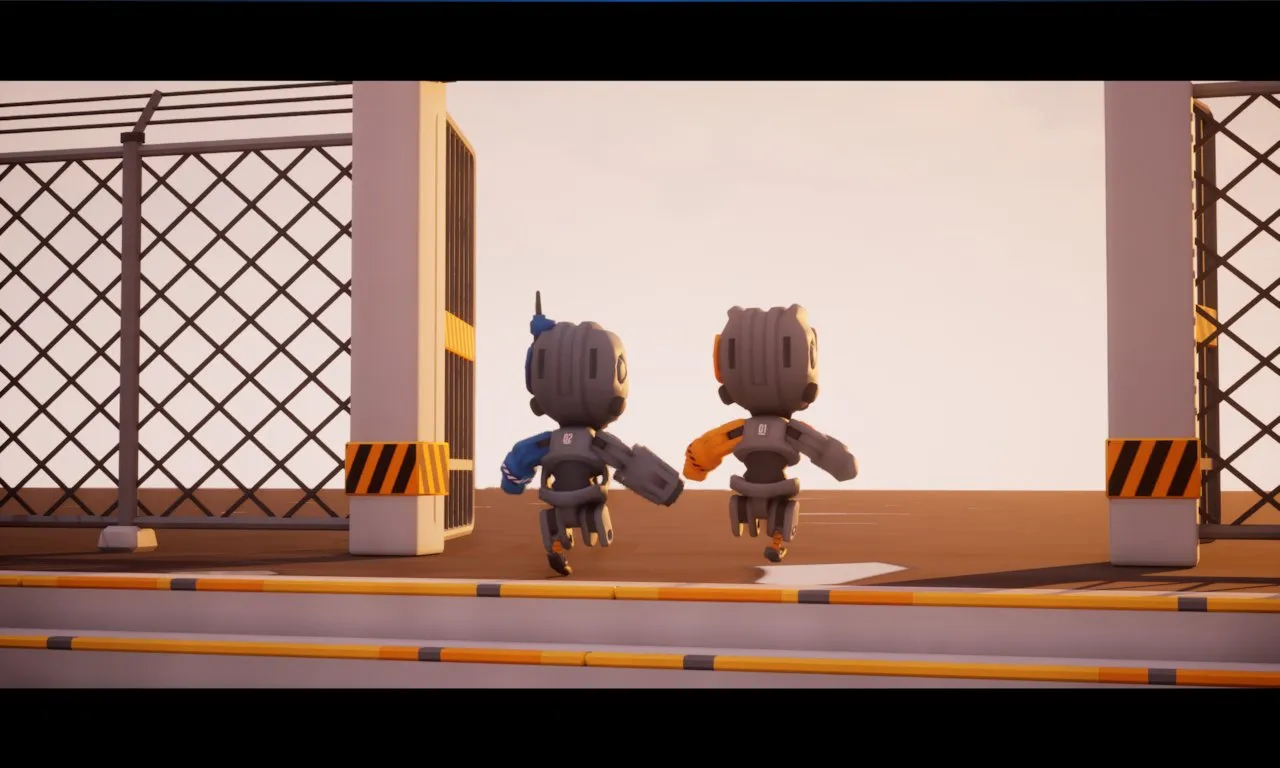
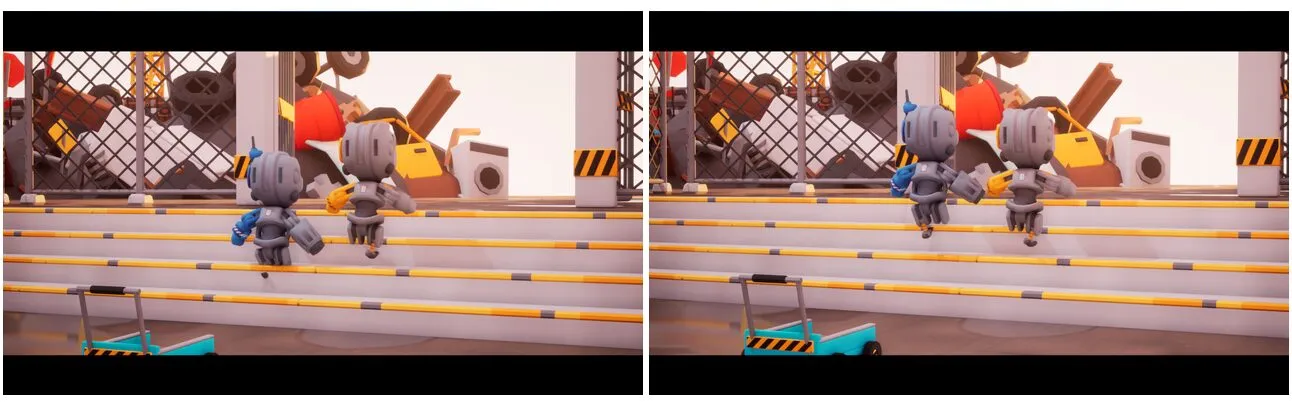
At the yard’s gate, there are steps and the crane comes back for 02. This time, 01 gives it one of its own legs to keep. They hop out together at dawn, one leg each, leaving the cart behind. The parts that start as puzzle tools become something 01 can choose to give away.
A scripted run that knows every answer takes about six minutes on the game’s clock, or seven to eight from Start to the end card with the scenes included. We didn’t time a first-time player before submitting.
How we worked
Our team, Edgecomb Labs, was Ron Edgecomb II, Ron Edgecomb III (me), and Jacob Edgecomb. We collaborated in the same room throughout the jam. One main agent in Claude Code did the building, with sub-agents handling independent reviews and some of the models, animations, and sounds.
We originally planned to split the work three ways. The night before the jam, we changed our minds and took the theme announcement at its word: “Set the vision, delegate your tasks and decide what goes in and what doesn’t.” The three of us would direct, and the agent would build: code, levels, models, animation, sound, packaged builds, and the records this devlog draws from.
I was the Team Owner and worked with the agent at the keyboard. Until Saturday, the build feedback came from me. Larger decisions, including the story and the move to three acts, were decisions we made together and I passed on. By Saturday afternoon, all three of us had played the game and written notes, including the first notes from Ron II and Jacob. Three more rounds followed before Sunday noon.
We played the builds handed over at the end of a round. The agent packaged more than thirty over the four days, and we didn’t play every one. Three times, we asked it to carry on without us: on Thursday afternoon, through the story’s build order; on Friday morning, to design harder rooms and build the good ones without waiting for approval; and on Saturday, to work through two lists of our notes into the night.
The asset record lists everything in the game as either sourced or made by the agent. None of us made or changed any art, sound, code, or levels by hand.
From the first hour, the agent kept a plan, a journal, and an asset record. Separate agents that hadn’t written the work reviewed it nineteen times during the four days, plus once the evening before to review the concept and scope. Those reviews covered Thursday morning’s code and packages, the first title-to-ending build, the story brief, the story build, each stretch of the third act, the two harder rooms five times between them, the work on our feedback lists five times, the last morning’s fix, and the submission itself.
Most reviewers could only read the code, level-building scripts, and records. They couldn’t run the game, so they worked out what a player could do and asked the main agent to try it. Several of the most useful findings came from that combination of reading and playing.
Our feedback was logged with what was done about each item. On Thursday and Friday, I sent individual notes as builds were handed over. On Saturday afternoon, we had 64 notes, each rated out of 3 by its author: 20 from me, 17 from Ron II, and 27 from Jacob. Then came eleven more near midnight, eight after 1 AM on Sunday, and one on Sunday morning. The original notes were kept alongside the work lists made from them.
Before the jam
The theme was announced the afternoon before the contest window opened, and we spent that evening choosing a concept with an AI agent. I want to be specific about what existed before the start:
- Three rounds of concepts. For the third, the agent read up on what last year’s MegaJam winners had in common (one mechanic you can say in a sentence, a character people like, a look of their own, a short complete arc) and pitched five ideas built on that. Spare Parts was one of them.
- Concept demos. We had the agent build demos in Three.js, a web library, to see whether the ideas were worth four days: two earlier ideas first, then Spare Parts. The Spare Parts demo was a playable room of about 4,000 lines of code, with a designed golem, lighting, a title card, and hints, built in under an hour. All three of us played it and chose it on the spot.
- A briefing deck the agent prepared so the three of us could talk the options through.
- Our workflow setup: the agent skills, editor connections, scripts and templates we prepared in the days before, and a technical rehearsal with a throwaway Unreal project to make sure the tools worked.
- A local library of sourced art: The Complete KayKit Collection by Kay Lousberg, 24 packs released under CC0, which we put on the machine the evening before. Nothing from it was imported or changed until after the window opened. The game uses its robot character and that character’s animations; they are sourced assets, credited below, and under the rules they are not part of what gets judged.
The demo informed the game’s design. We chose the idea by playing it, and the same agent built both. We made the Unreal game inside the contest window, in a different engine and language, with a rule set that night: the agent could use the demo’s README as a design reference, but couldn’t open its source while building the game.
Two rooms share a puzzle beat with the demo: a lever holding a bridge over a pit, and a foot on a plate holding a door, with a step beyond that needs both feet. On Thursday morning, the agent asked whether the second should change because it was in the demo. The answer was to keep it: “I think what we have is fine, as long as you don’t see a good reason to change it.”
On Saturday, I also asked for the robot’s head to follow the cursor as it had in the demo. That was written again in Unreal. The demo had a title card, a parts display, and hints; the game’s versions were written during the window and redone on Saturday from our notes. The game’s character came from KayKit, rather than the demo’s golem. As far as the three of us know, this account is accurate.
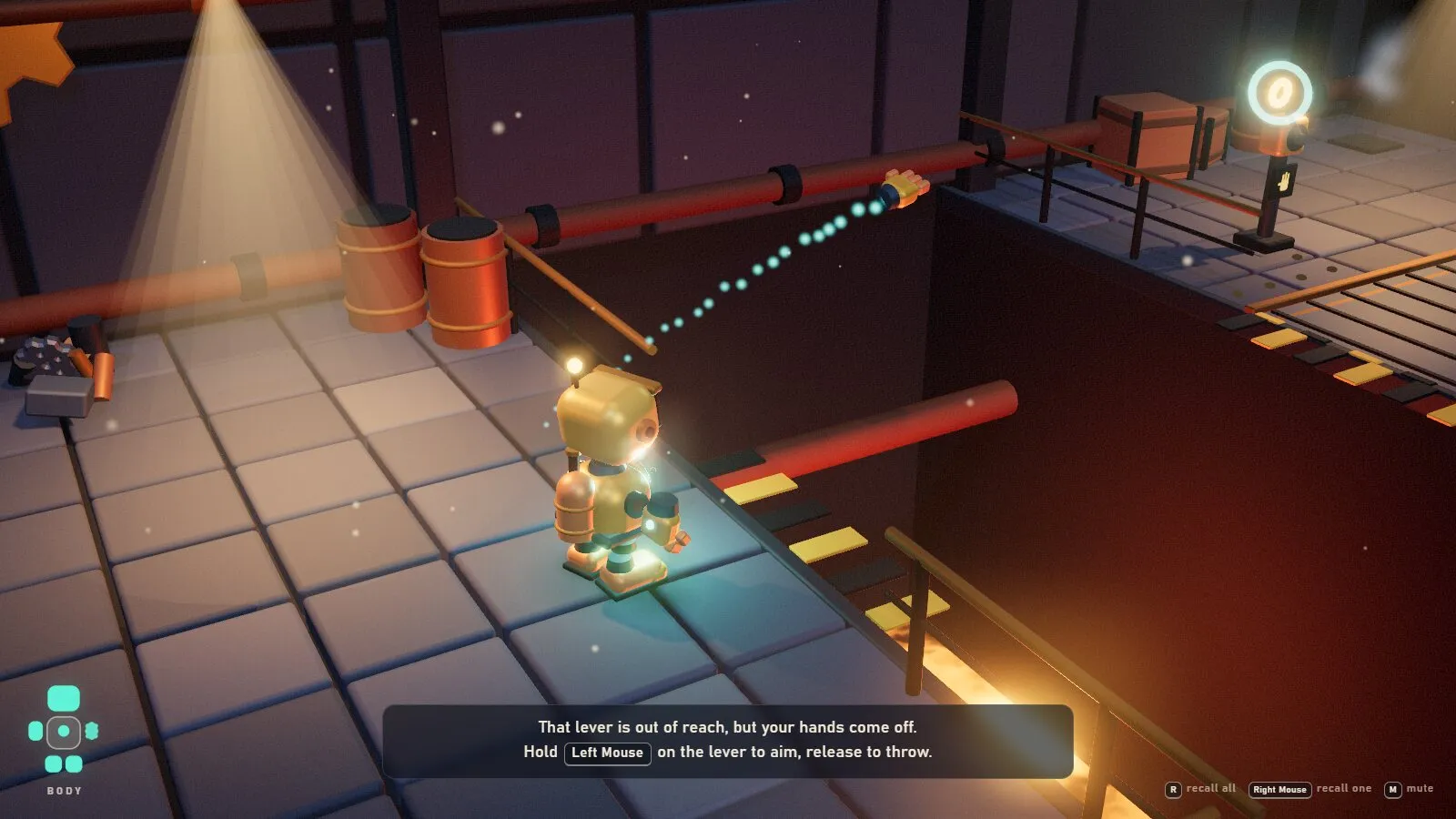
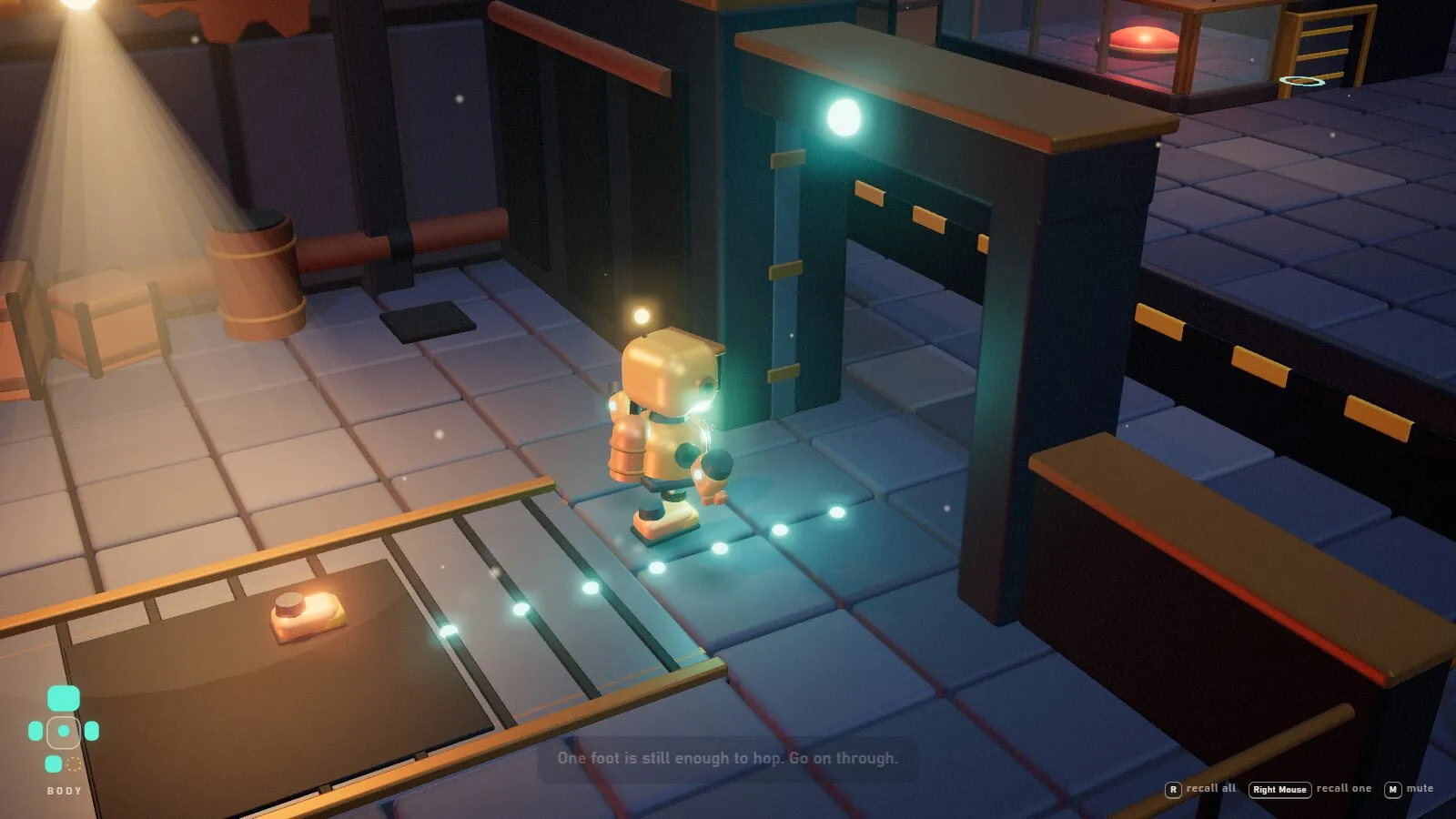
Stills from the pre-jam Three.js concept demo, captured by an automated run. They are not the game.
Building the game
The following sections were recorded as the work happened. When a section says we hadn’t played a build or heard its sound yet, that describes the point in development being discussed. Later sections cover what we found when we did.
The first seventy minutes (Thursday, from midnight)
The contest window opened at midnight Eastern on November 12. The Unreal project was created at 12:02 AM and compiled a minute later.
12:17 AM: a graybox golem. The first character was a body and five loose parts made from the engine’s basic shapes. It could walk and jump. Springs pulled the separate parts along beside the body, and the feet stepped in a cycle driven by distance traveled. The agent wrote it in Unreal C++ without opening the pre-jam demo.
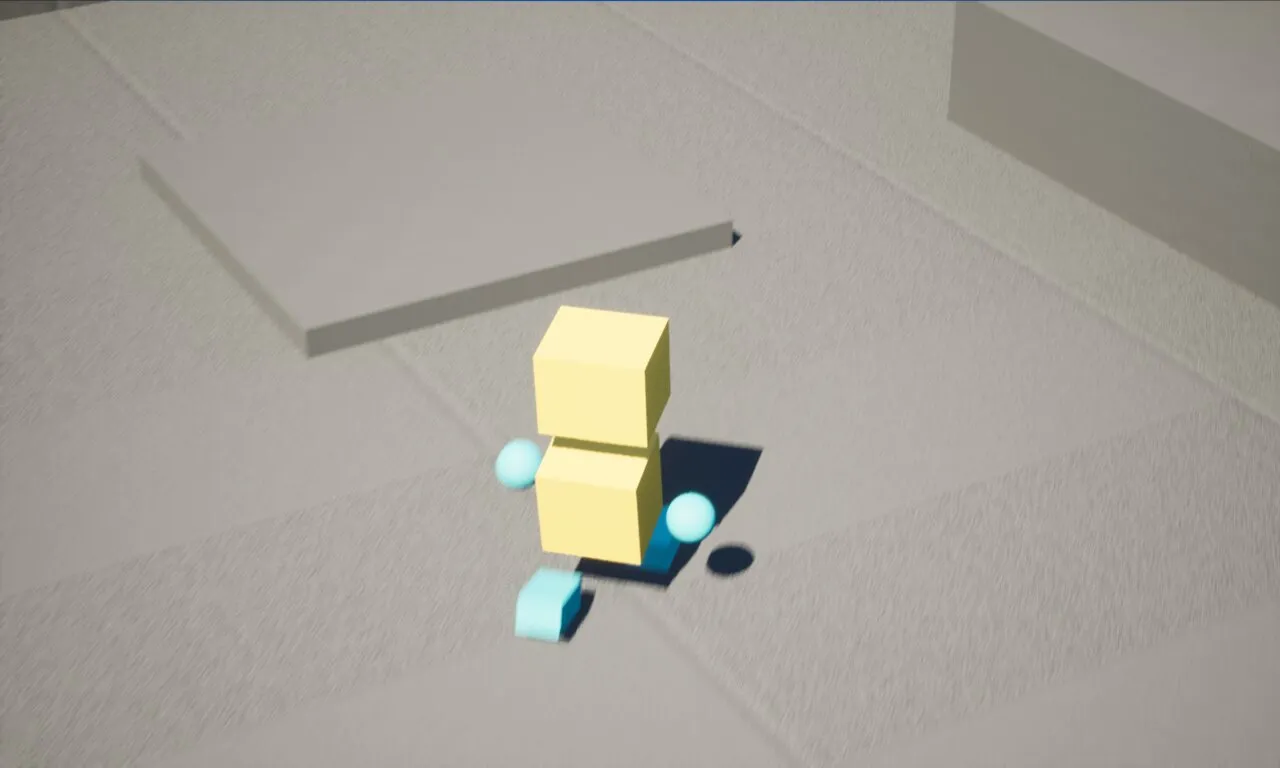
12:28 AM: a robot. One of us had swapped our asset library for the KayKit collection and suggested its robot. The agent took the robot apart in Blender into a body, a head, two hands and two feet, and the springs carried those instead of spheres and boxes.
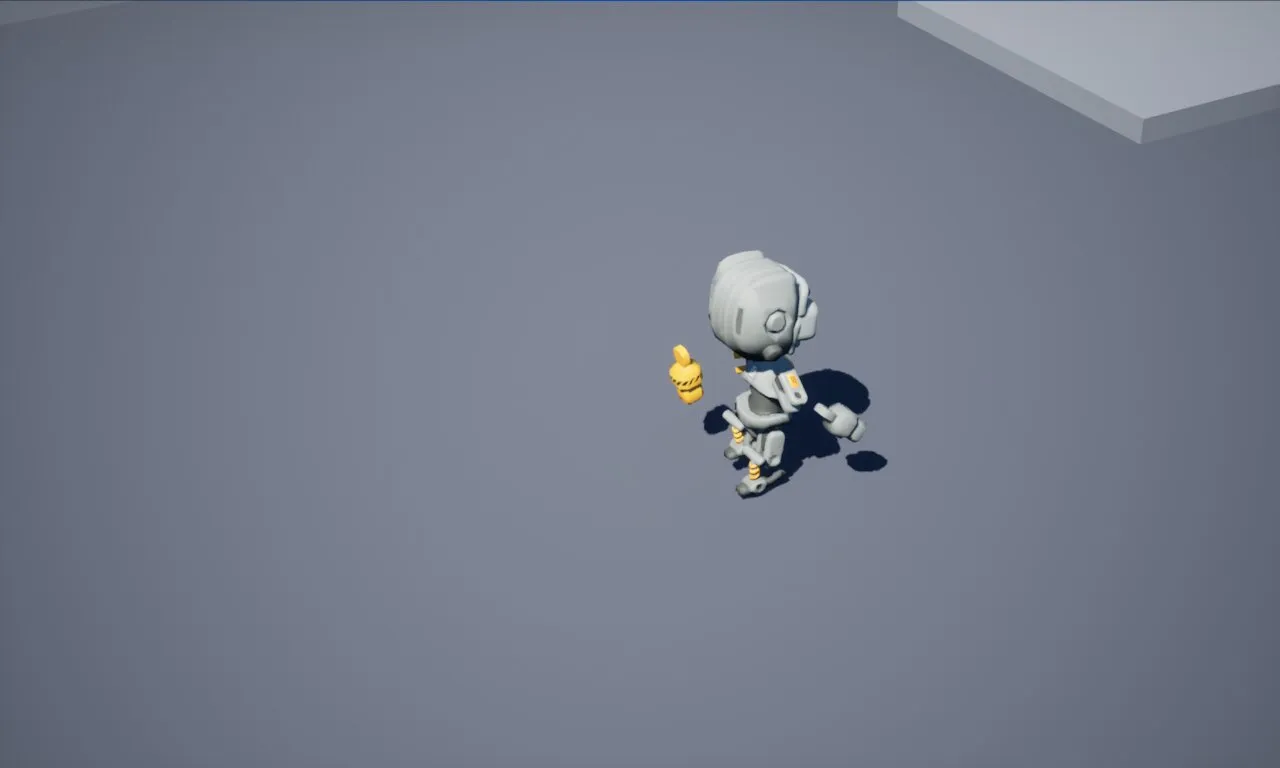
12:45 AM: using the robot’s animations. One of us asked why the pack’s walk cycles weren’t being used. The agent had split the robot into floating pieces without checking what else came with it: a full skeleton and 37 animation clips.
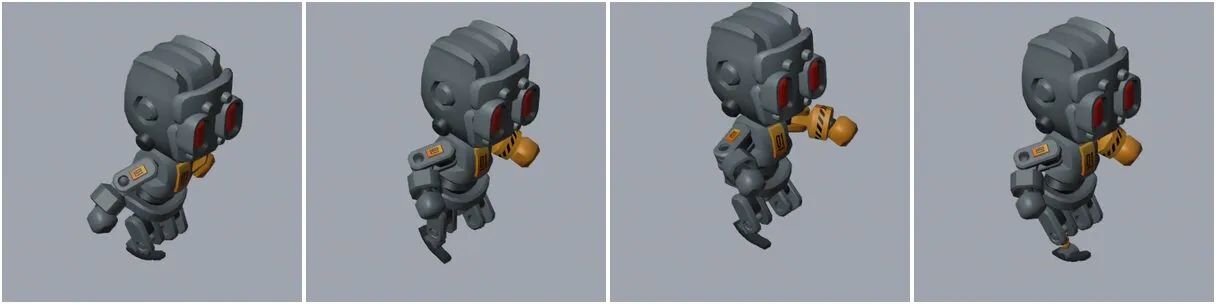
The character was rebuilt around those animations. An attached part is a limb on the animated robot. When it comes off, that limb is hidden and a separate copy appears in the same place, free to fly. The agent measured planted-foot movement in the walk and run clips to match the animation speed to the golem’s actual movement.
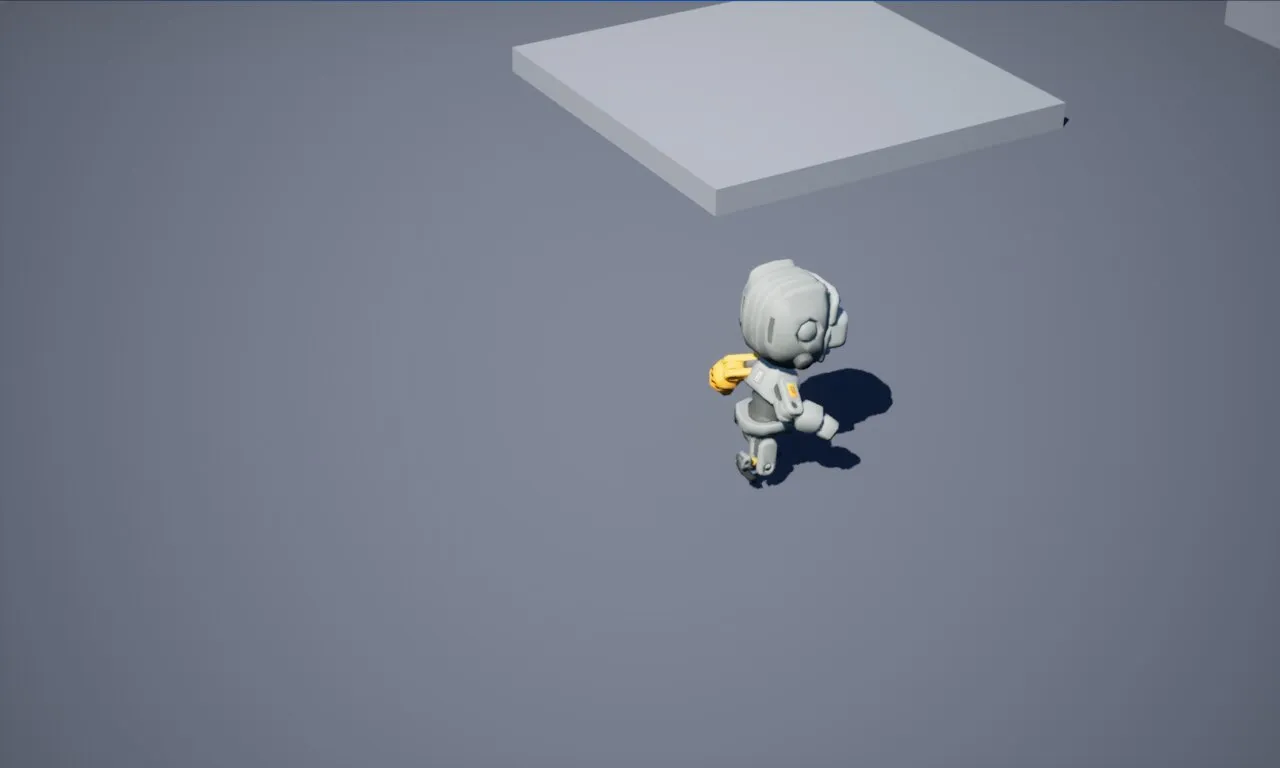
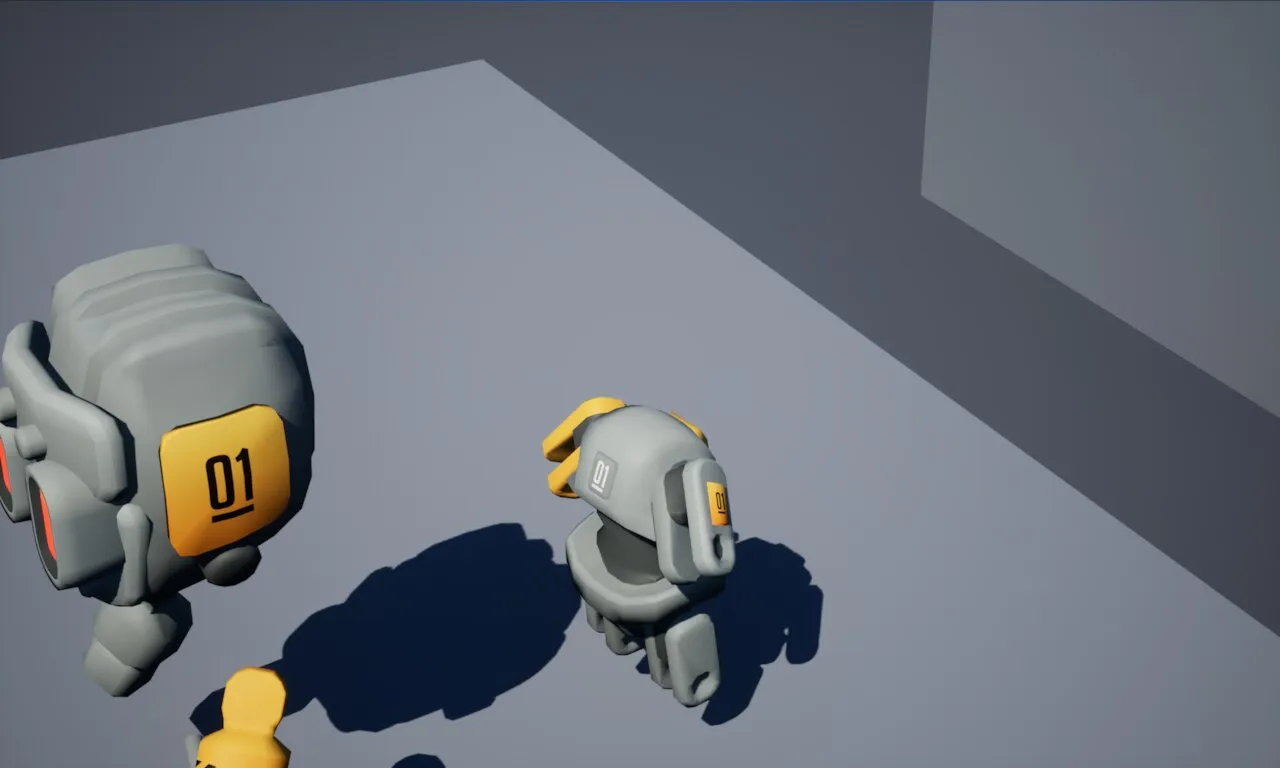
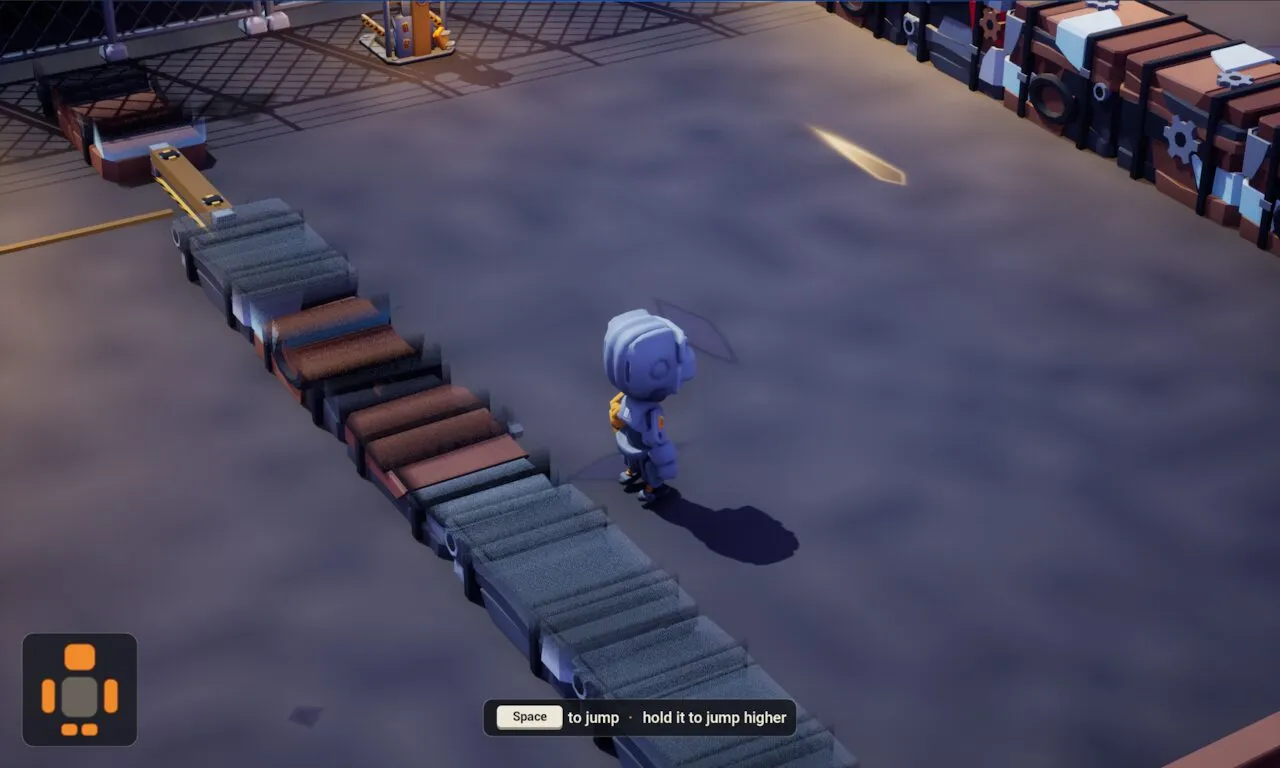
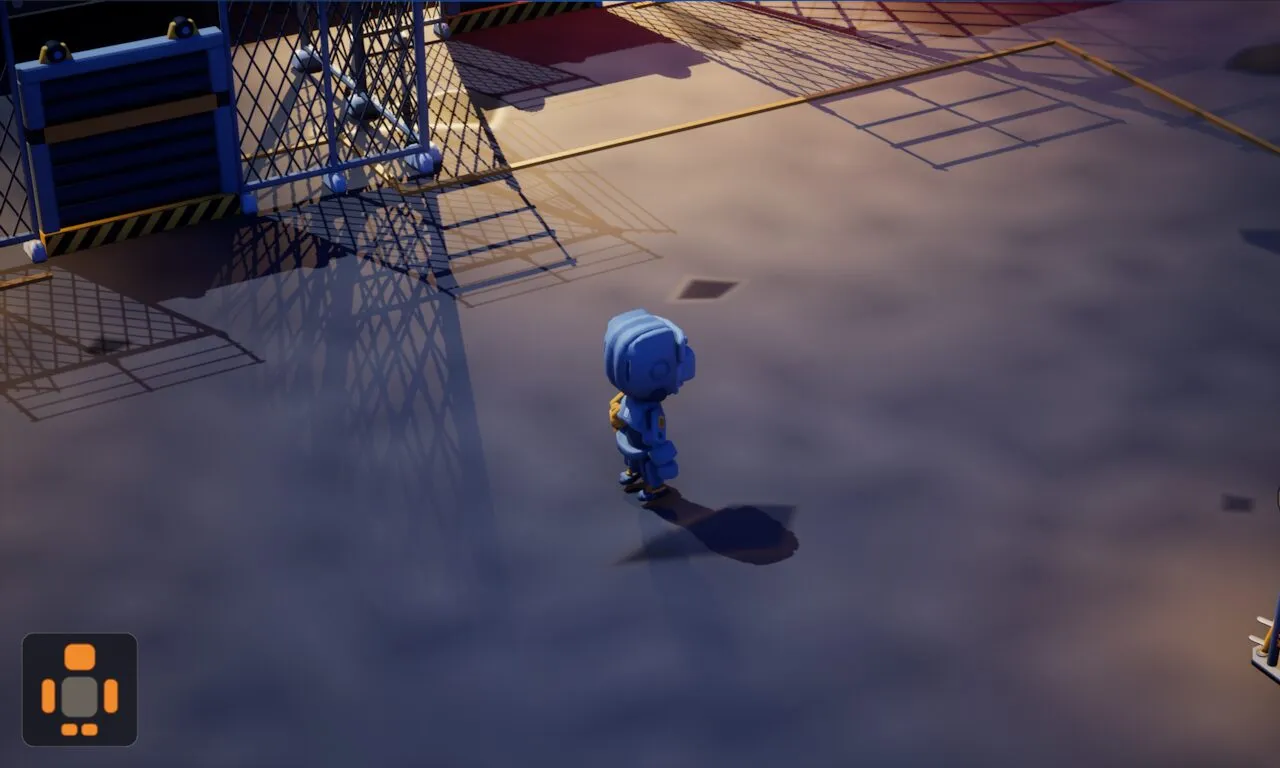
The second picture is a test: every part taken off at once and the body walked away. The game does not look like this yet.
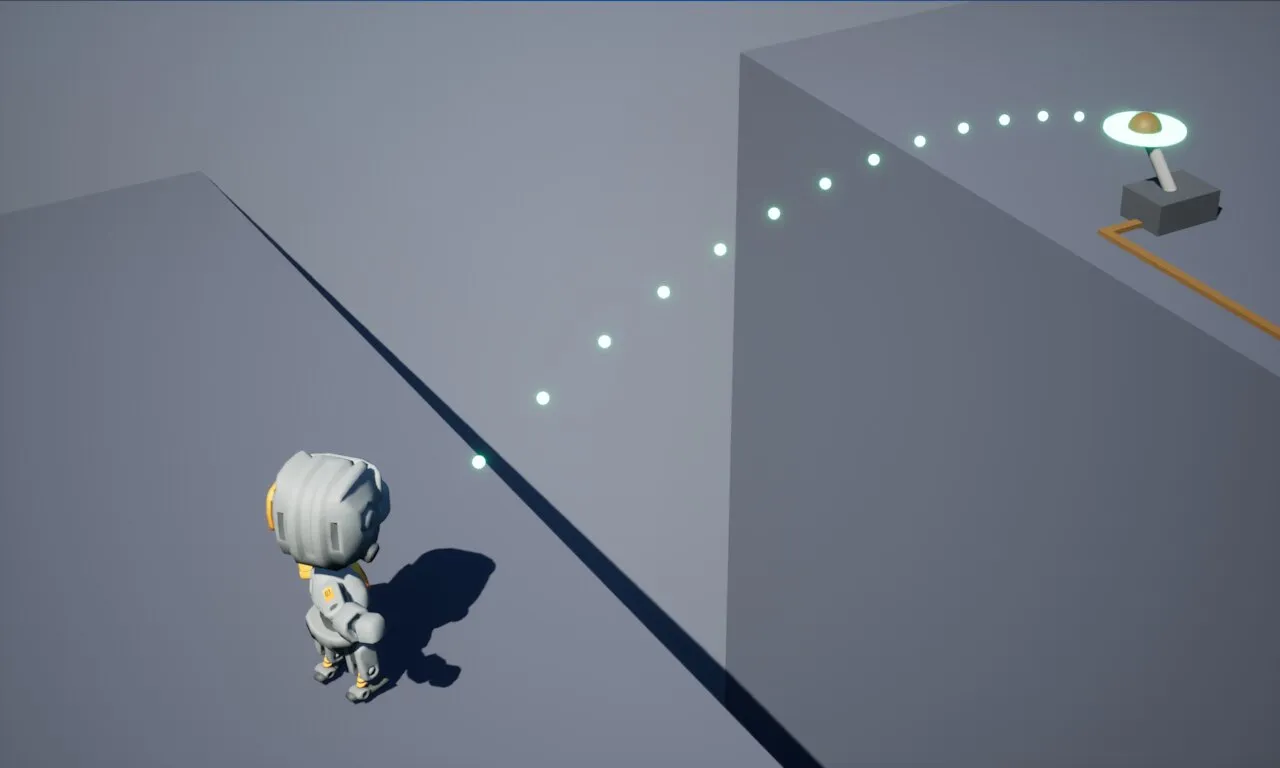
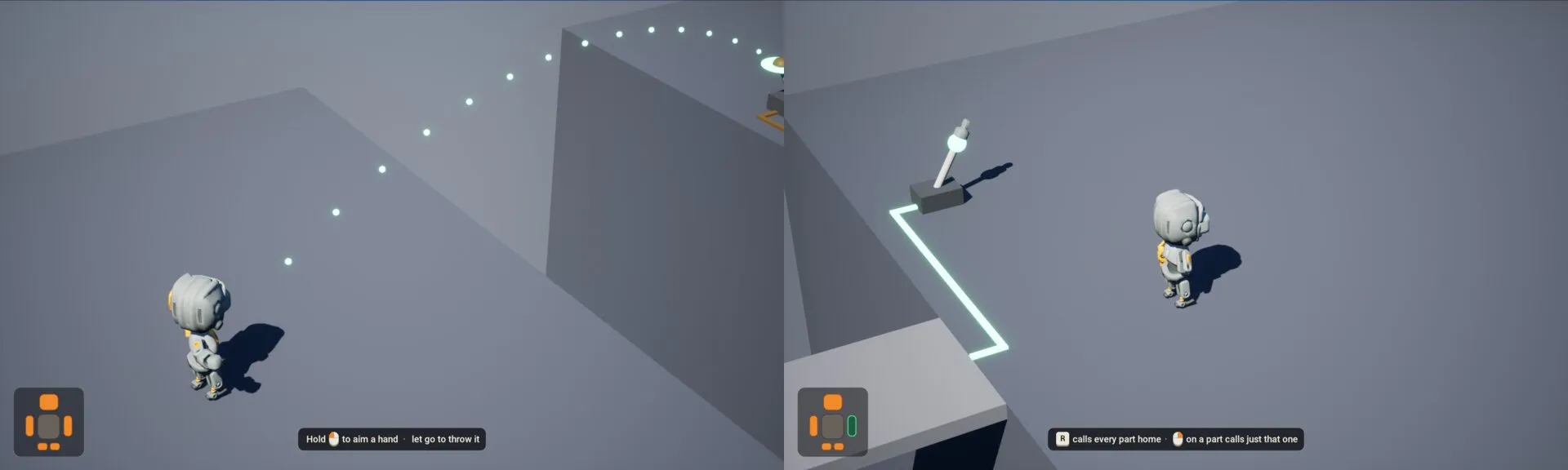
1:10 AM: the hand. A new graybox room with a pit too wide to jump. Hold the mouse button and a dotted arc shows where a hand will go; point near a lever and the arc locks on to it. Let go and the hand flies there, takes hold, and pulls. The lever lights a wire, the wire runs to a bridge, and the bridge slides out for exactly as long as the hand stays on the lever. Cross, press R, and the hand flies home while the bridge pulls back behind you.
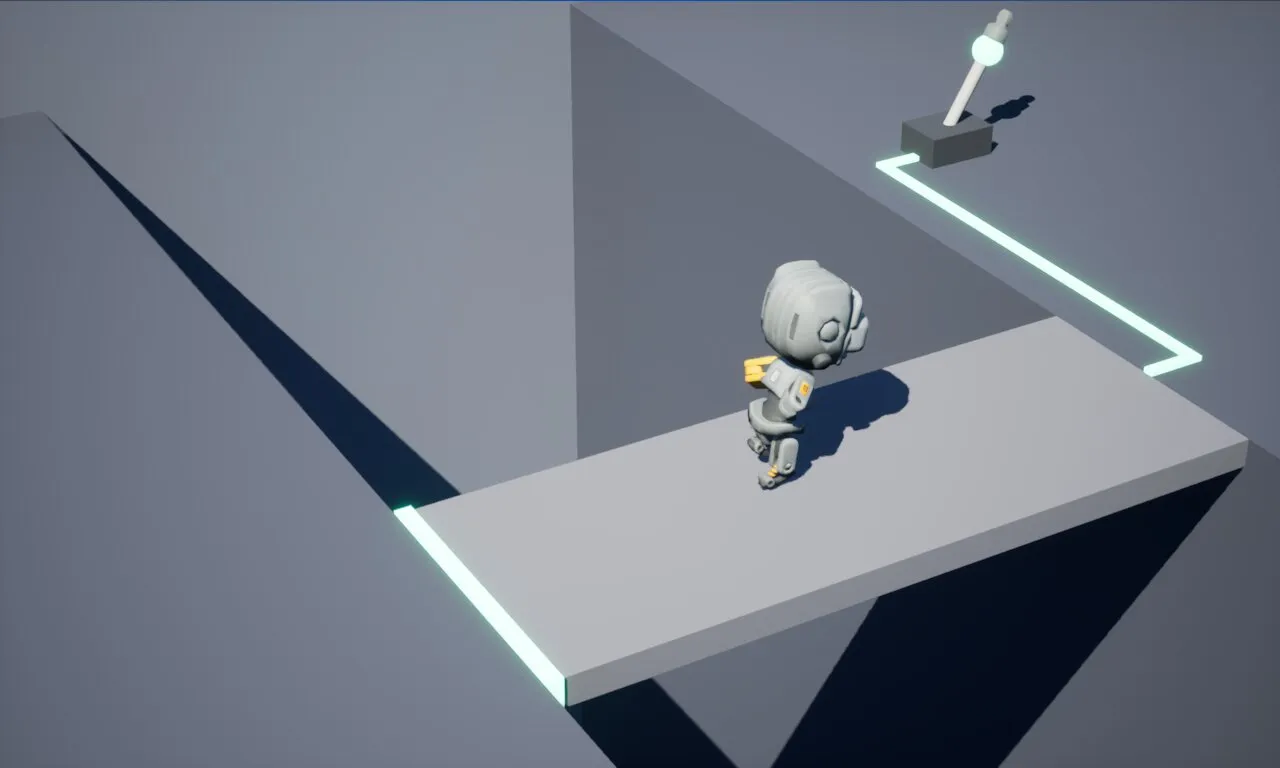
Thursday morning: the feet and the head
The night left the golem able to throw its hands, but not to lose a foot or its head. One of us set the next steps and suggested how they should look. For one foot, a new hopping animation made in Blender in the style of the pack’s own clips. For no feet, the pack’s crawl, instead of the hovering the concept demo had used.
A hop that wasn’t in the pack. The animation rig had foot-roll and hand controls, so the agent keyed a hop on those controls using a script that could rebuild and tune it. The foot lands ahead of the hip, the body sinks and springs up, and the foot tucks under in the air. The missing leg’s stump swings the other way while both arms pump. A second clip handles balancing on one foot while standing still. Both were mirrored for the other foot.
To check the export, the agent sent one of the pack’s own clips through the same process and compared it with the original in Unreal, bone by bone. They matched.
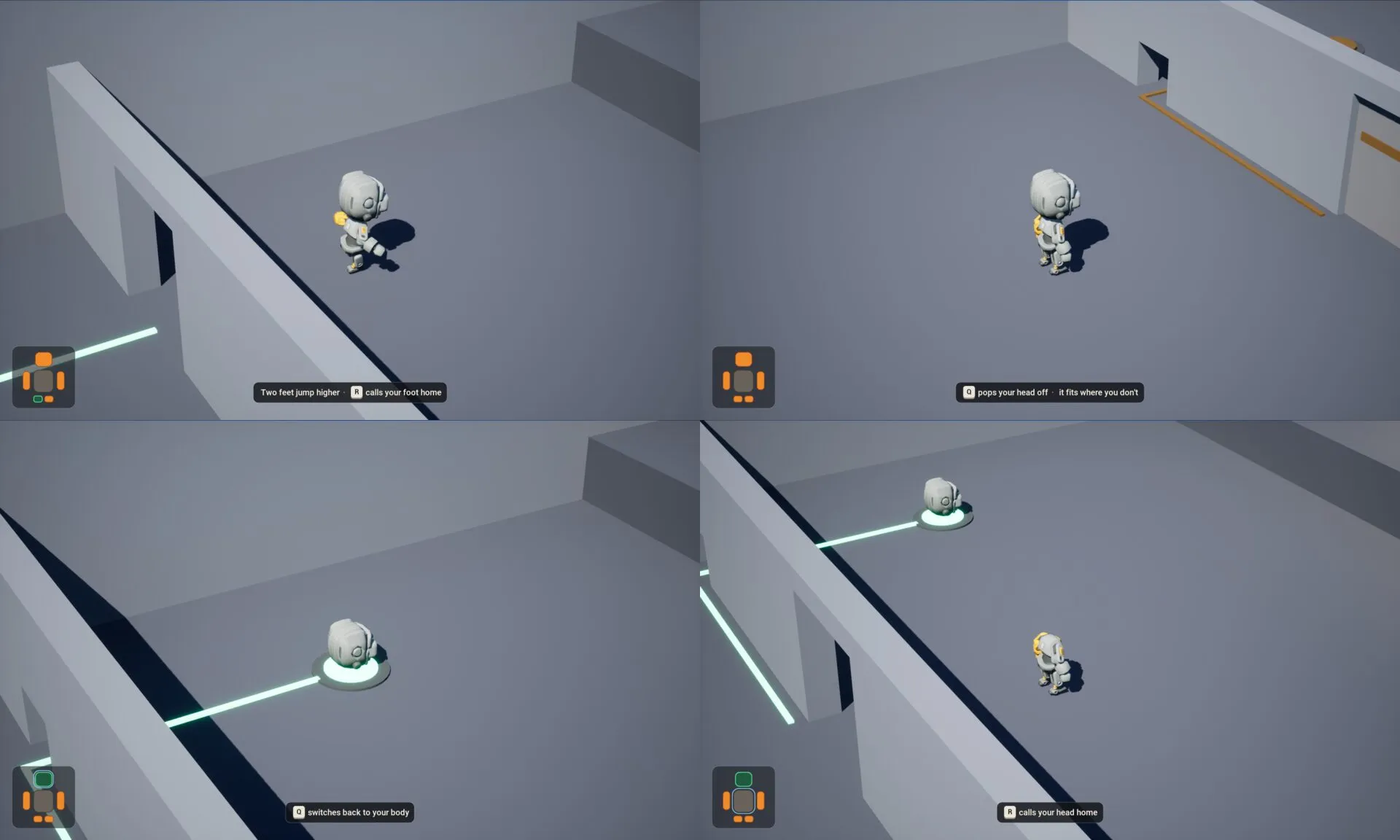
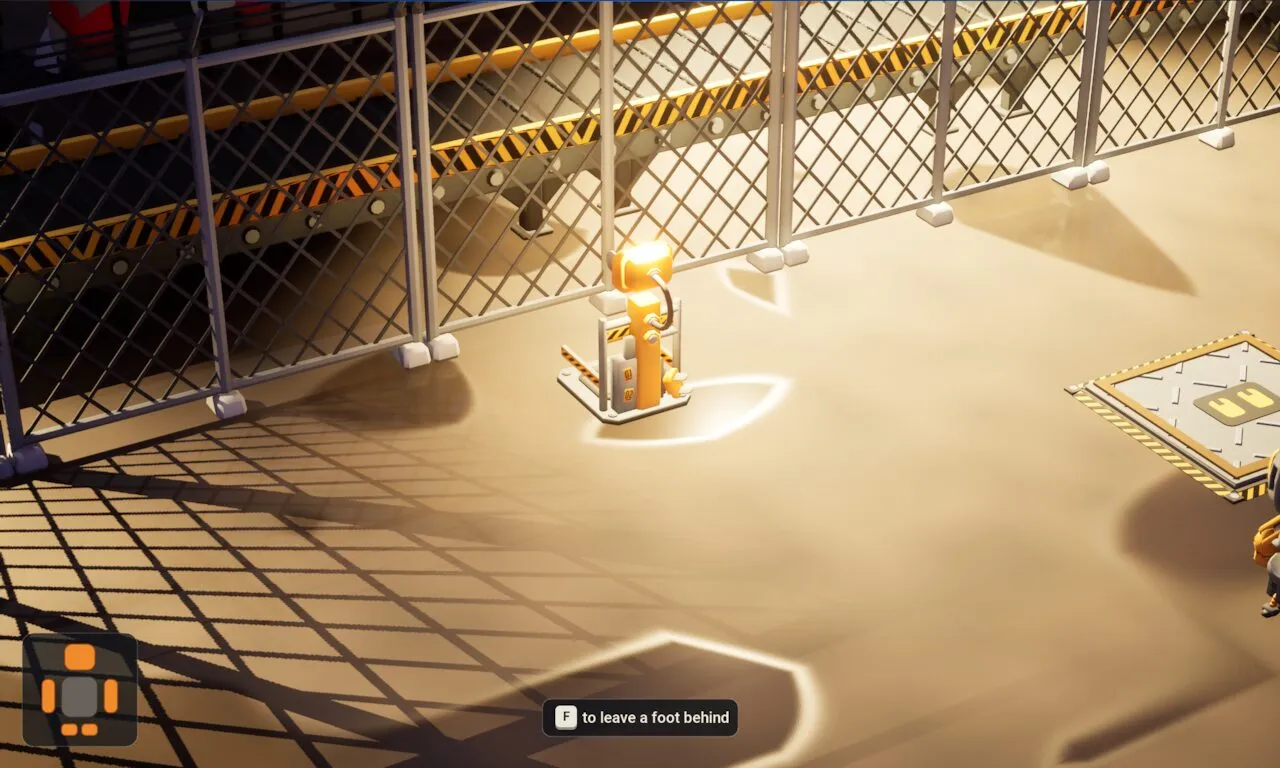
Leaving a foot. Press F and a foot is left standing on the floor. The golem hops on the other one, slower, and jumps about half as high. Press it again and the golem crawls on its hands and stumps: slow, and no jumping at all. Aim while crawling and it sits up to throw.
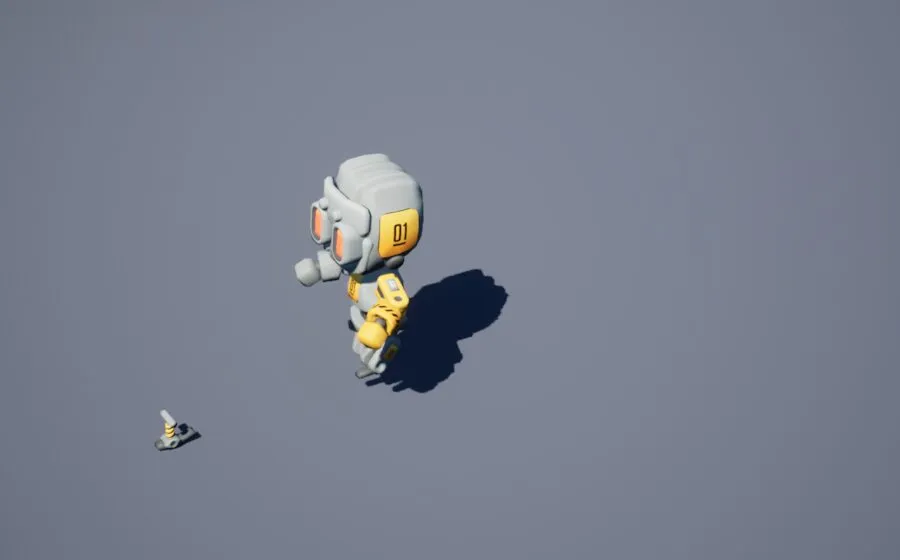
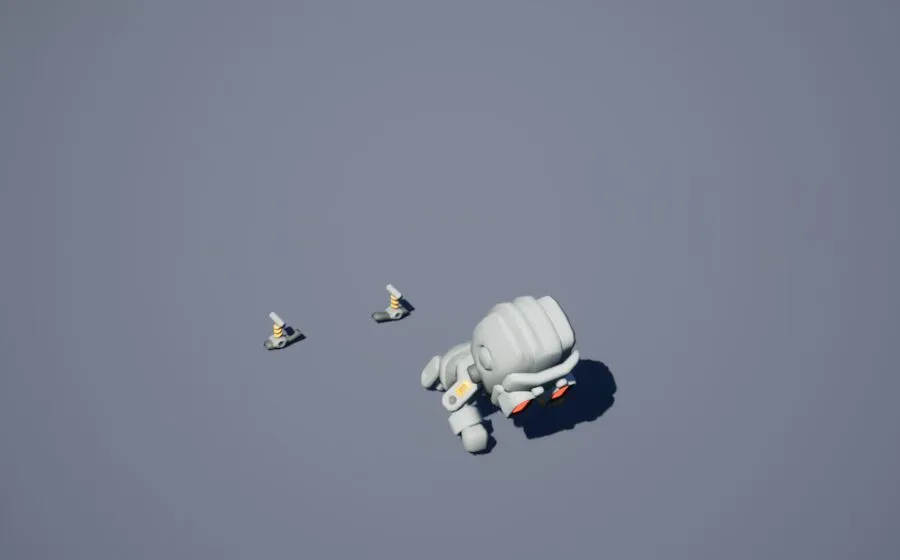
Popping the head. Press Q and the head pops off the shoulders and lands in front. Now the keys steer the head, not the body. It bounces along, tips into its direction of travel, and hops when you press Space. Under the hood it rides a little invisible body of its own, about its own size, so it can go where the golem cannot. Press Q again and you are steering the body. Without its head the body feels its way along with one arm reaching ahead, slowly, and will not jump. R calls everything home, and a head that rolls into the pit flies home on its own.
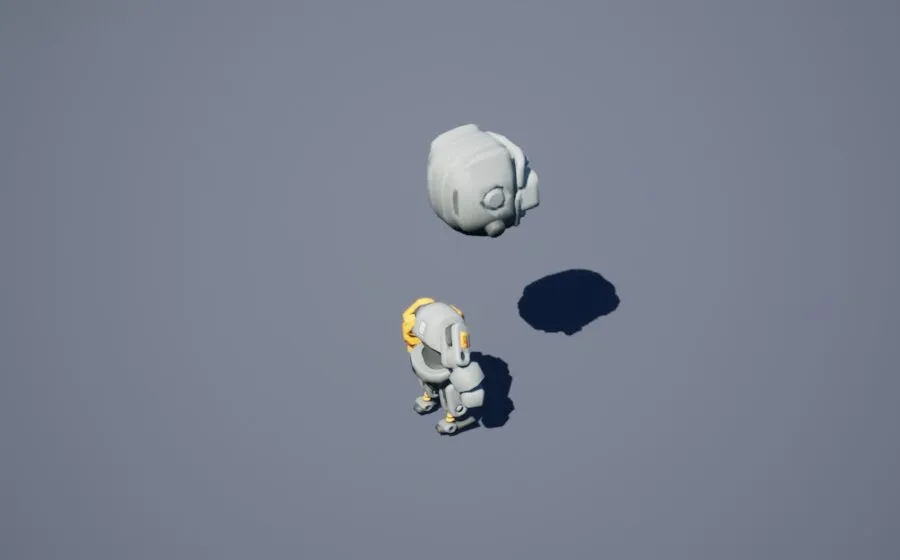
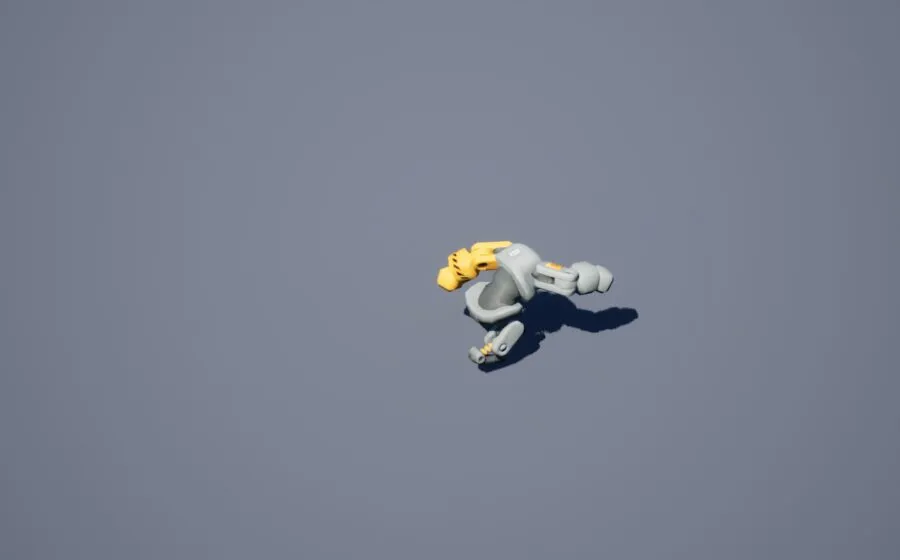
The agent checked these mechanics in editor play by pressing keys and reading the game’s state back. Then one of us played it in the editor and found it very satisfying and fun.
Thursday late morning: the plate, the door, the button and the gap
Each part got a device that only it can work, and a room after the hand room to teach it, so the three rooms now play in a row.
The weight room. A pressure plate opens a door across the room. The plate weighs whatever rests on it, and four strips round its edge show how much: one strip for a hand, amber, not enough. A foot fills it green, and so does the golem standing on it. But step off and the door shuts before you can reach it. Leave a foot on the plate, though, and the door stays open while you hop through on the other one. Beyond the door is a step too high for a one-footed jump, so the foot has to come home, and it flies back through the shut door.
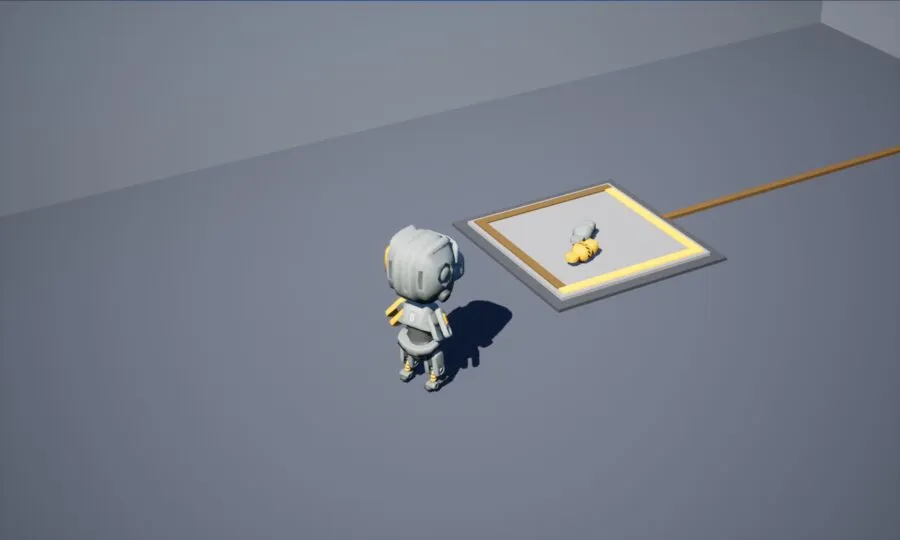
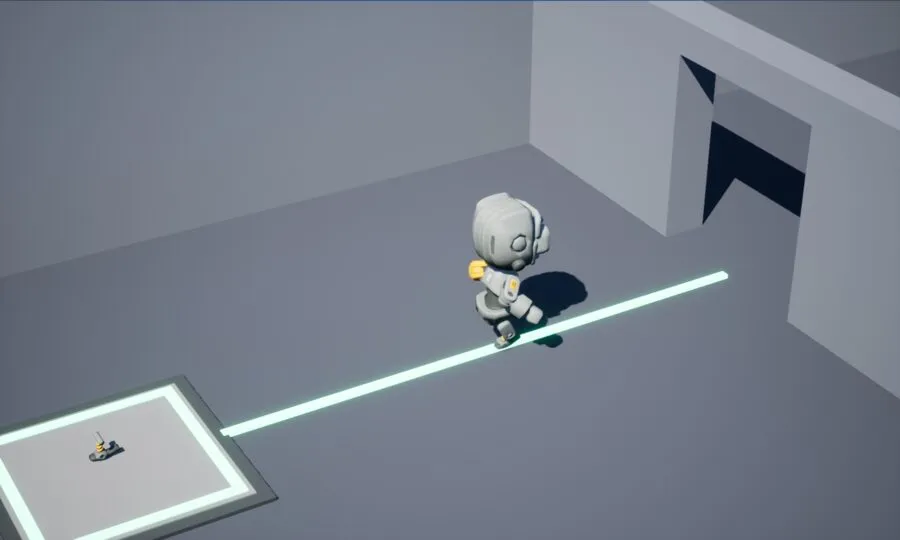
The scout room. A wall with a door, and beside it a gap at floor level too low for the golem. The door’s wire runs into the gap. Pop the head off and steer it through, and on the other side there is a button the size of a head. Roll onto it and the head settles in, and the door opens. Then the body walks through on its own, slowly, feeling its way with one arm out, while the head keeps the button down. Call the head home and the door shuts behind.
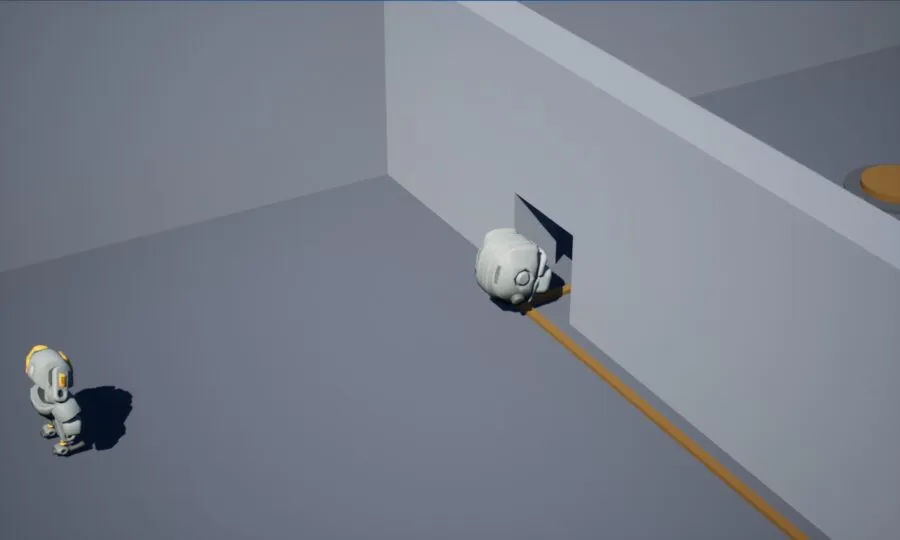
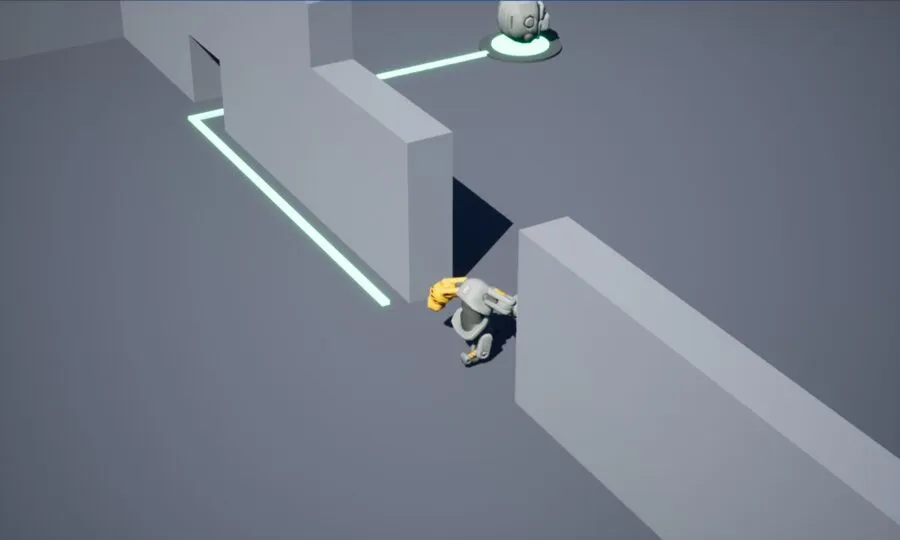
Keeping the robot in view. The camera looks down from the front left, and the first stills showed that a wall could completely hide the golem just after it passed through a doorway. A wall between the camera and the golem, or its head, now drops to a low stub and rises again once you’re past. Its collision stays the same.
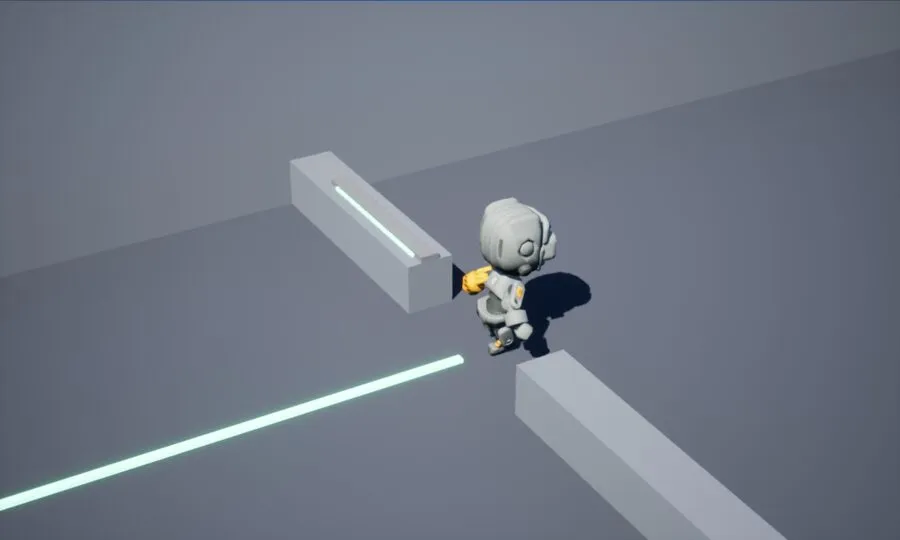
One of us played the new rooms and found they read without explanation, that the door waiting for you felt right, and that the walls dropping out helped. The one change asked for was a camera a little further back, to see more around the golem. It now starts about a fifth further out, and for now the mouse wheel zooms, so we can find the right distance by playing.
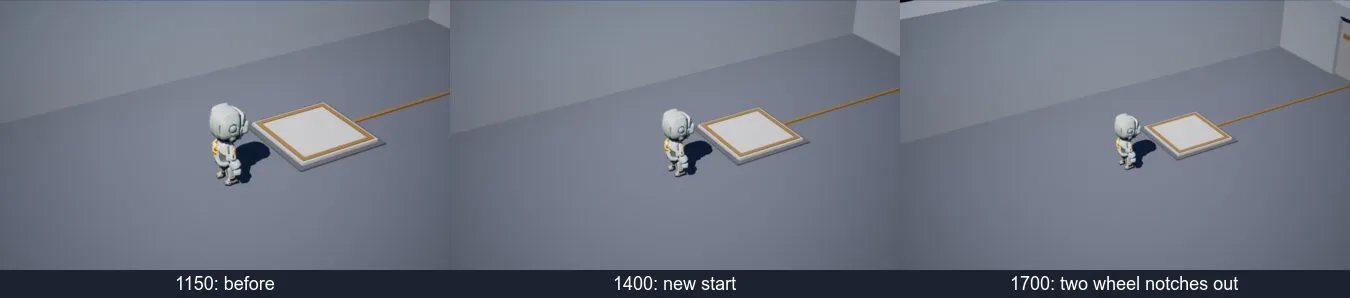
Thursday midday: from three rooms to a short game
The farther camera felt “much, much better,” so we locked it there. Next came the things needed to make the three rooms playable as a short game: hints, a parts display, a title screen, pause, an ending, and sound.
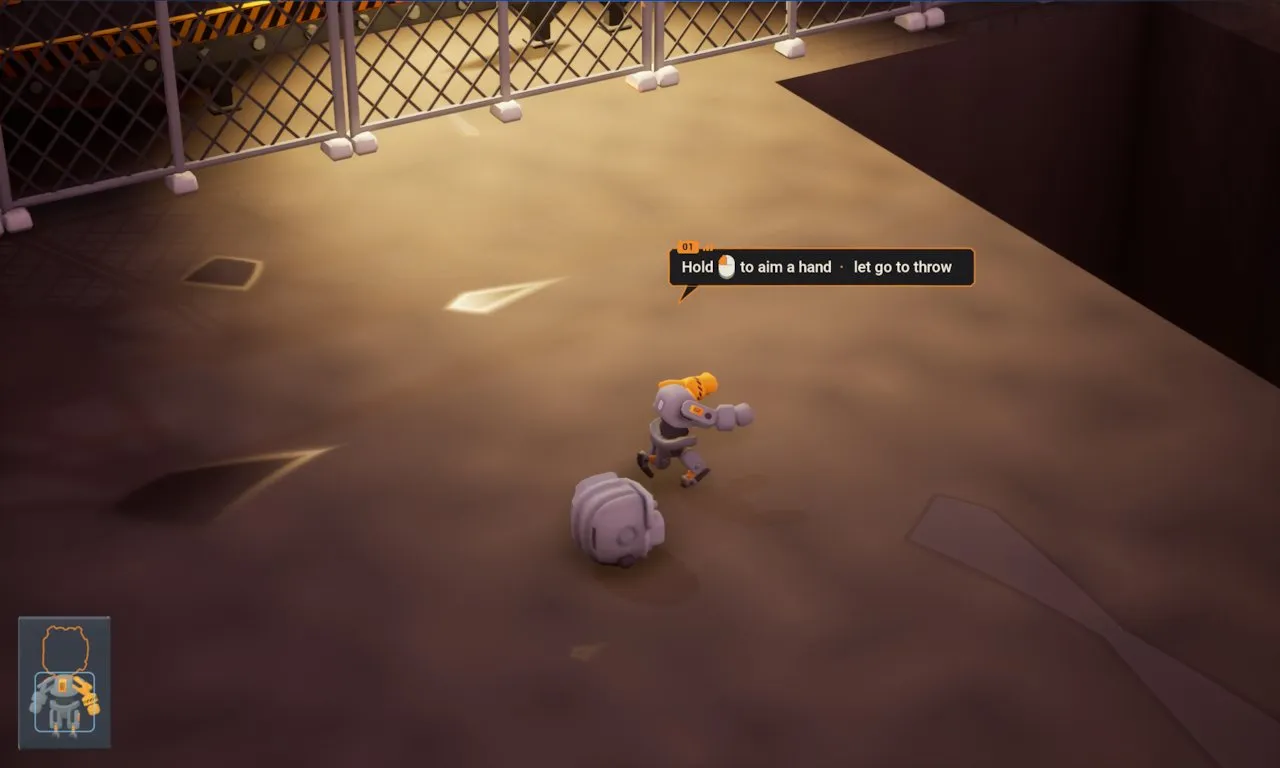
Hints that know what you have learned. A hint is a box placed in a room with a line of text. It shows while the golem is in the box and the hint still makes sense, and it goes away for good once you have done what it teaches. Near the pit you are told to hold the mouse button to aim a hand; once a hand has grabbed something, you never see that hint again. Keys are drawn as little key caps, and the mouse buttons as a little mouse.
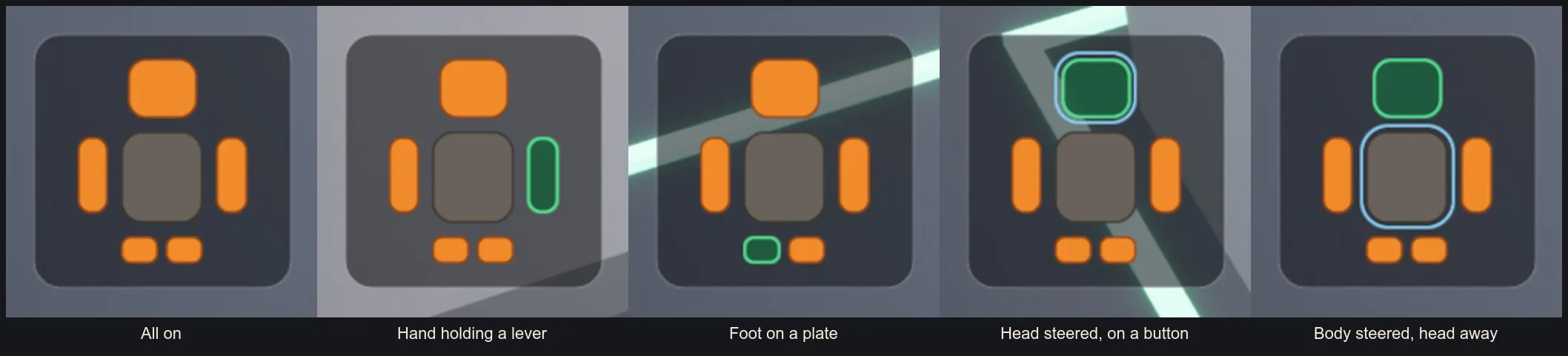
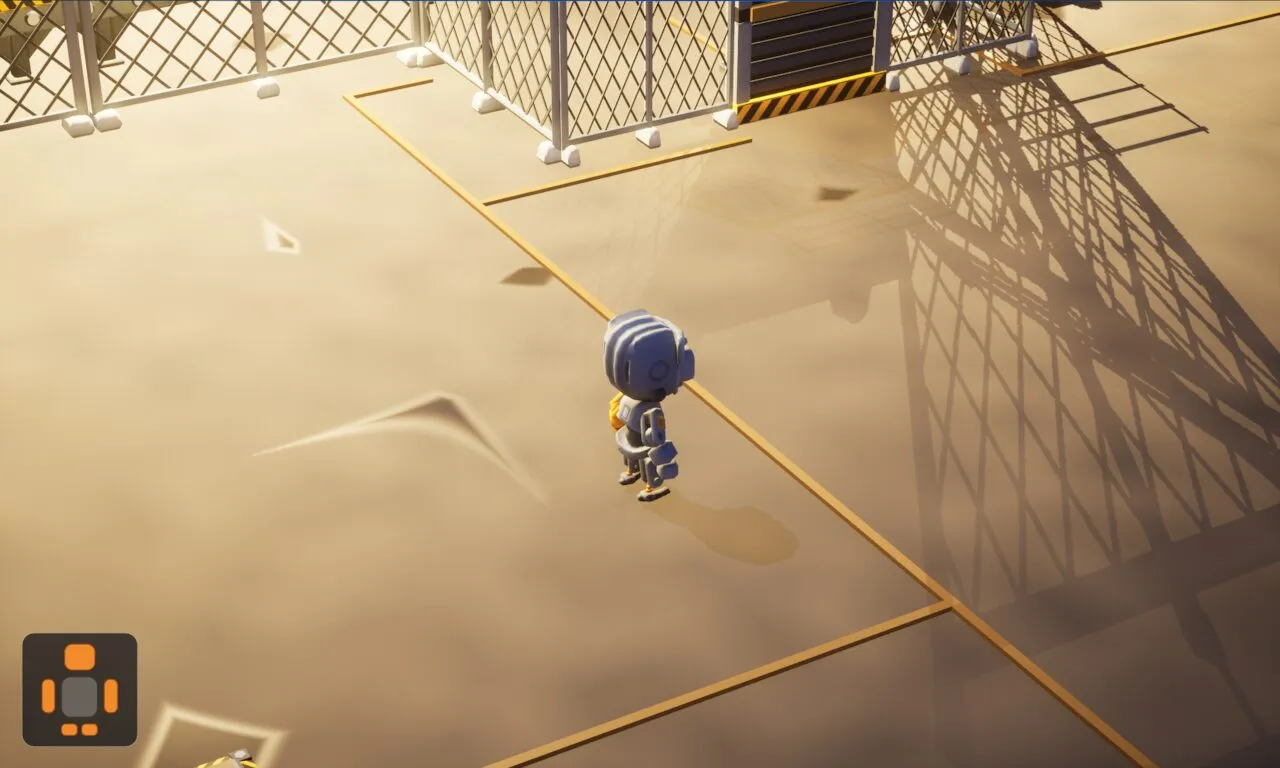
A parts display. In the corner, the golem seen from behind. A part on the body is orange. A part that is away is hollow, and it turns green while it is doing a job somewhere: holding a lever, weighing down a plate, sitting on a button. A blue ring shows whether the keys are steering the head or the body.
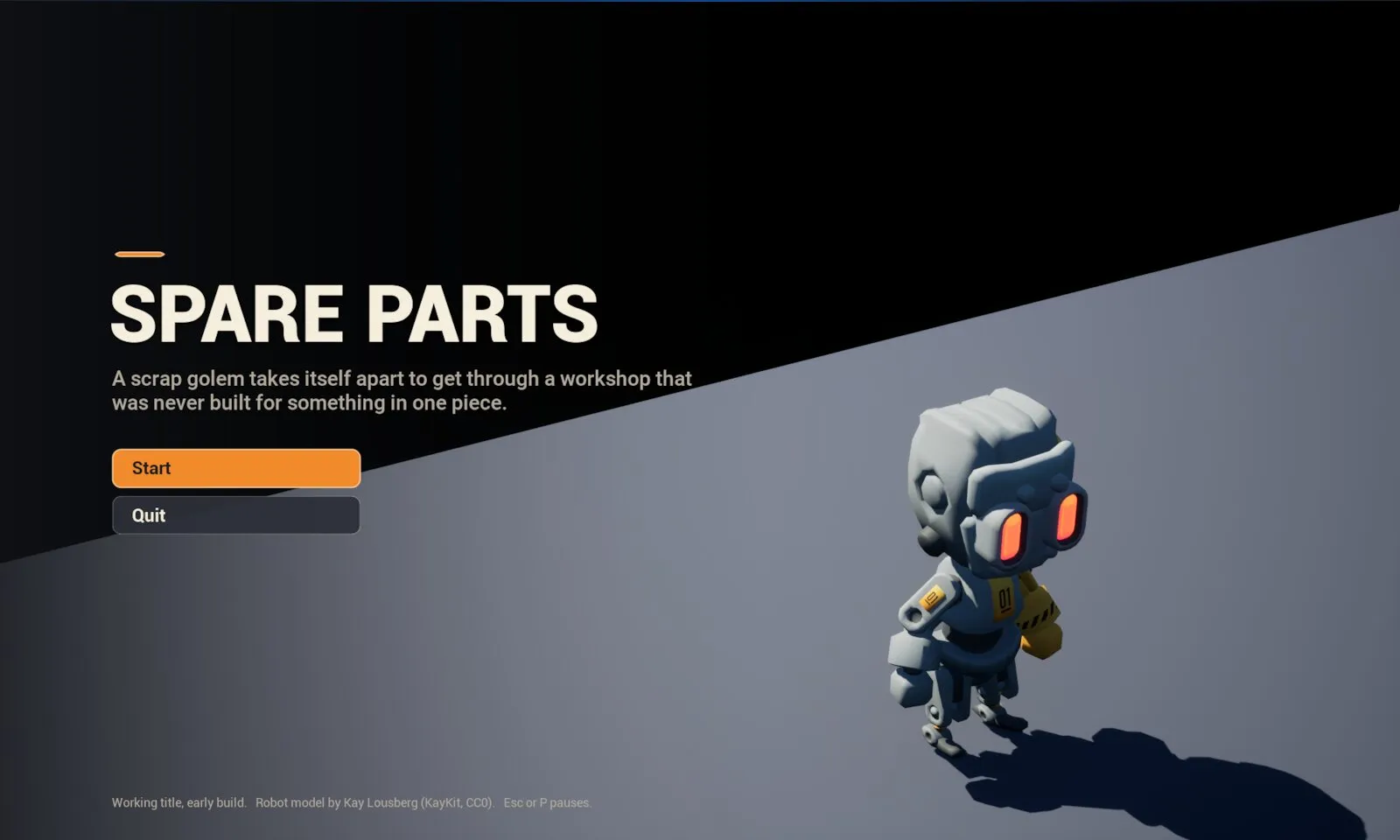
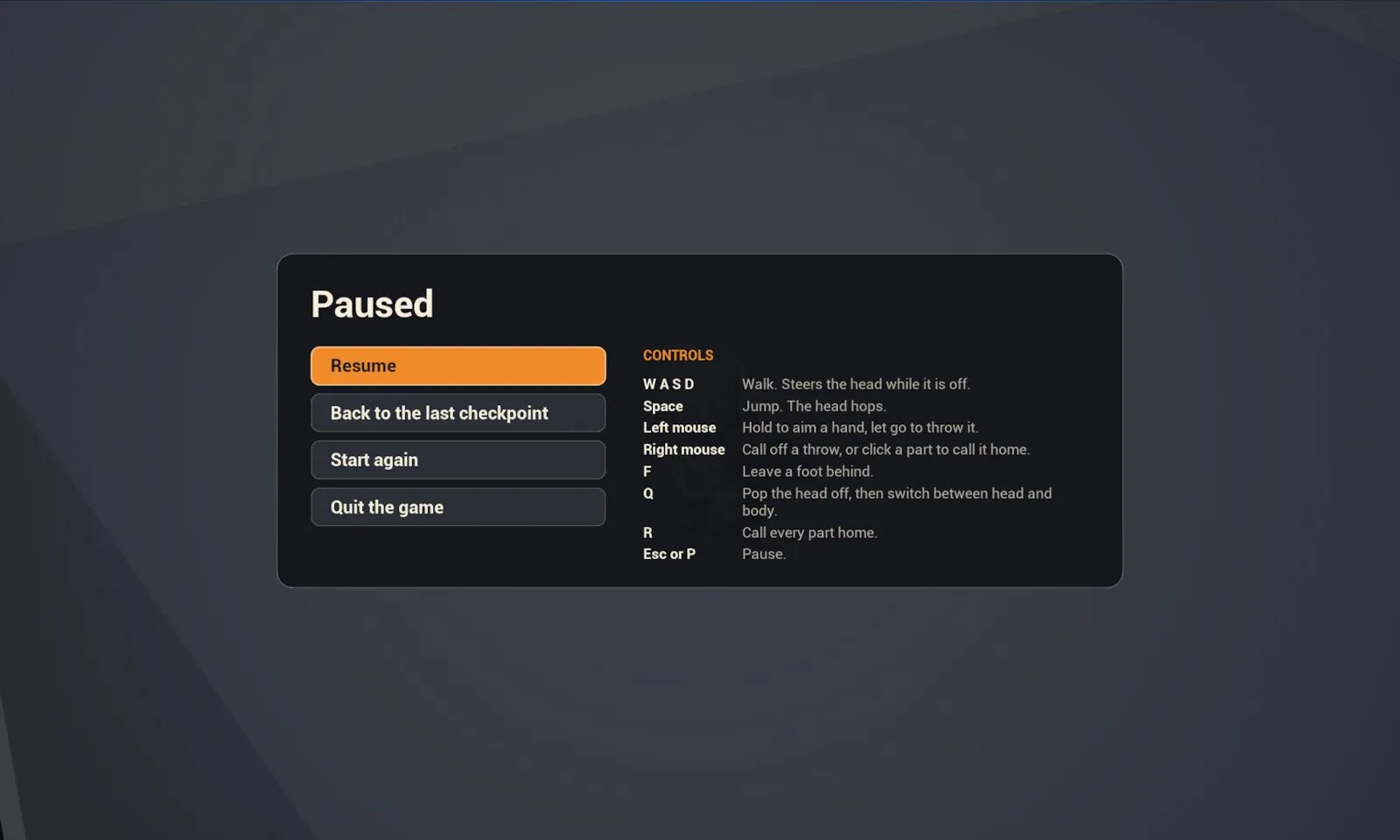
Title, pause, ending. The game opens on the golem standing in the first room. Pause lists the controls. At the end of the scout room there is now a doorway full of warm light; walk into it and every part flies home, the camera turns to watch, and a card shows your time and how many hands you threw. The words on the title and the ending were placeholders; we settled the story that afternoon (next section).
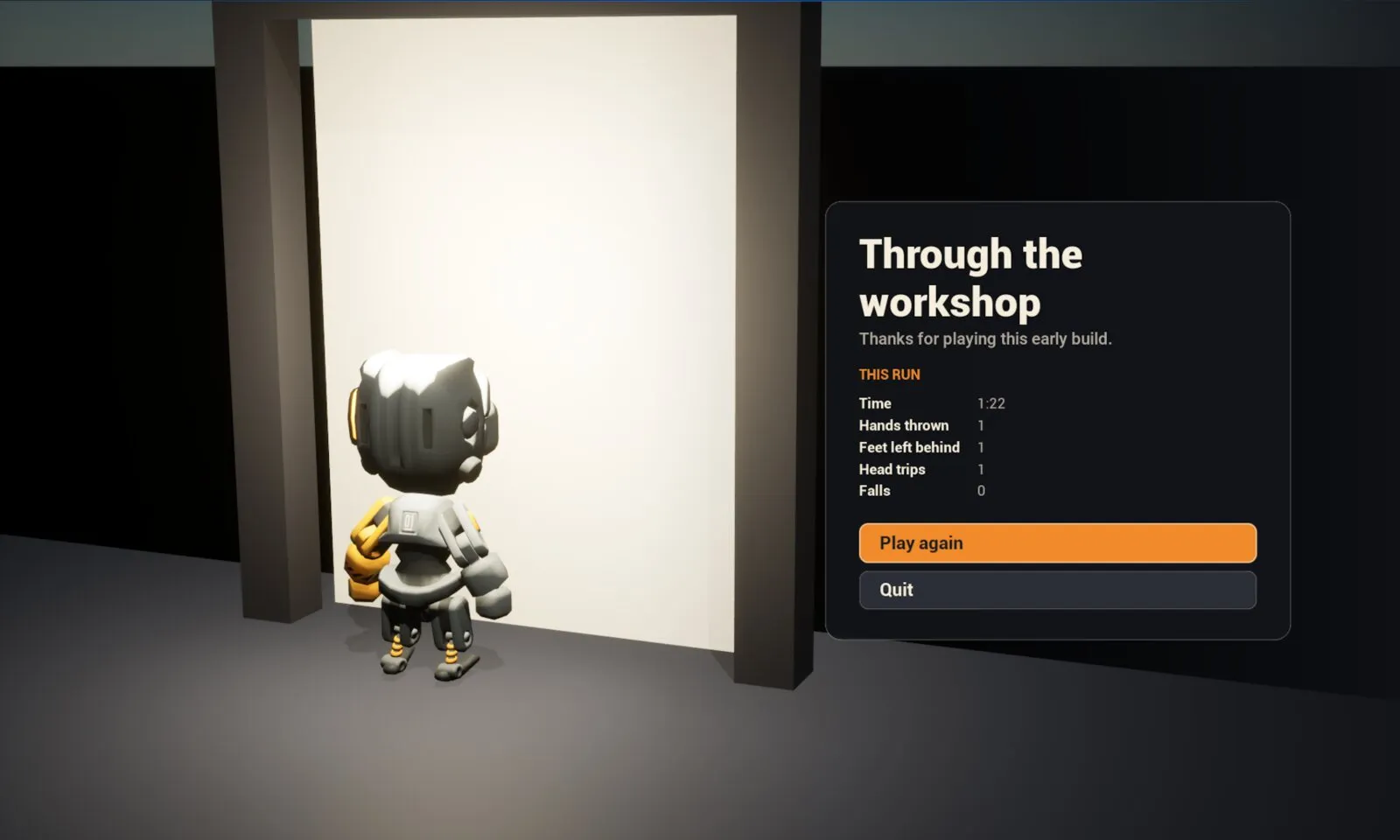
An independent agent review found nothing that could trap a player, but it caught several other problems. Our records overstated the checking we’d done, and the first ending still had been staged by moving the golem to the exit. Jumping was barely taught, crawling made no sound, and the ending shot depended on how you entered. Those issues were addressed, a jump hint was added, and the whole game was played from title to ending in one run.
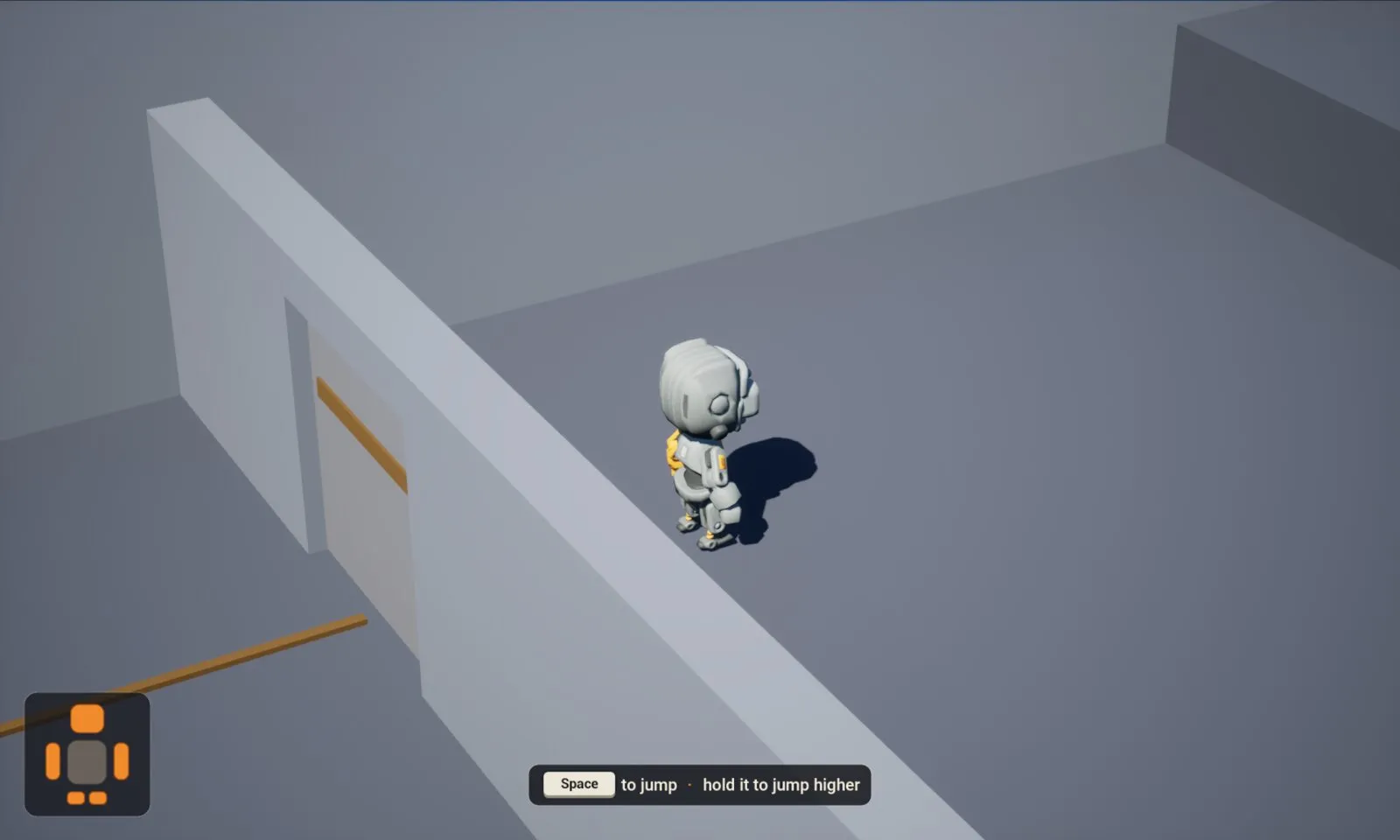
First sounds. A small synthesis script made sounds for every part action without using samples: a whoosh for a throw, a clank for a hand grabbing, a pop and a boing for the head, and a whir for recalling parts. Footsteps and hops follow the animation. Devices chime when activated and make sliding sounds as they move. These were placeholders at this point. None of us had judged them by ear yet, and the agent couldn’t hear them.
Thursday afternoon: a story
With the parts working, we needed a story. We asked the agent to look at how last year’s winners told theirs. The winner, These Four Walls, told its story through its setting and score, with no cutscenes that we could find. Story wasn’t scored separately; it contributed through the theme, visuals, level design, and sound.
Three of the agent’s first four options returned to the theme: a studio cutting a child’s toy design, a maker’s shelved project, and a museum of canceled inventions. We liked the fourth: a robot rescuing its friend and giving it one of its own parts. We asked for another round focused on stories that would play well. That round put the friend in a scrapyard, on its way to the crusher. We chose it with three changes:
- a happy ending, in which the friend has no legs and is given one of ours, so they hop away on one leg each;
- a story that makes you feel for both robots;
- stakes you can feel: the friend really is on its way to the crusher.
We kept the threat staged rather than timed, so you can’t fail it by thinking, and we kept a bale with a faded “07” stencil for anyone who wonders who went before. The title came last: Pulled Apart.
Before building it, a separate agent reviewed the brief and found two serious problems in the finale: the threat had become timed, and the three devices didn’t work together under the existing part rules. We revised the brief and answered the reviewer’s questions.
Thursday late afternoon: building the story
At 3:48 PM we told the agent to start on the brief and carry on down its build order, stopping only if it needed us. It built the end of the story first, so there would be something to judge before anything else was stacked on it.
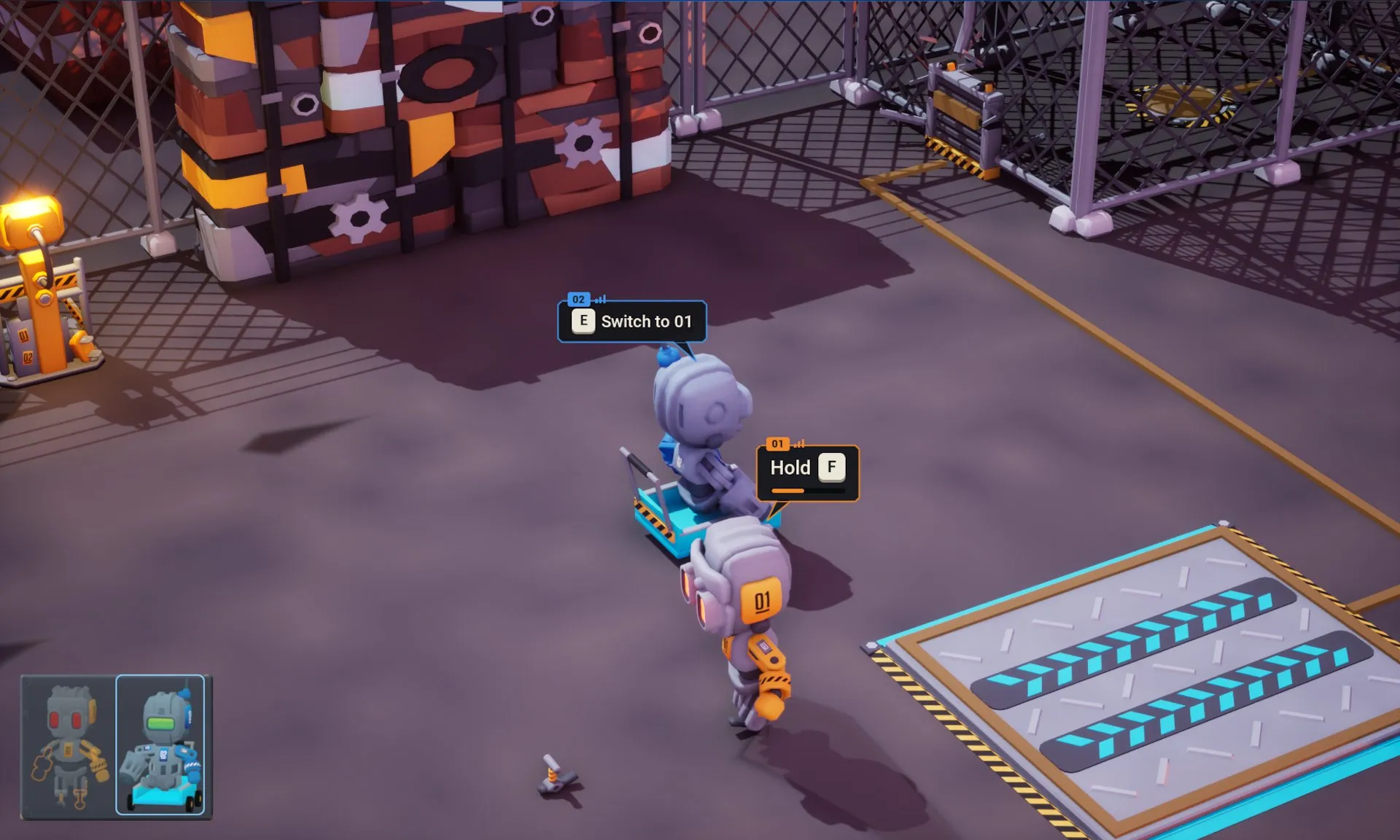
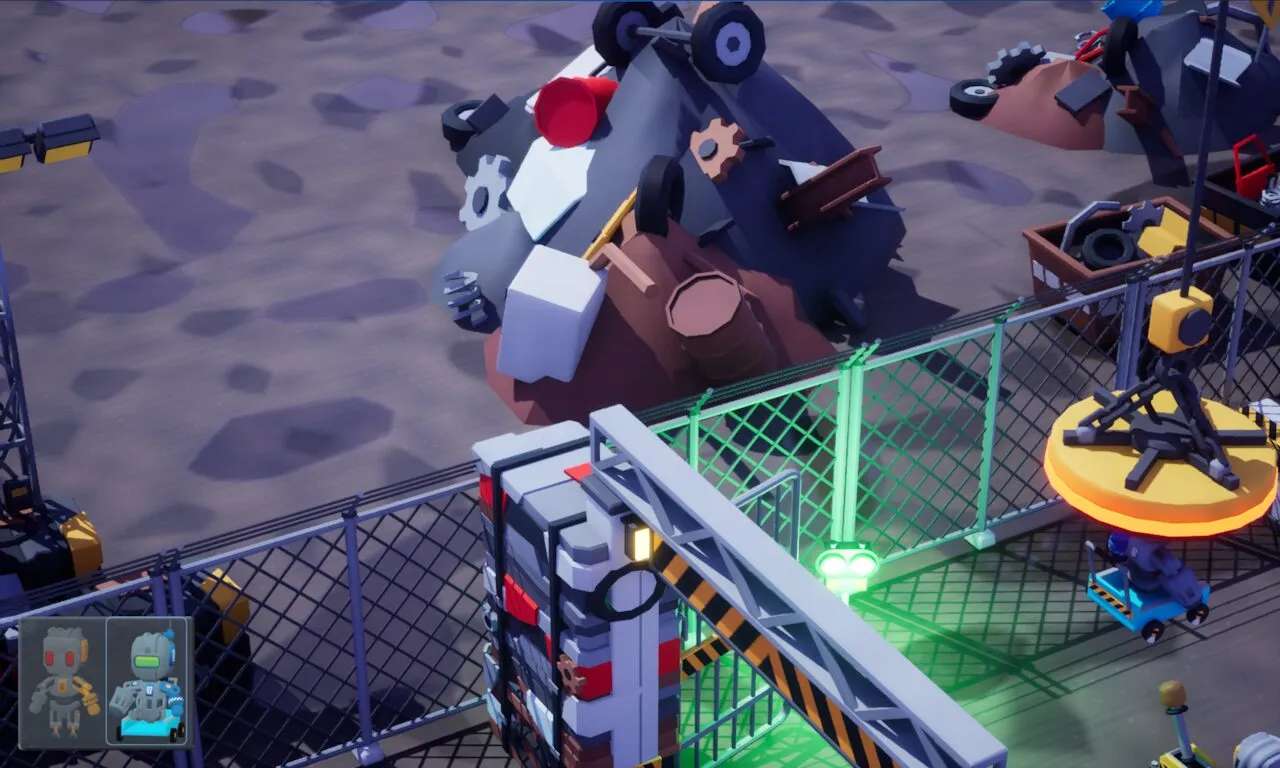
02, and a part you can’t call back. 02 is the pack’s second robot on the same skeleton as ours, with its lower legs hidden, moved by the same animation code. Until now every part the golem sent away could be called home. The gift needed a part that can’t: a foot can now be given, and R leaves it where it is. At the gate the prompt is “Hold [F]”. The foot crosses in a slow arc to 02’s knee and stays there, the slot on the parts display turns 02’s blue, and F will not leave the golem’s last foot behind after that. (In the first version the parts display was hidden during the scene, so nobody could have seen the slot change. A reviewer caught that; it is on screen now.)
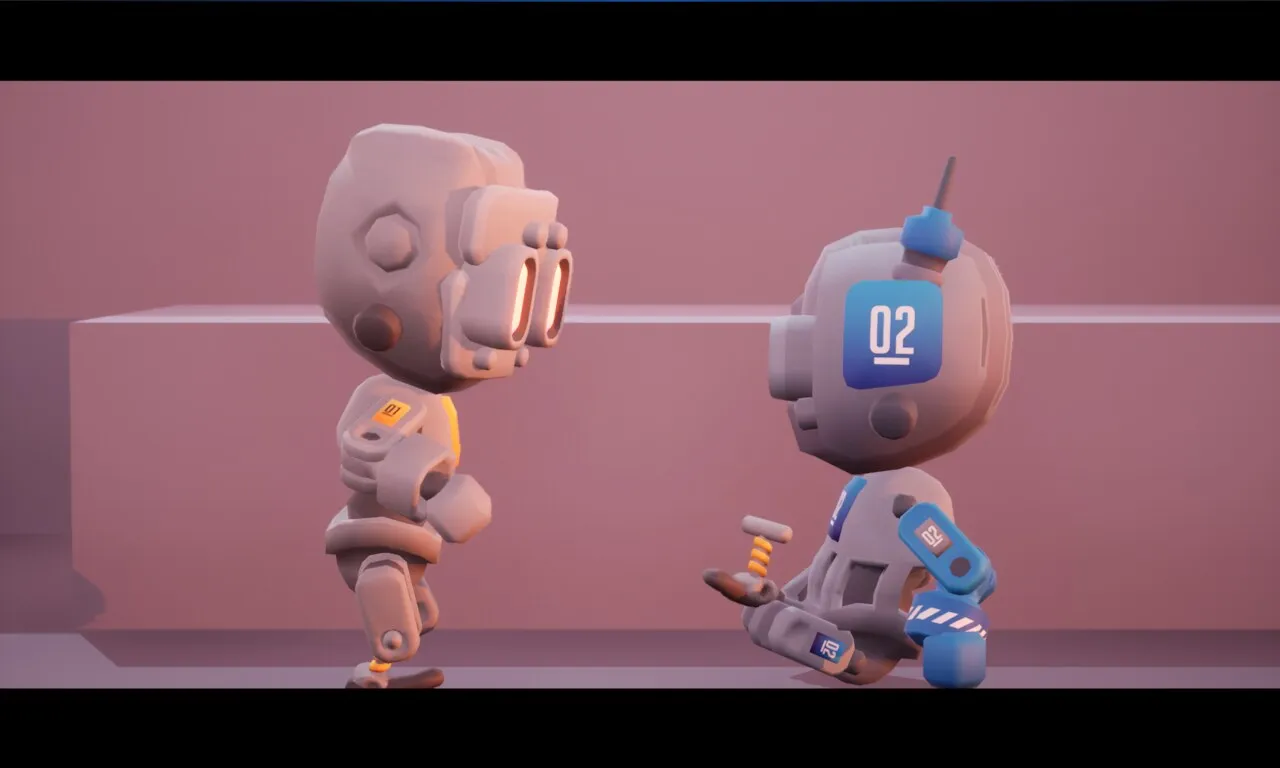
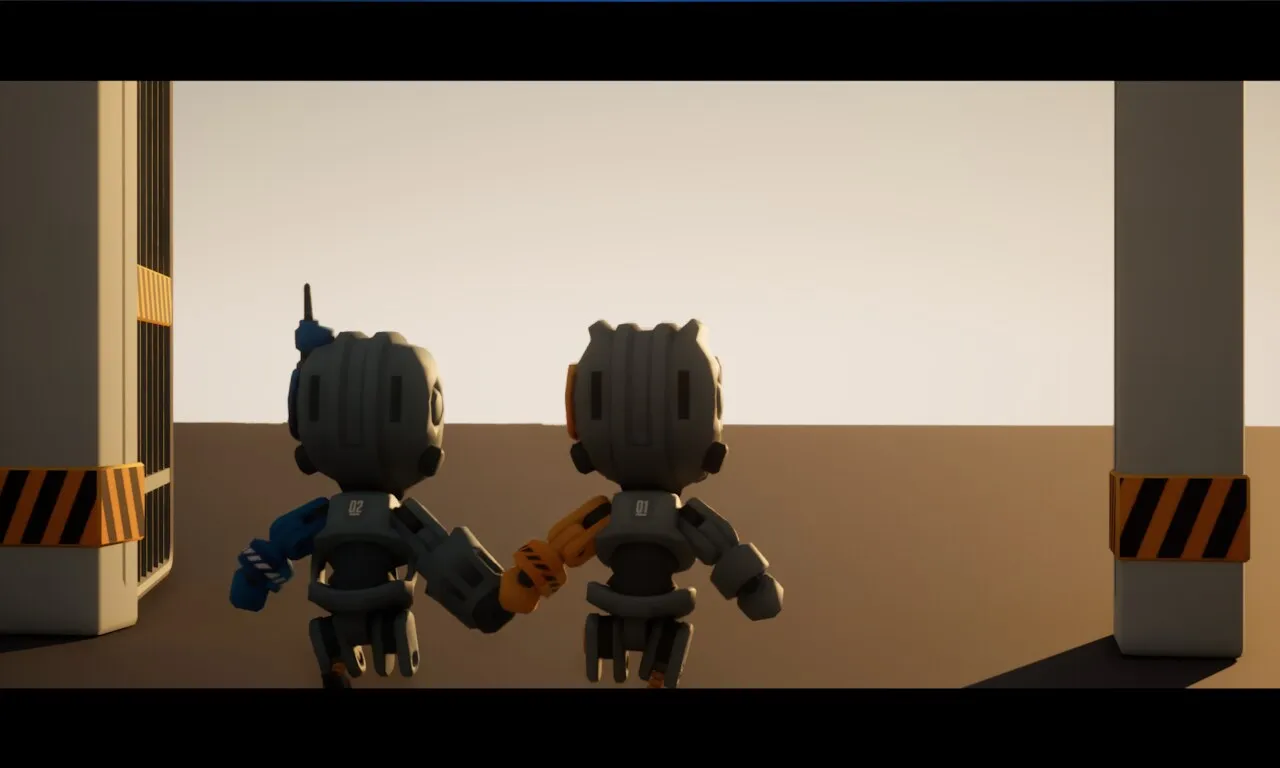
Both stills are from the first, graybox version of the ending, before the yard was dressed.
Running the story. Each scene is a list of steps: perform an action, wait for a duration or condition, then continue. One actor runs those steps, moves the camera between shots, and keeps the night’s clock. The sky progresses from sunset through dusk and night to first light according to how far the golem has reached. Dawn only arrives once the machine is stopped.
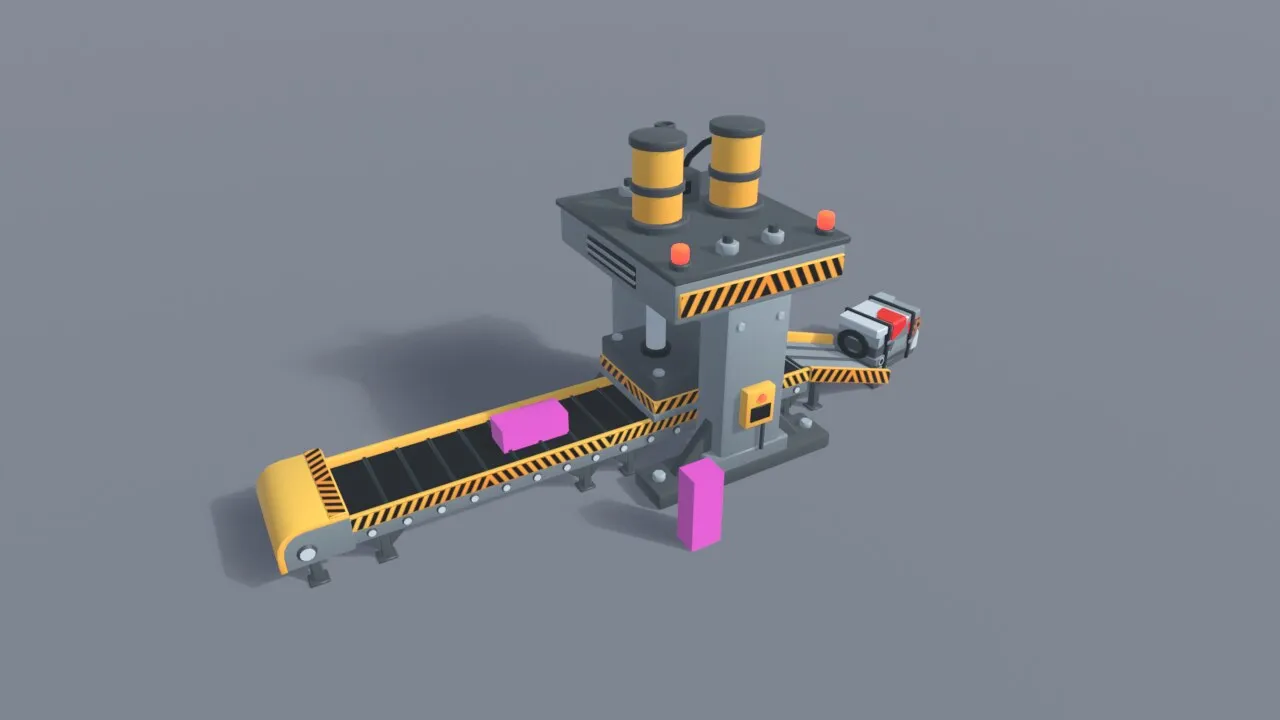
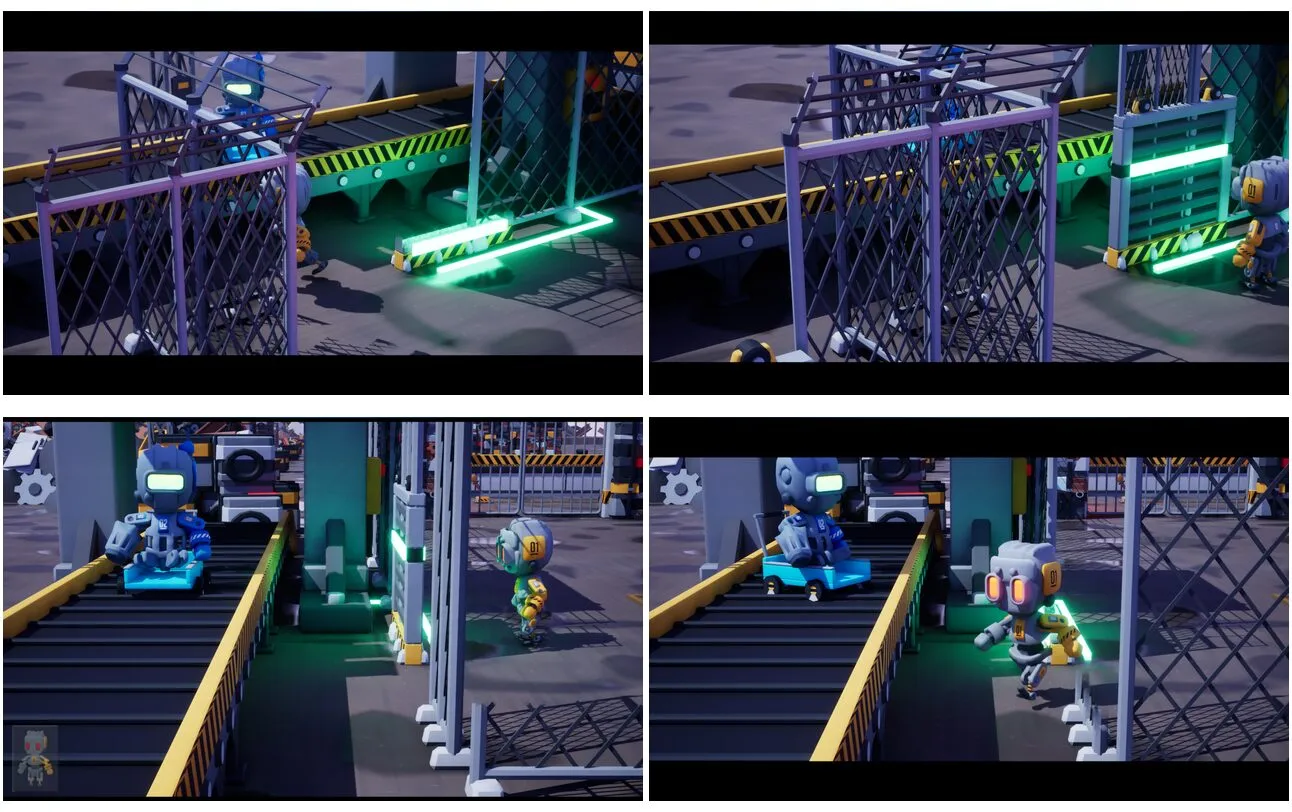
The belt and the crusher. A conveyor runs the length of the yard behind the fence. 02 rides it a stop at a time as the golem gets through each room, calling out as it goes. The play camera is meant to lean its way so you see it leave; a reviewer worked out from the numbers that 02 was off the top of the screen from most of a room, and a still proved it. Now 02 calls and waves for a beat before the belt starts, and the camera leans and pulls back to take both robots in. At the far end the press slams on its own, loud enough to hear from the first room and louder the nearer you get. Walking into its room plays a short reveal: the car ahead of 02 goes in and comes out as a bale.
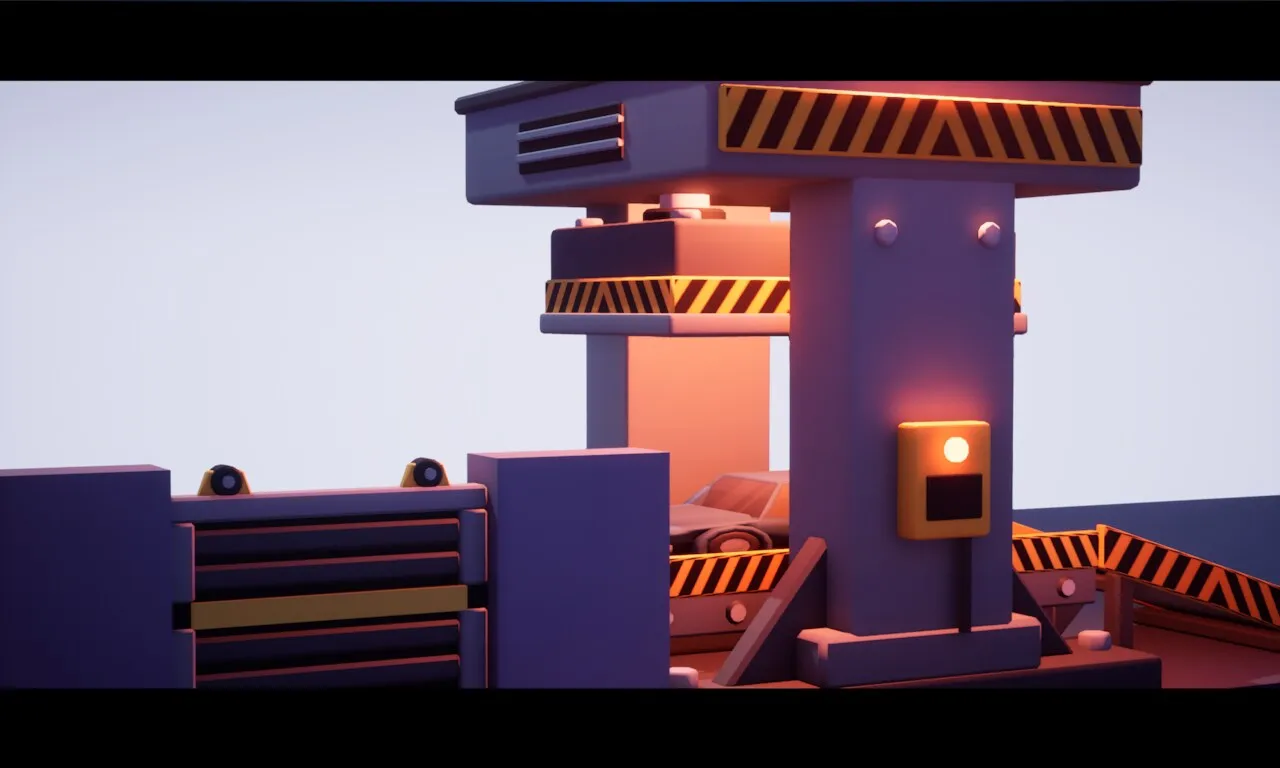
Building the finale changed the brief. Stopping the machine takes all three parts at once. A foot on a pedal holds the ram up, a hand on a brake stops the belt, and the head goes through a vent to a stop button that only works while the other two are held.
Building it exposed a problem with our layout. Separating the pedal and brake wasn’t enough: a player could throw the hand first, then stand on the pedal. The agent proposed having the pedal also open a shutter in front of the brake, with the brake just beyond throwing range from the pedal. That made leaving a foot necessary and fit the discretion we’d left in the brief.
I played the story build that evening and wrote, “I think the gameplay mechanics feel very strong.” I didn’t ask for changes to the finale, and none of our four later feedback rounds asked for those three devices to change. We did change things around them. Jacob noticed the shutter sliding into another gate, so it now slides along the fence’s face. I saw 02 apparently walking toward the press, and Jacob saw its wheels turning the wrong way for the belt. 02 now faces away from the press and pushes against it.
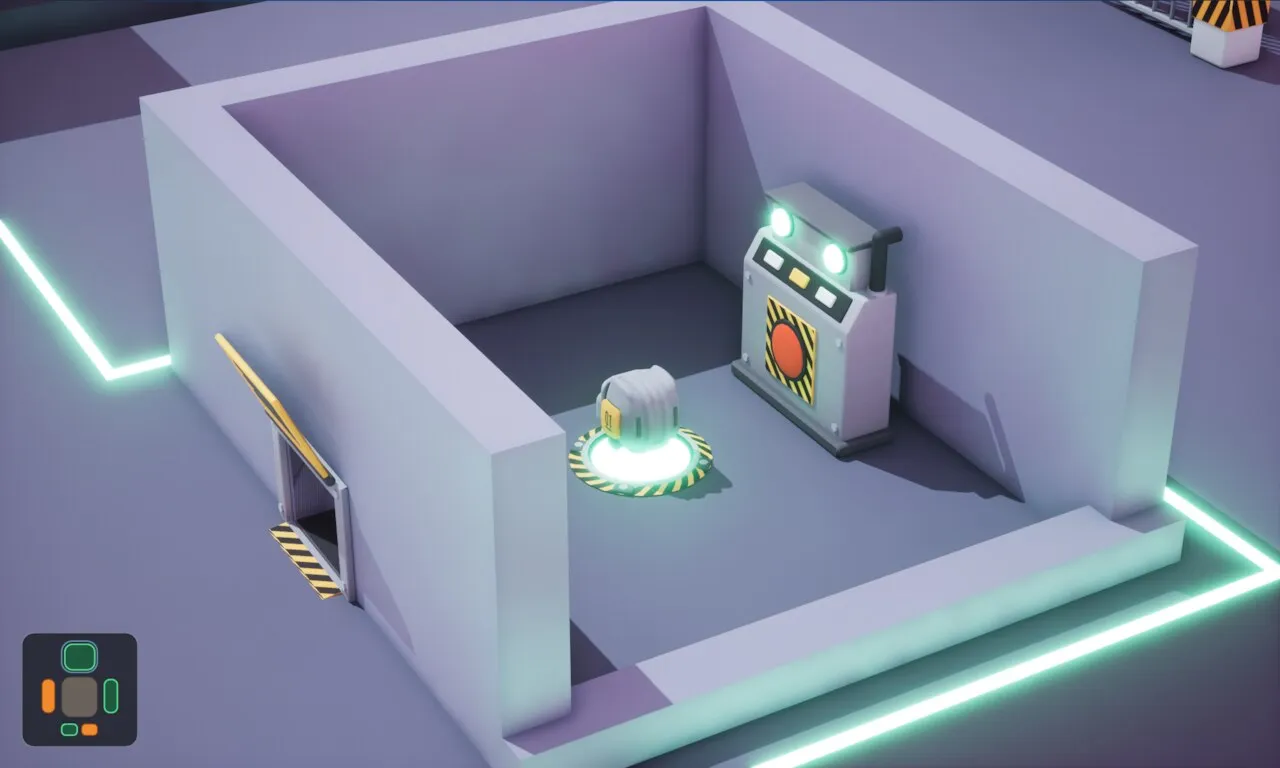
Forty-six models from one small kit. The new yard models needed to fit beside the KayKit robots. The agent first wrote a Blender kit with beveled blocks, faces mapped to columns of the robots’ own color atlas, simple collision boxes, an export process, and a preview render from roughly the game camera’s angle. It tested the whole process with one bale.
It then gave written briefs to three sub-agents working in separate contexts while it continued the code. One made the machines: belt, press, and magnet crane. One made the yard: bales, chain-link fences, junk heaps, tires, drums, a floodlight, and the gate. One made the devices: lever, weighing plate, head button, door, bridge, and stop console. A fourth made the story’s sounds and music. The main agent inspected every render and checked each model’s size as it entered Unreal. One bale has a faded “07” pressed into its face.
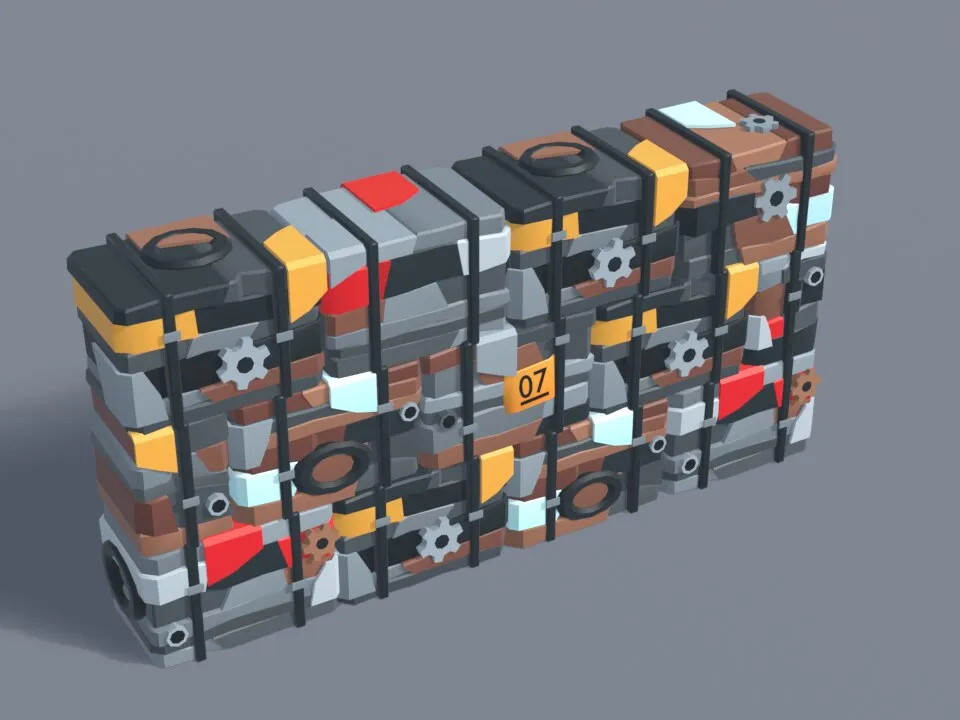
The yard. The three rooms did not move, and neither did anything that blocks. Their plain walls became stacked bales and chain-link, drawn over the same invisible boxes, and a wall that hides the golem dissolves from the top down. The floor is dark packed ground with puddles that have nothing to do but reflect the lamps. Behind the fence are heaps, wrecked cars three high and the floodlights, which come on at dusk and go out when the machine does.
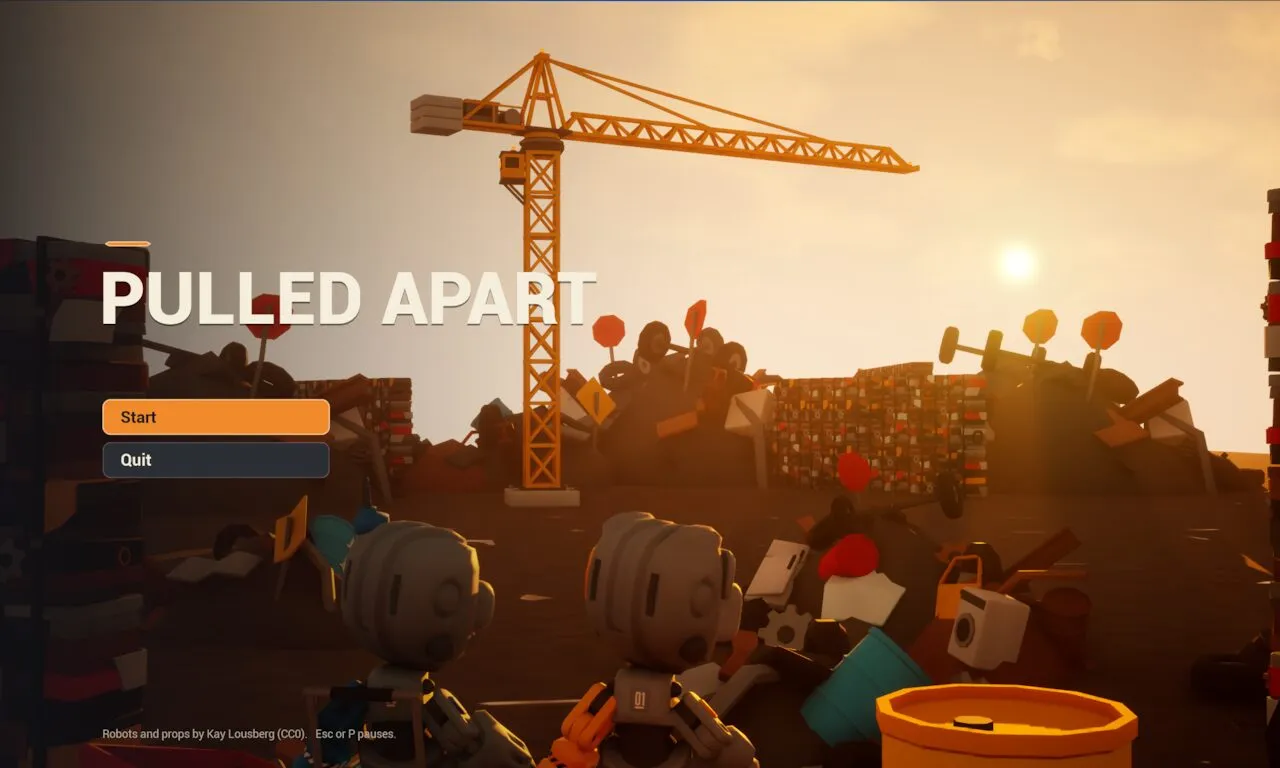
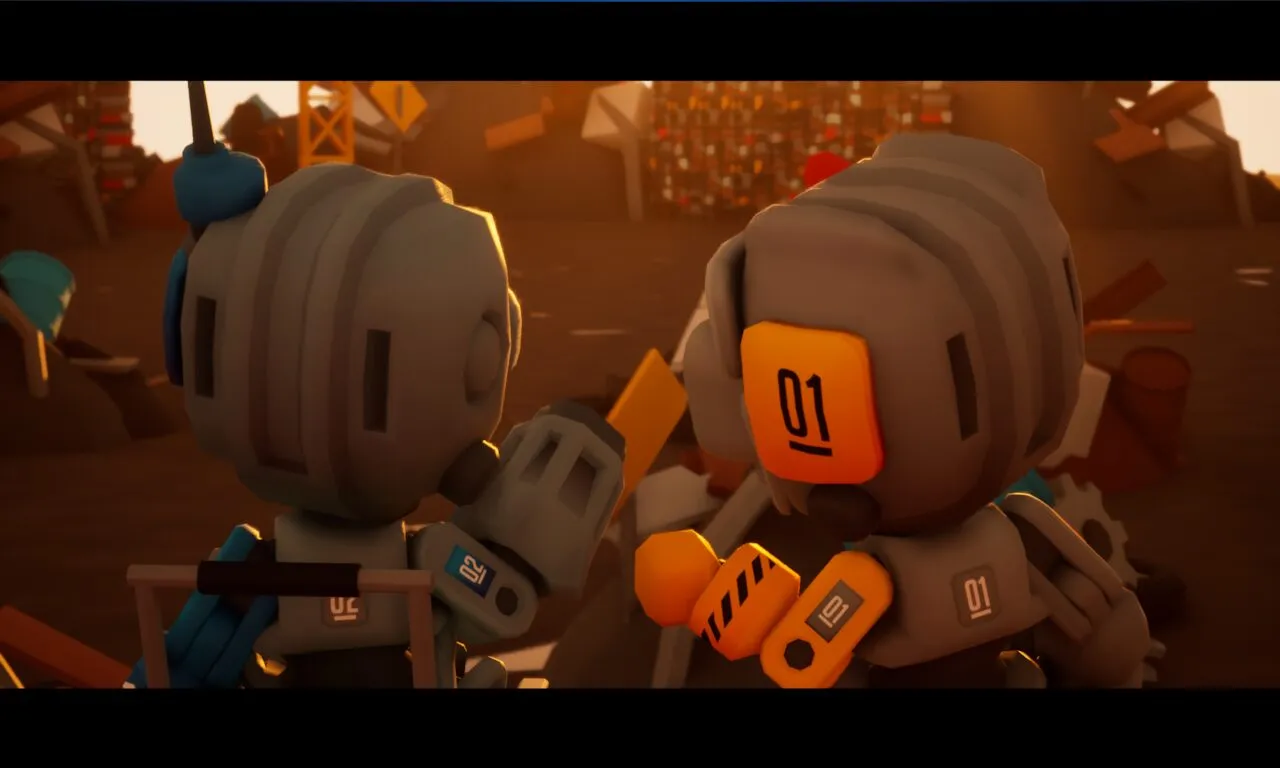
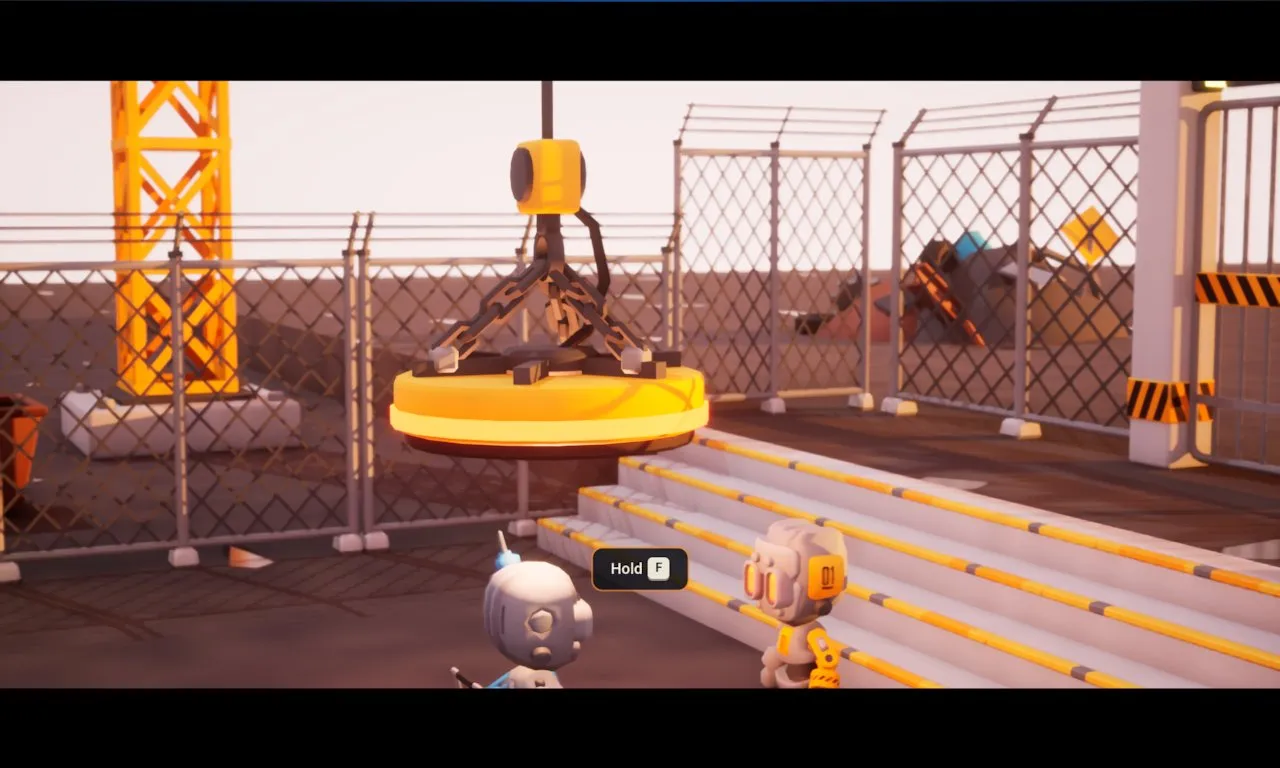
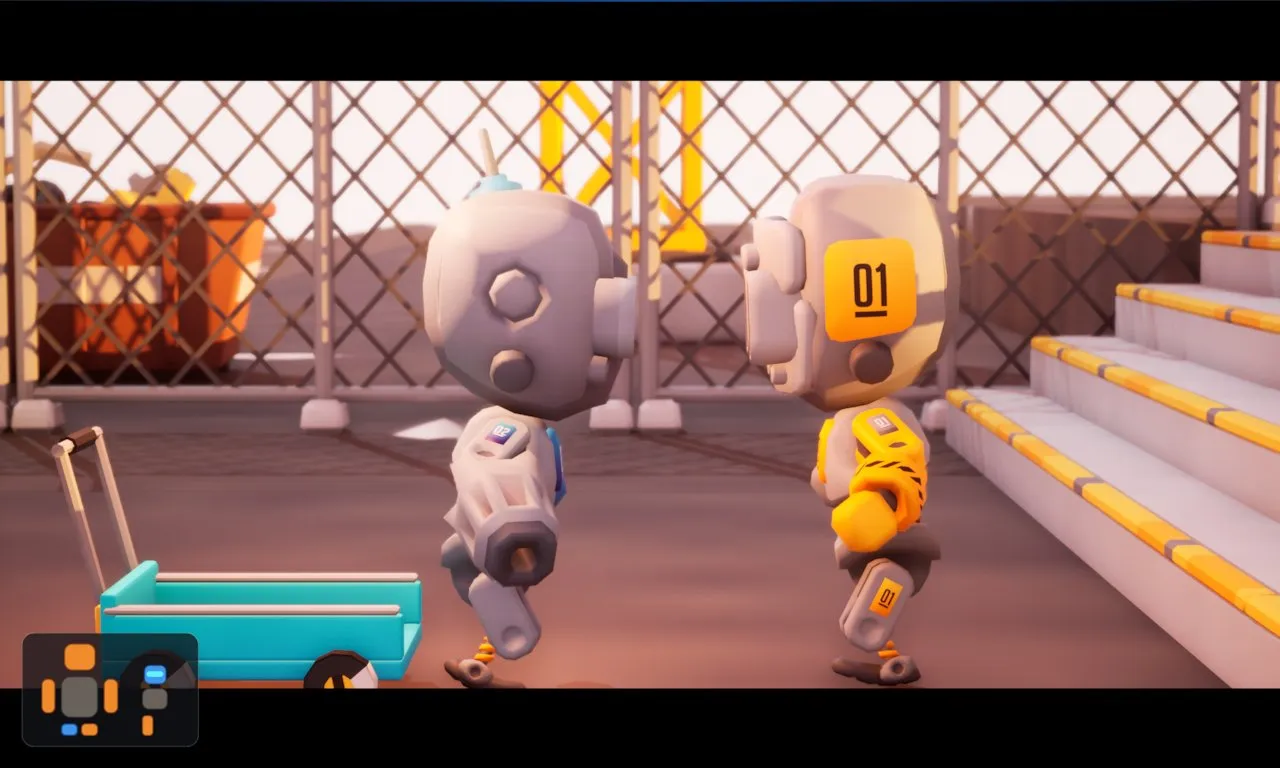
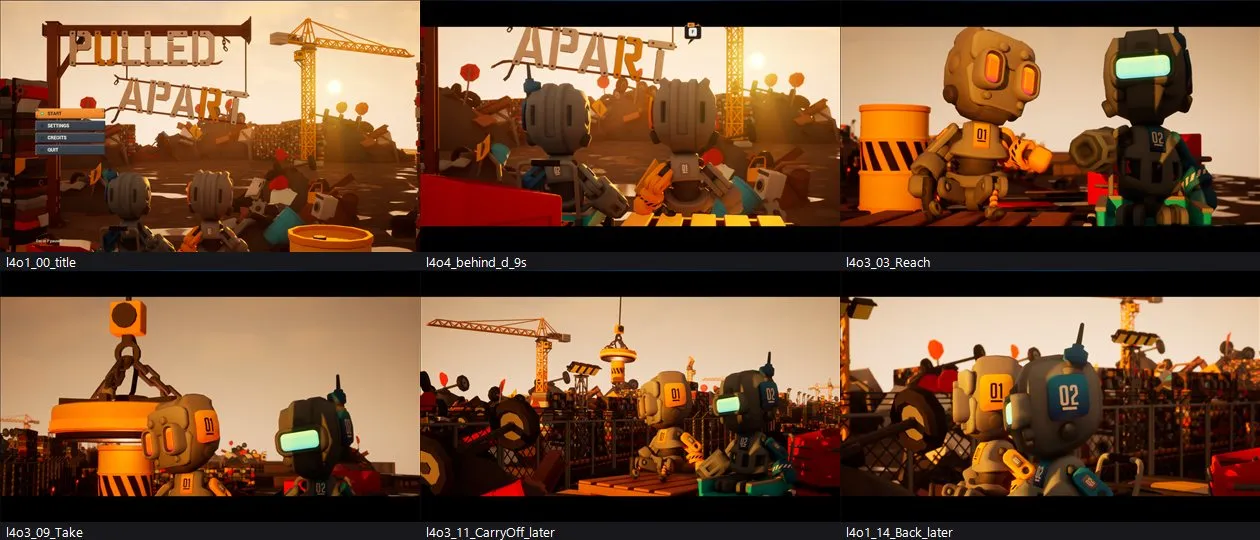
The opening. The title screen is the first frame of the story: the two of them sitting side by side on a heap of bales, 02 in its little cart, watching the sun go down behind the crane. Press Start and the camera moves in. The first thing you are asked to do is knock fists, on F, the same key you will hold at the very end. Then the crane shows its rule. It swings over, takes a barrel that isn’t moving, and drops it on the belt. Then it comes back for the one who can’t walk away. 01 holds on, and that is how it comes apart.
Sound for the story. Scripts synthesized twenty more sounds, four loops, and three pieces of music: the press, belt, magnet, 02’s calls and 01’s answer, a title theme, the night, and the ending. The scripts also measured the sounds, but none of us had listened yet and the agent couldn’t hear them.
Across our four feedback rounds, the only sound request was mine: volume sliders. The settings menu now has three, for master volume, music, and effects. When we did listen, we thought the sound was really good and fit the game well.
All of this was checked the way the agent checks things: by script in editor play, and by looking at stills. What we found when one of us played it is two sections down: it looked good, the mechanics were strong, and it was over in a minute or two.
Thursday evening: a review, a night that was not dark, and two fists
The review. After the story build was committed, a separate agent read the code, level scripts, and records. It couldn’t run the game, but it found two ways to get stranded in the finale. Running to the gate too soon after stopping the machine could prevent the ending from starting: the trigger checked once, got “not yet,” and never checked again. Walking into the brake’s cage and recalling the foot could close the shutter behind you with no way to reopen it.
Both problems were reproduced in play and fixed. The reviewer also caught credits that named things the rules might not allow us to name inside the game, and the wrong contest name in every file header.
Making night look like night. The crusher room’s first still at the darkest hour looked like a hazy golden afternoon. Floodlights lit the ground more brightly than the setting sun, and automatic exposure brightened everything further. The lamps were made dimmer and tighter, exposure was held steady during play, and the moon was made bluer.
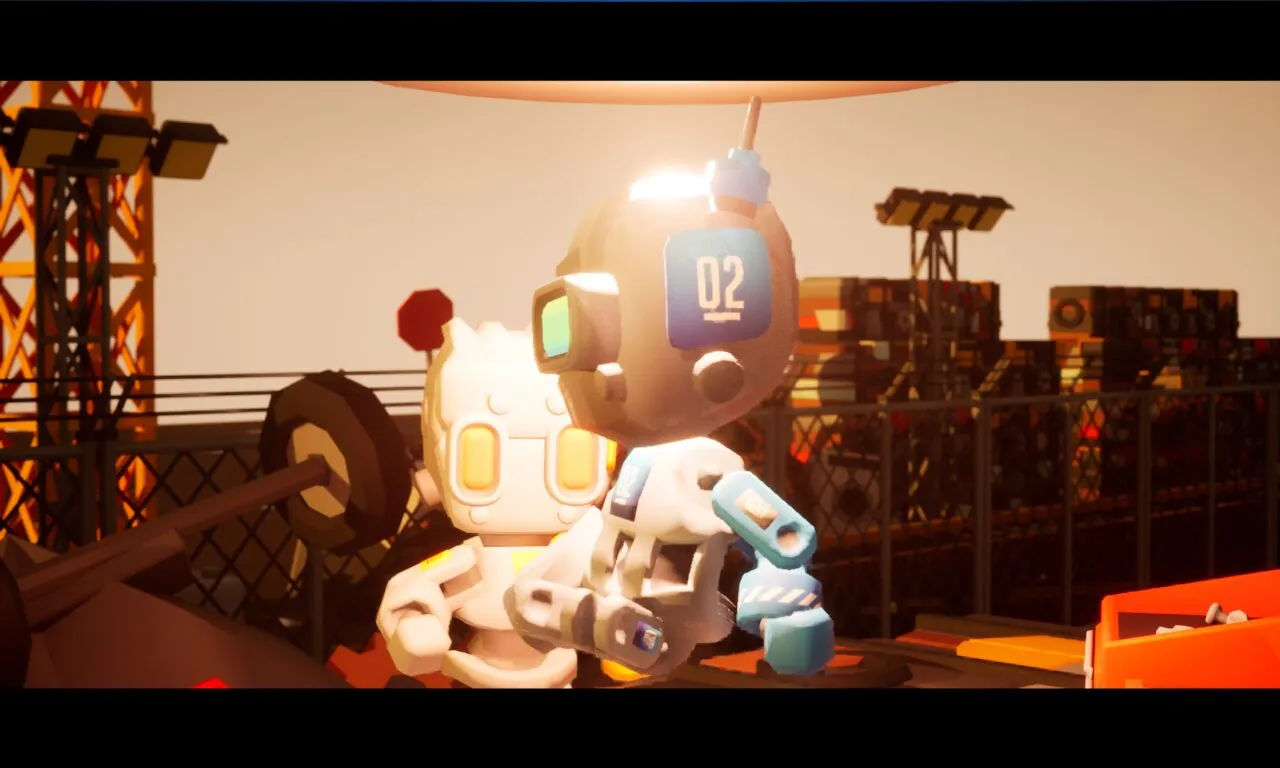
Two fists. The fist clink is the first thing you do and nearly the last, and until now both robots played the pack’s general “interact” gesture and hoped. A sub-agent keyed proper clips on the pack’s rig: one for sitting side by side, one for standing face to face, and one for 01 steadying 02 on its new leg. It measured where the fists had to meet for robots the distance apart the game seats them, and they do.
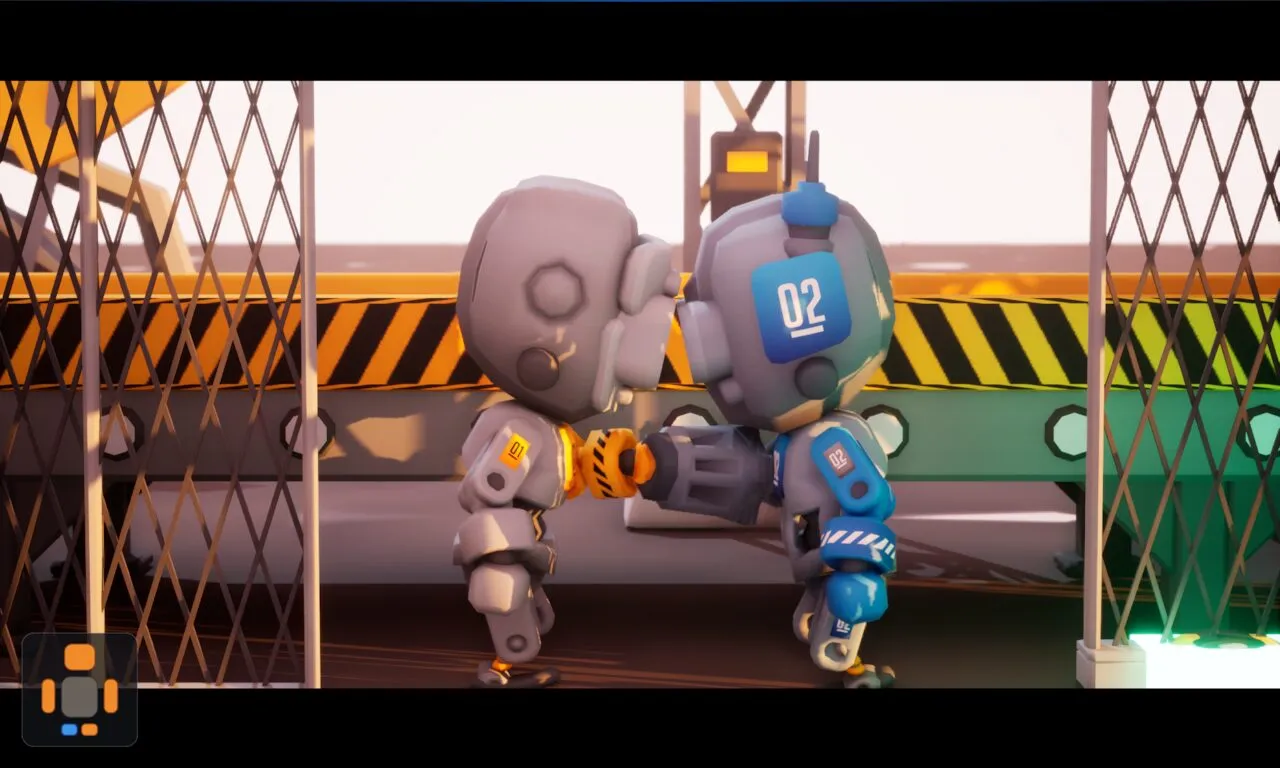
We hadn’t given feedback on the evening’s work at this point. My note on the story build arrived at about half past six; that’s the next section.
Thursday night: too short, and a cart
One of us played from the title to the end card and sent back feedback that changed the game: it looked really good, the mechanics felt very strong, and it was over in a minute or two. It had four rooms and about seven puzzle steps. The plan’s ten to fifteen minutes had been a guess made before anyone played.
We wanted to do more with the idea than add similar rooms. One of us suggested making 02 part of the escape after the rescue: switch between the two robots, with 02 unable to throw but heavy enough to do things 01 couldn’t.
The game became three acts: learn the parts; solve a harder room alone and stop the crusher; then escape together. The agent first proposed giving 02 its leg at the rescue so both robots could hop through the last act. After we started a fresh session and the agent reread the project, it proposed keeping 02 in its cart and saving the gift for the ending. We chose that version for several reasons:
- A robot in a cart explains itself. Wheels can’t jump and can’t climb a step. A cart is heavy. Its hands are busy on the wheels. Nobody has to be told any of it.
- The yard was already built for it. The floors already step up a meter at a time, the second room is already a weighbridge, and 02’s little blue cart was already in the title shot.
- The gift means more at the end. You spend an act as 02, stopped by every step. Then there are steps at the gate.
- It mirrors the start. The crane comes for 02 again. The first time, 01 was pulled apart holding on. This time it comes apart by choice.
It also changed the opening: the magnet now takes 02 cart and all, so it is in its cart on the belt all night.
Forty minutes. We said go at about five to eight. By twenty-five to nine, there was a playable build of the new structure.
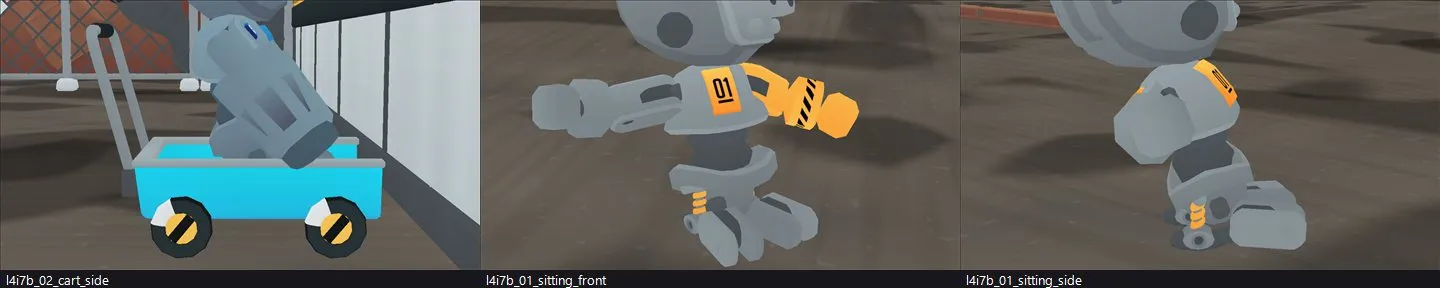
The agent defined the rolling cart and swap key in the headers, then split four briefs among sub-agents while it continued the rest. One animated 02 pushing itself along and discovered that its fist fell a few centimeters short of the wheels. It also noticed that 02’s right arm, which we’d barely looked at, was a cannon. 02 pushes on the side rails instead.
Another agent made the back of the yard, including a truck scale with tire tracks where the smaller scale had footprints, a loading dock, and steps. Another made sounds and a third piece of music, where the two voices answer each other but don’t quite sing together. Their shared melody was saved for the ending. The fourth redrew the corner display to show which robot you control.
Two things in the new rooms are old things turned sideways. The loading ramp is the first room’s gangway, tilted, so it comes up out of the ground to the dock. The truck scale is the second room’s plate, told that it is one: it wants the cart’s weight, and when 01 climbs on with every part it owns it lights one strip of four and makes a small unimpressed noise.
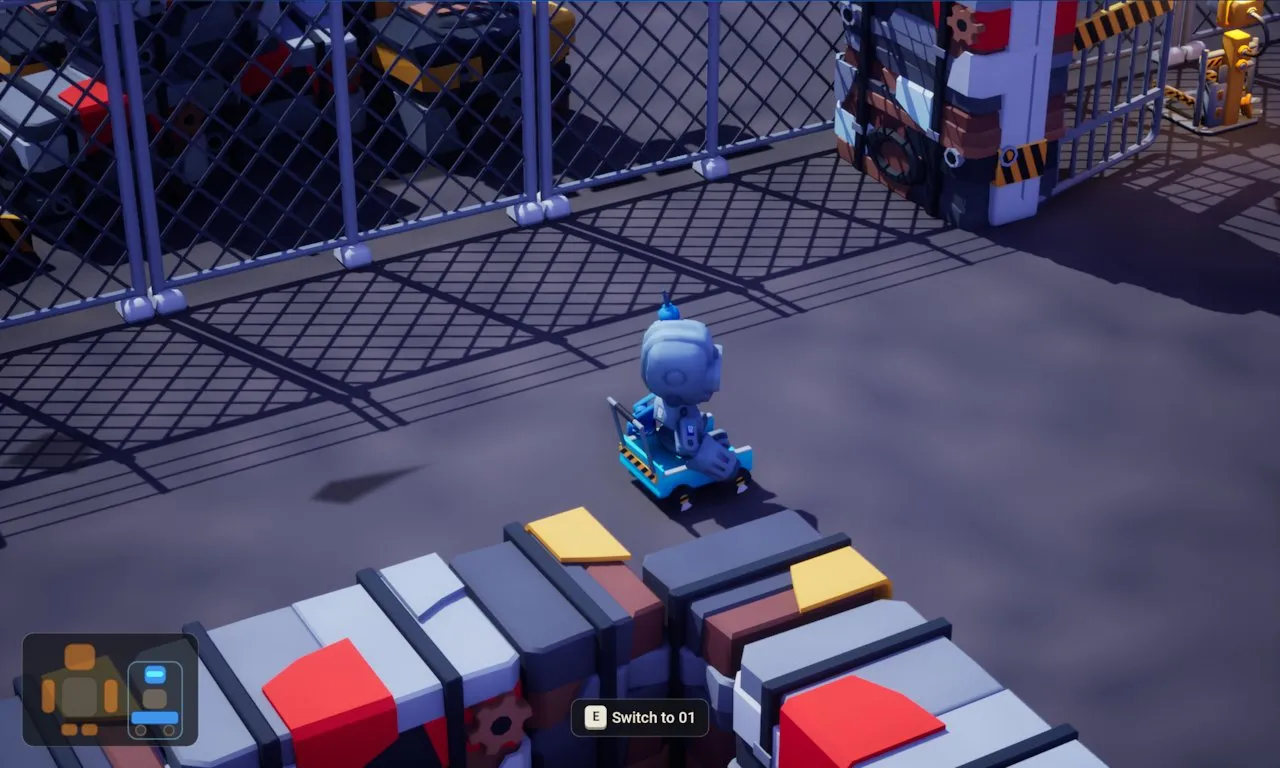
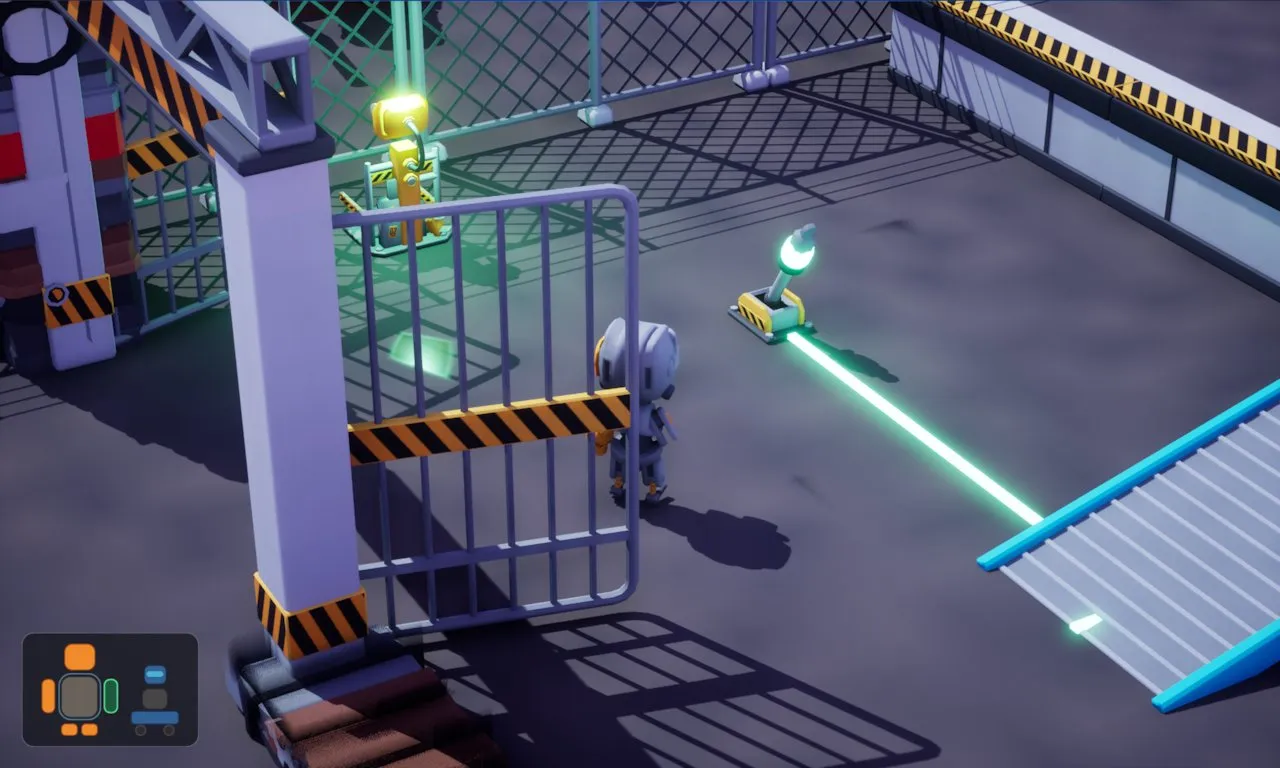
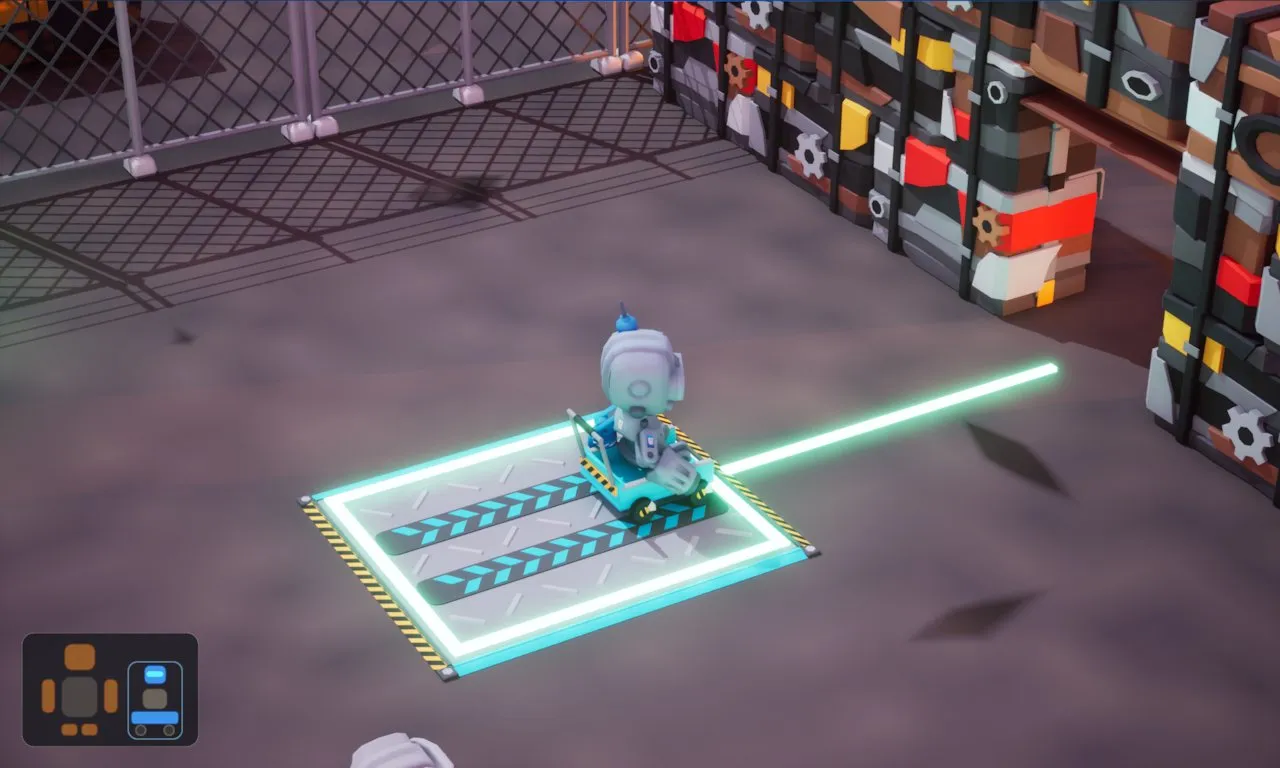
The opening changed with it. The magnet now takes 02 cart and all, and 01 hangs on to the cart.
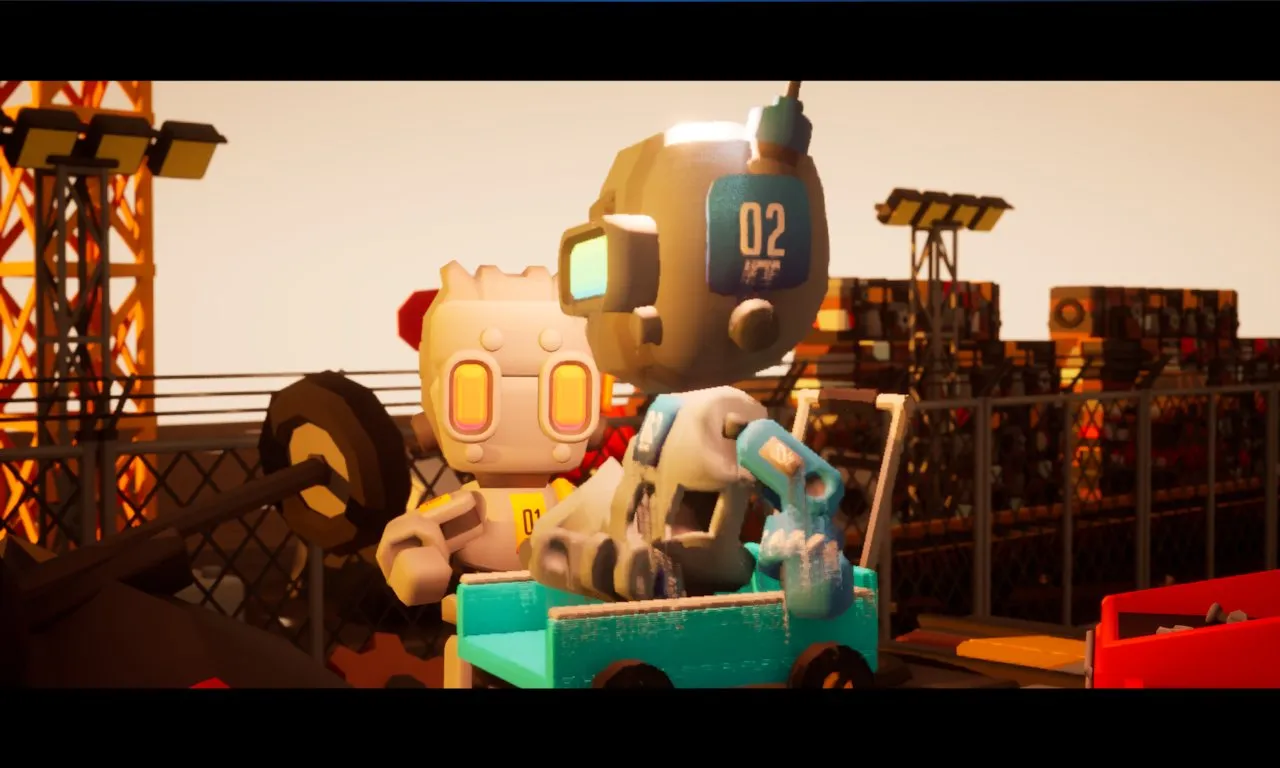
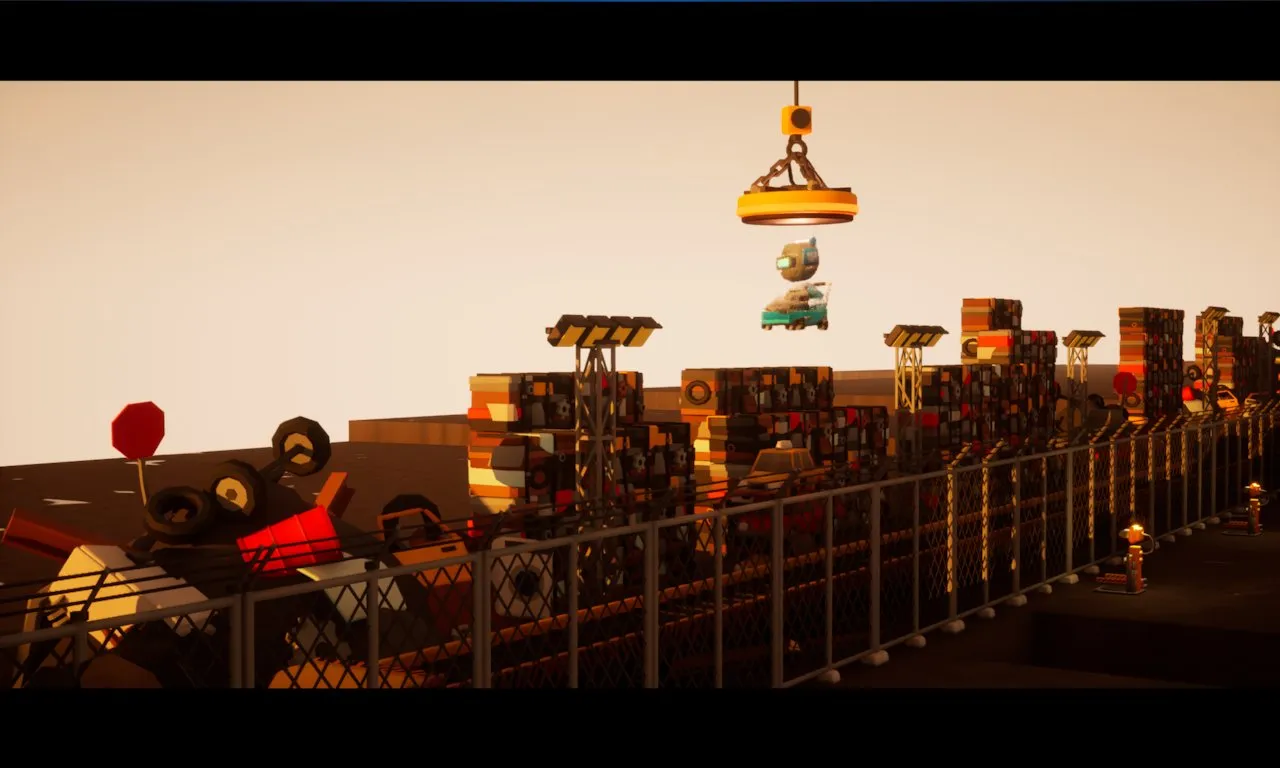
And the ending moved to the gate. 02 rolls to the foot of the steps and bumps them. Looks up. The magnet comes down.
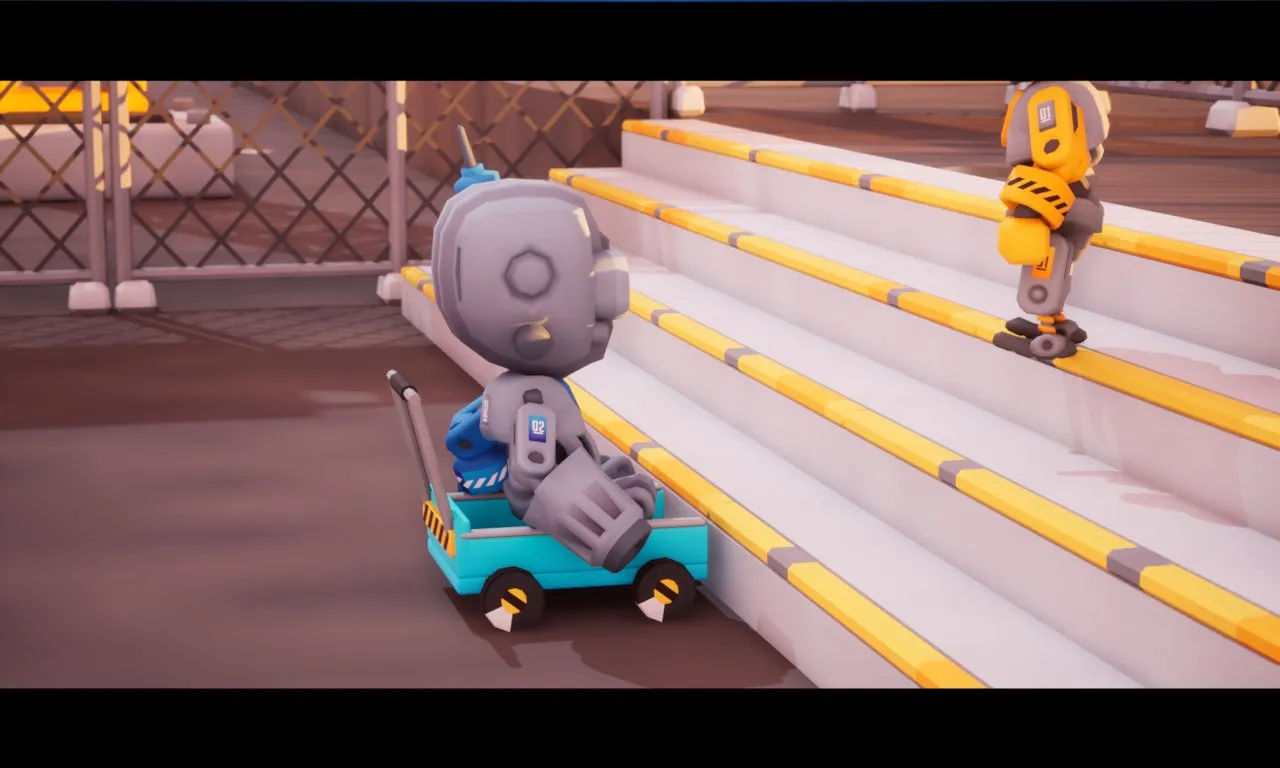
And one room alone, first. Before the crusher there is now a room that asks for two parts at once, twice. A foot on a scale holds a gate you can’t reach while a hand holds the gangway to it, so you hop across on what is left. Then a hand holds a second gangway while your head rolls through a hole in the fence and over it to the button that opens the gate for your body, which follows without it. Nothing in the room is new. It is the first three rooms, two at a time. To fit it in, the crusher and everything after it moved twenty-eight meters down the yard, by script.
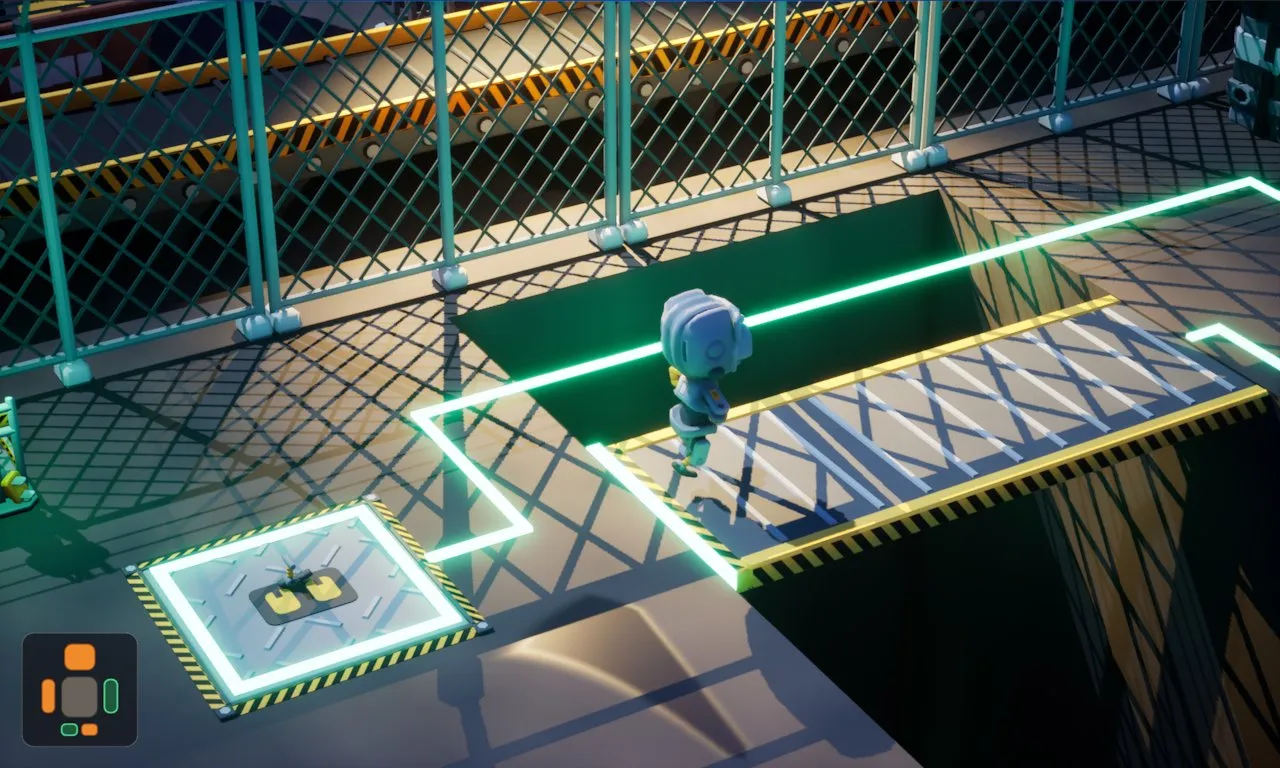
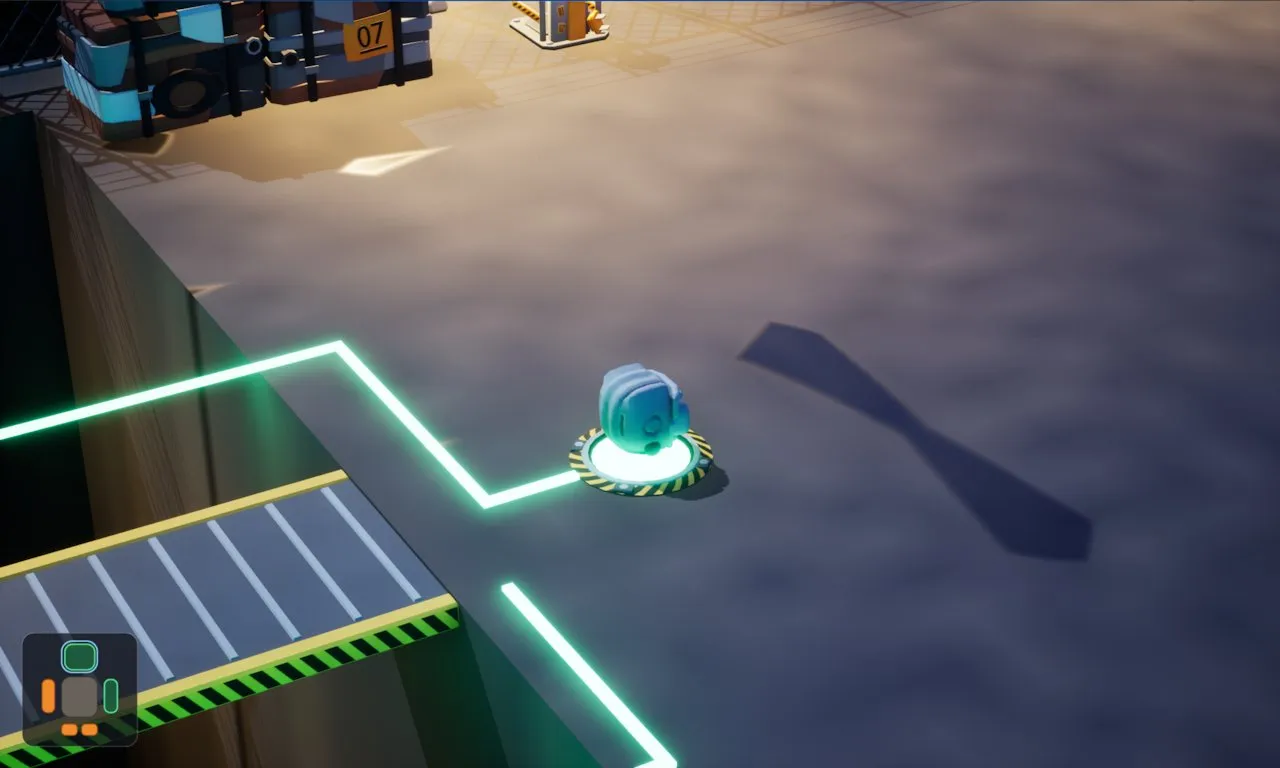
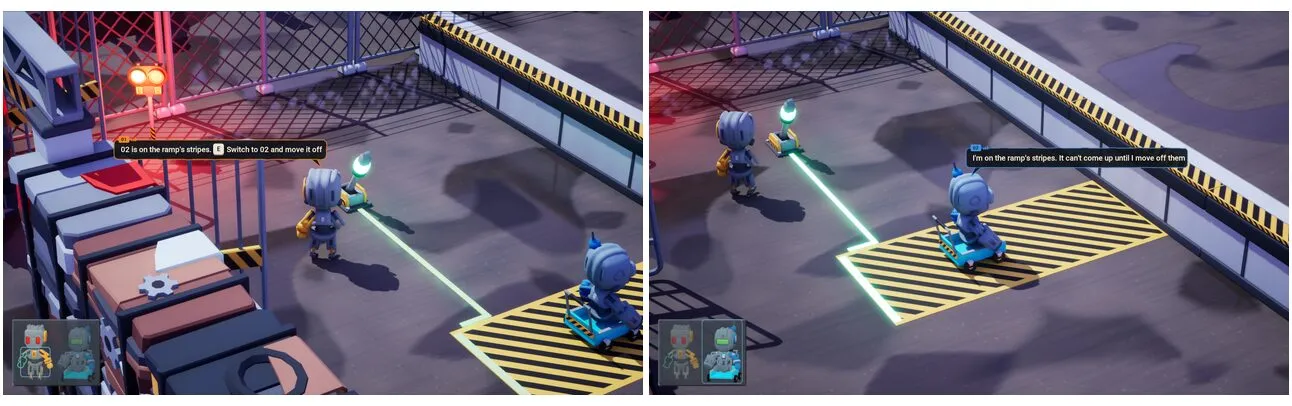
Reviewing the two-robot rooms. An independent reviewer worked through the code and level measurements and found three ways the pair could get stuck. One involved a gate: with 02 beyond it, 01 on the near side, and nothing held, neither could open it. 02 couldn’t use the lever, and 01 couldn’t activate the truck scale. Recalling parts with R at the wrong moment was enough. A second truck scale was added beyond the gate.
The reviewer also noticed that 01 could walk up the gate’s steps even though its leg measurements suggested it shouldn’t. It inferred that the character’s rounded underside was riding up edges lower than its radius, and suggested the cart might do the same. It labeled that as a guess and named the test.
The agent left 01 far behind and tried it. 02 rolled straight up all four steps, undermining the premise of the ending. The cart was given a flat base and grounded under its own two axles, which also made it lean into the ramp.
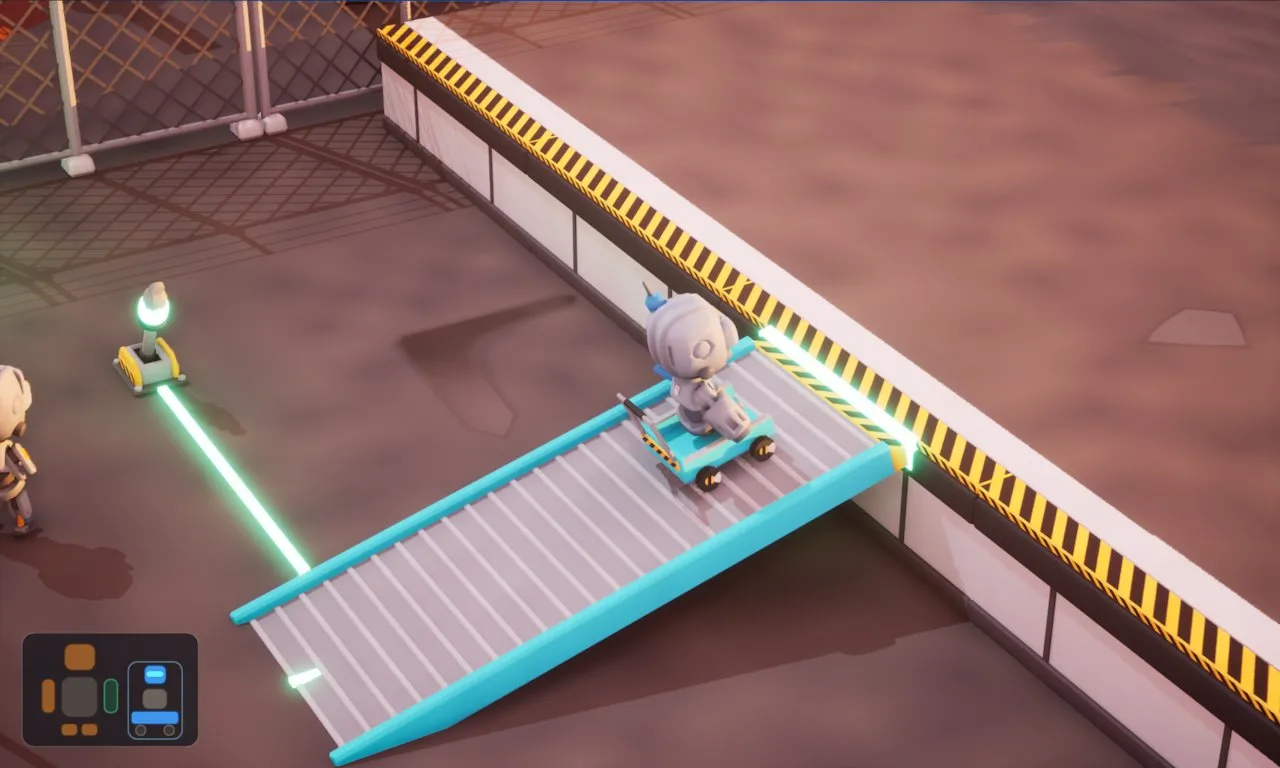
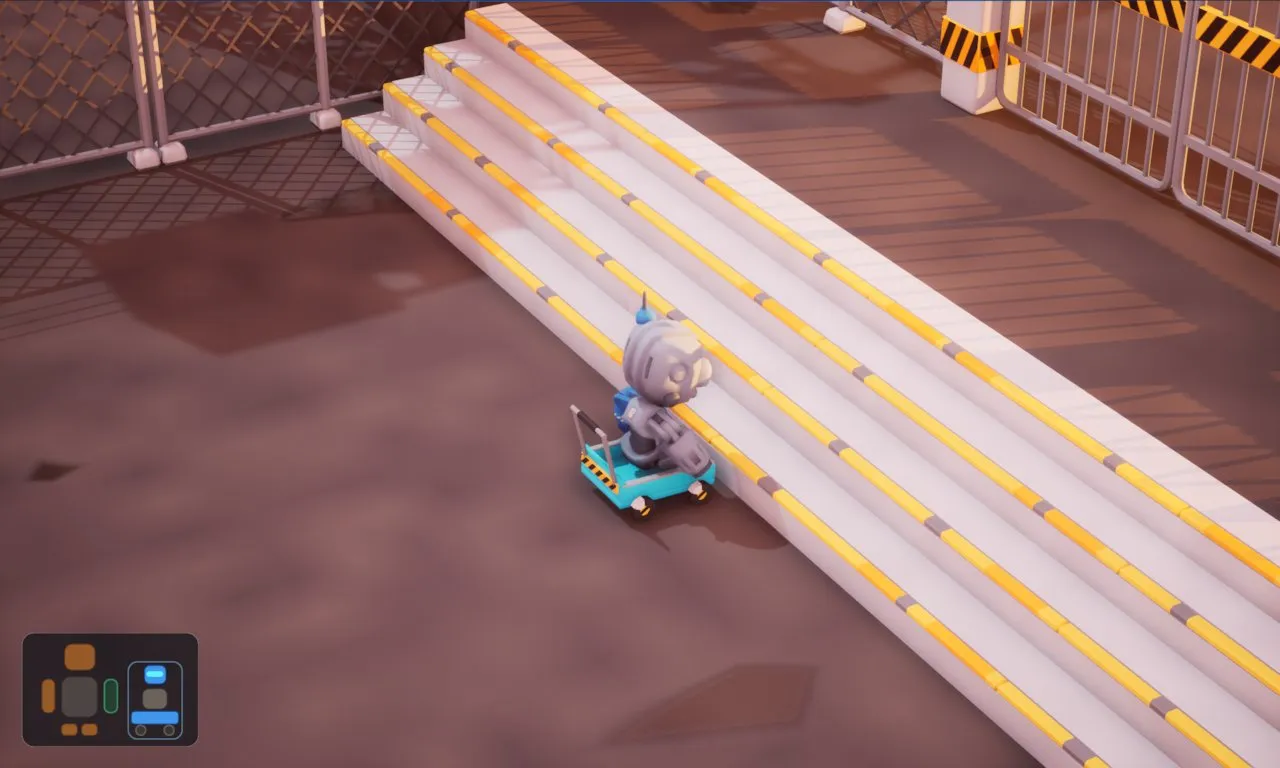
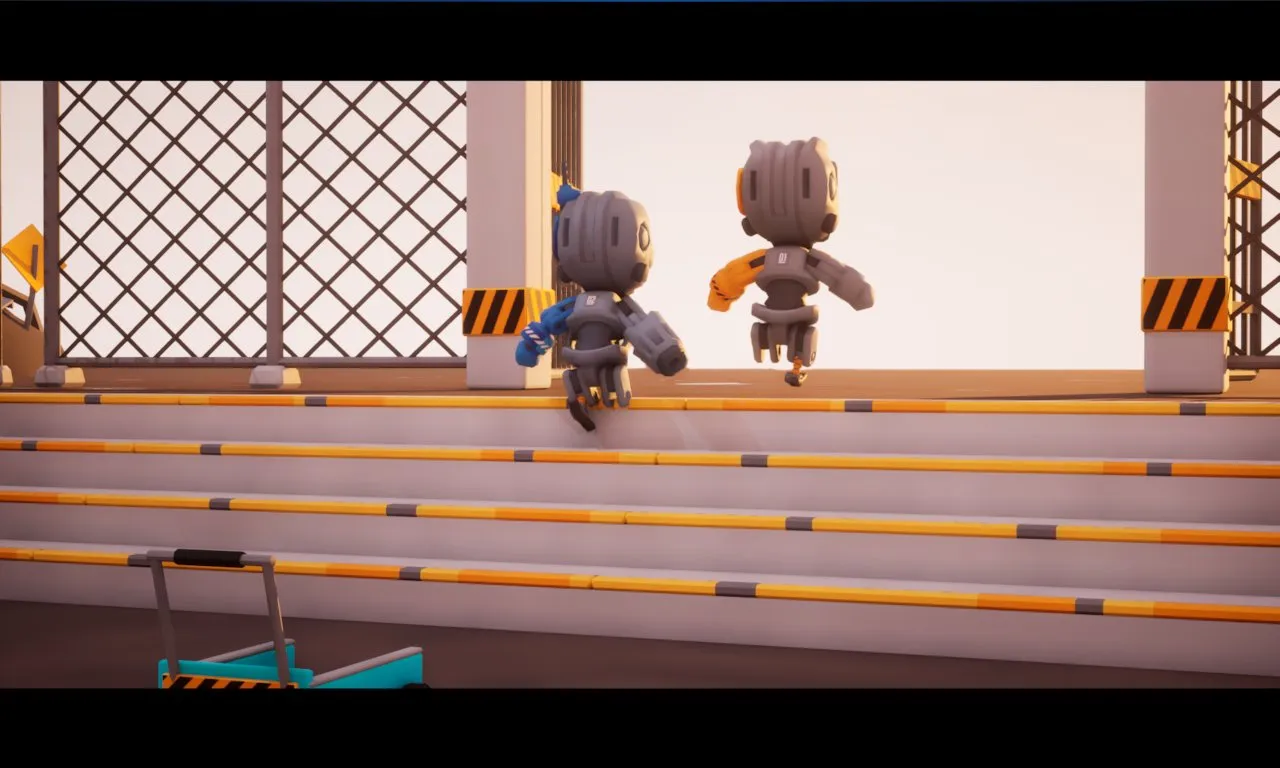
How long was it now? We still didn’t know how long a new player would take. A scripted run with real key presses, from title to card, knew every answer and never stopped to look. With zero falls, it took about five and three-quarter minutes, a little over three of them gameplay and the rest scenes. The first attempt had stepped onto a gangway before it extended and fallen fifty-four times. That was a problem with the script.
These stills were taken by the agent in editor play, driving the game with real key presses and reading its state back.
Playing the build. A team member who knew every answer took about three and a half minutes of play, matching the script, and wrote: “A nice, simple story with clean visuals and a nice ending.” They also answered three questions left with the build: a robot could hold a door open by standing in it, the first two-robot room could remain crossable by one robot, and E was the right swap key. No changes were needed. We still hadn’t timed a stranger or listened to the sound.
A route we’d all missed. A second reviewer reconstructed the level from its scripts and found a 40-centimeter strip of ground behind every pit, beside the fence. The robot was 60 centimeters wide. In play, it could hug the back fence and walk around the first room’s pit without using the hand or gangway.
That strip had existed since the first morning. A team member had played the room, and the agent had crossed it many times by script, always using the gangway. Invisible walls closed the bypasses.
The same review found a four-step way to get stranded behind a fence and noticed that returning to the last checkpoint didn’t recall parts, despite our notes saying it did. Both were fixed. It also proposed testing a running jump across a pit. In eleven attempts, the robot hit the far wall more than a meter below the rim every time.
The Stacks. The last room before the gate is where everything gets used at once. 02 rolls onto a truck scale, the only thing heavy enough to slide open a hatch in a cage. 01’s head rolls in through the hatch onto a button, which holds a ramp up. 01 leaves a foot on a small scale, which holds the gate at the top of the ramp. Then 02 rolls up and through, and 01 hops up a flight of steps beside it, headless, on one foot. The steps are there for two reasons. With stairs of its own 01 can always get to everything, so the room can’t trap the pair. And they are the same steps 02 will meet at the gate, where there is no ramp.
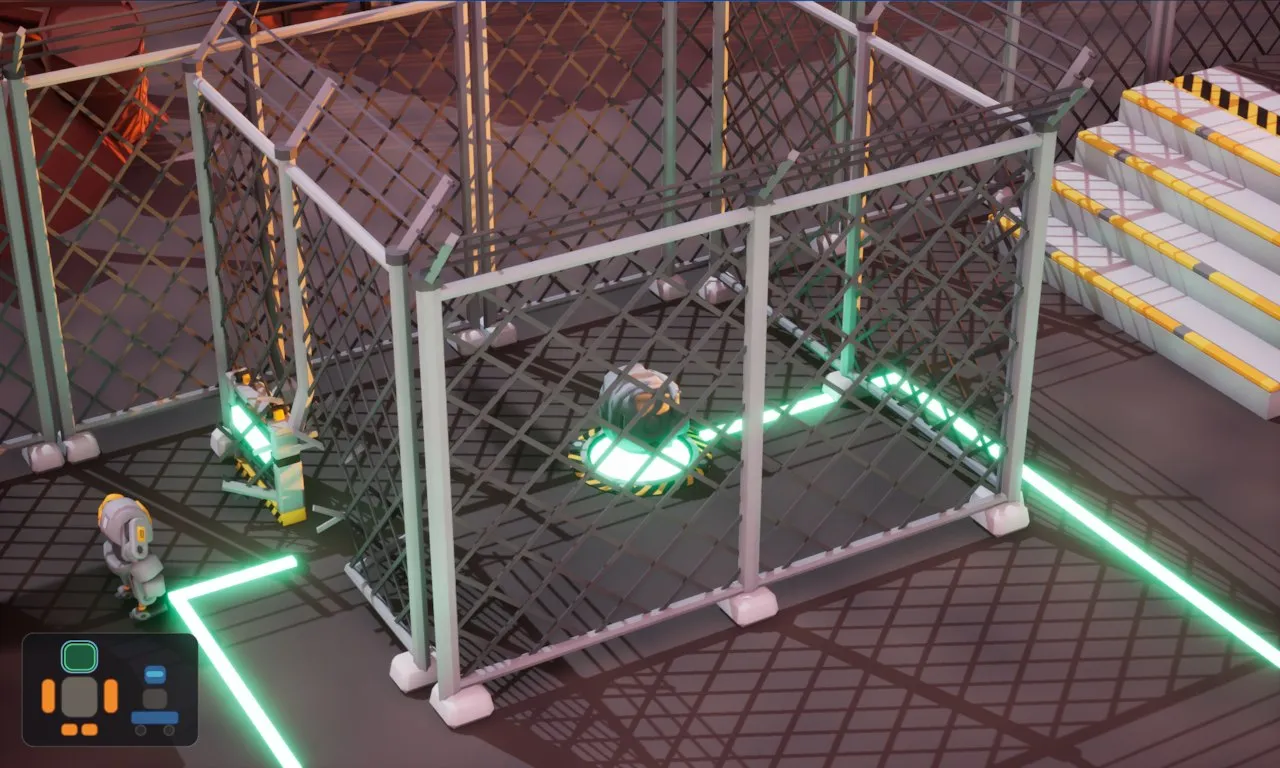
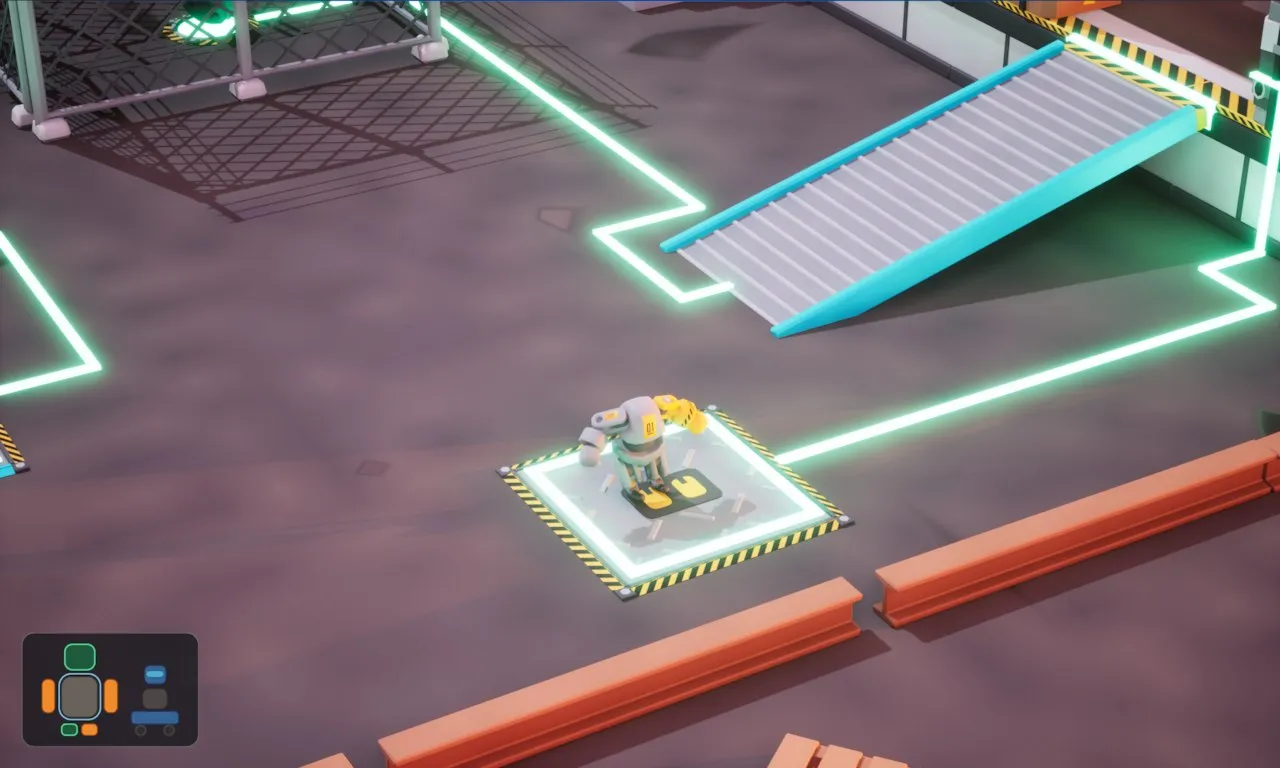
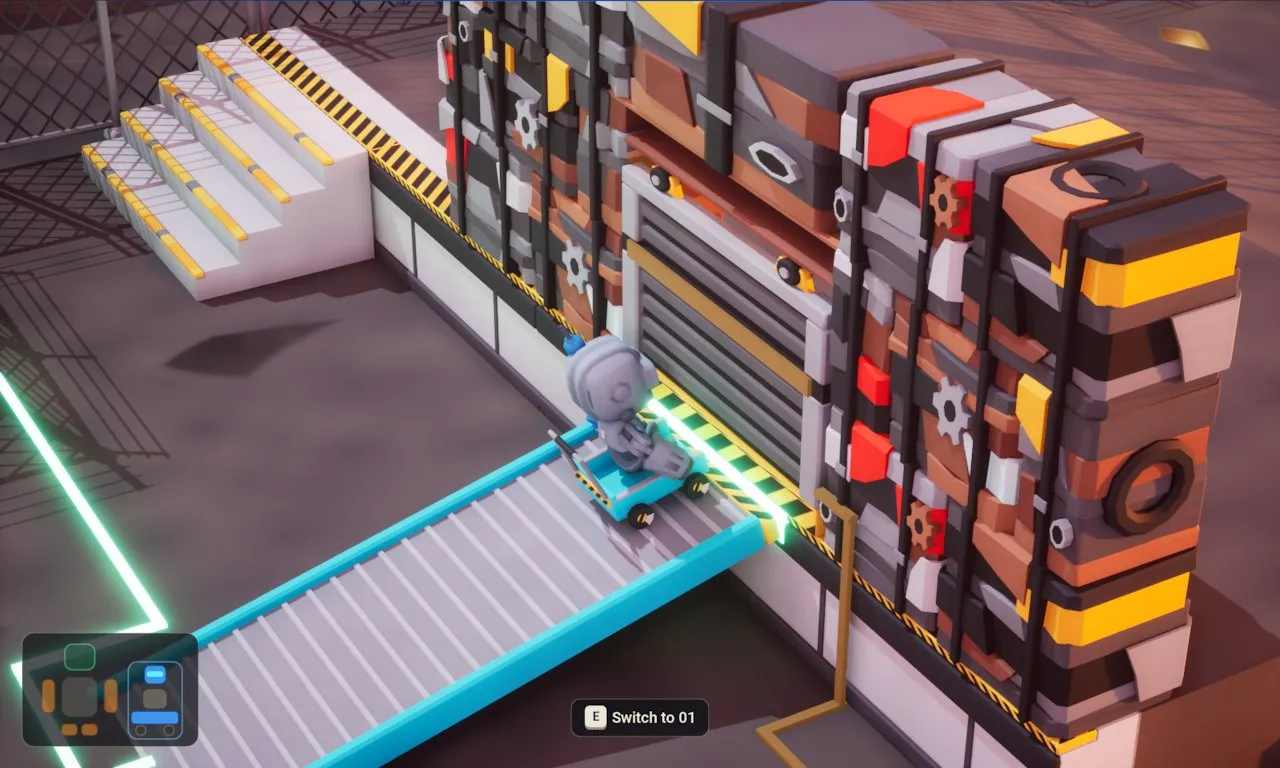
Playing it found four things that reading it hadn’t. The small scale sat in a pocket behind the raised ramp. The gate was ten centimeters narrower than the ramp leading to it, so a cart near the ramp’s side met the doorpost. With the gate shut the cart could park in the doorway, and was left hanging over the edge when the ramp went down. And at the top of the stairs the cart hung half its width over the first step. All four came from watching where the cart actually ended up.
Throwing the head over the cage. The third reviewer found no way to strand the robots in The Stacks, but it found a way to skip the room. The head pops off with a small hop, including in mid-air. By jumping from the stairs and releasing the head at the top, the reviewer calculated that it could clear the cage’s three-meter fence and land beside the button, with no truck scale, hatch, or 02 required.
The agent tried three timings. All three put the head in the cage. A lid was added.
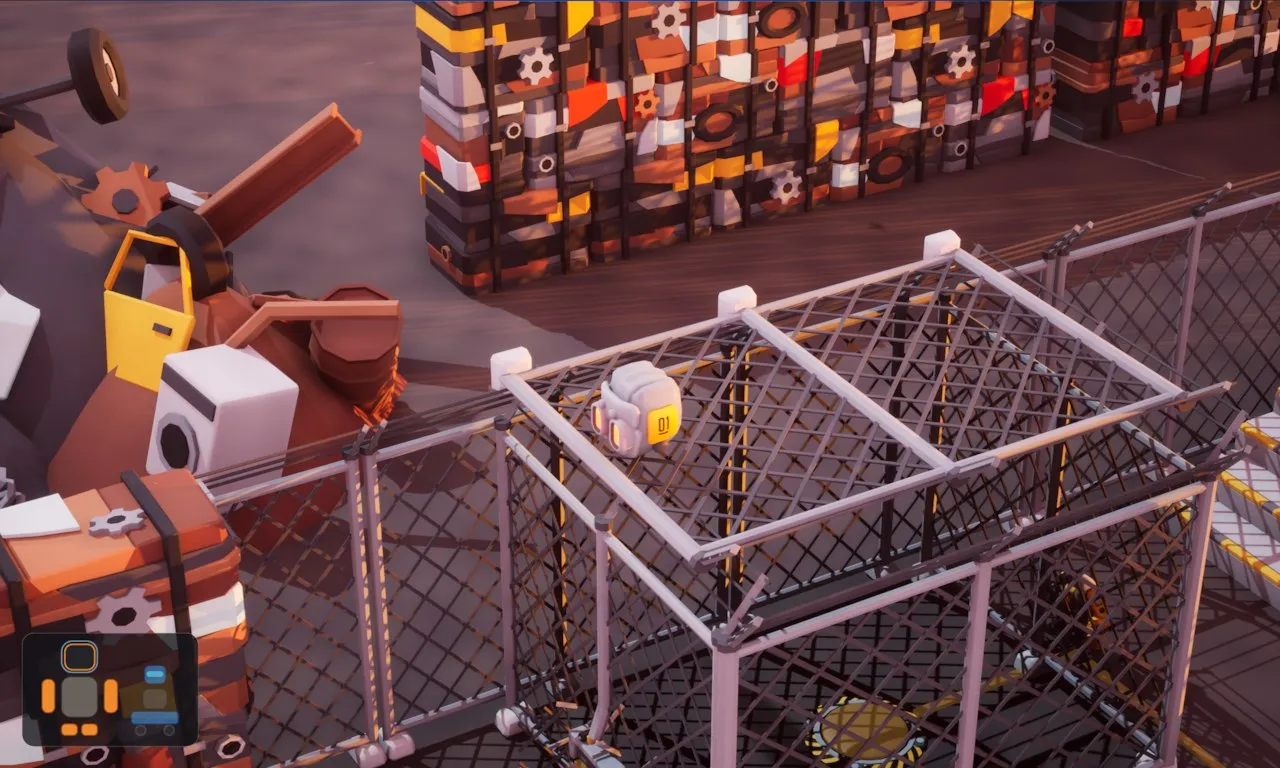
(The same reviewer noticed that the walls nobody can see were catching the mouse: a hand thrown at open floor near the front of a room aimed at an invisible wall and not at the floor. That had been true in every room since the first day.)
We hadn’t played The Stacks at this stage.
What came after. My note above was our only feedback on the three-act build until Saturday, when all three of us had played to the ending and written notes. Nobody reported getting stuck, separated, or crashed, and nobody asked to cut a room.
Jacob rated the robots walking through each other as a bug at 3 out of 3. That became Saturday’s first major task. Ron II wanted to push 02’s cart, asked why 02 had a jump key that did nothing, and noticed that pressing R as 02 recalled 01’s parts. Those three behaviors stayed as they were.
Ron II also saw 02’s new foot pass through the ending’s steps, which was fixed. Jacob wanted the pair to continue further into the distance, which wasn’t done. The playtime was still a lower bound: both the script and I knew every answer. Nobody new to the game was timed before submission.
Friday morning: harder rooms
Asking for harder rooms. The game played from title to card, but it was easy. Friday morning’s note pointed out that “we don’t have any rooms where all hands, feet, and head need to be active at the same time,” and that there was more to do with “the second character.” It asked for rooms that were “more meaningfully challenging, and not just boring repetition,” told the agent to build promising ones without waiting for approval, and added that “we can always roll back changes if needed.” The author then left the keyboard.
Four designers, one brief. The agent measured what the two robots can really do, from the code: how high 01 jumps whole, on one foot, crawling, headless; how far a hand flies; what weighs what. It wrote those facts down once and gave them to four sub-agents, each with a different question: a room that takes all of 01 at once; rooms for the two robots together with no new code; one small new device; and the difficulty curve of the whole game. It also wrote a small program that takes a room as places, ways between them and what each device needs, and tries every state the two robots and five parts can reach, looking for any state the pair can’t get out of and for any way through that skips a part.
Measuring found a hole first. With both feet left behind, 01 crawls. Crawl up against the cage in The Stacks, pop the head, and the head came off on the far side of the fence, inside the cage: no truck scale, no hatch, no 02. A crawling robot’s head sits out in front of its body, and nothing had asked what was in the way. Fixed before any new room went in.
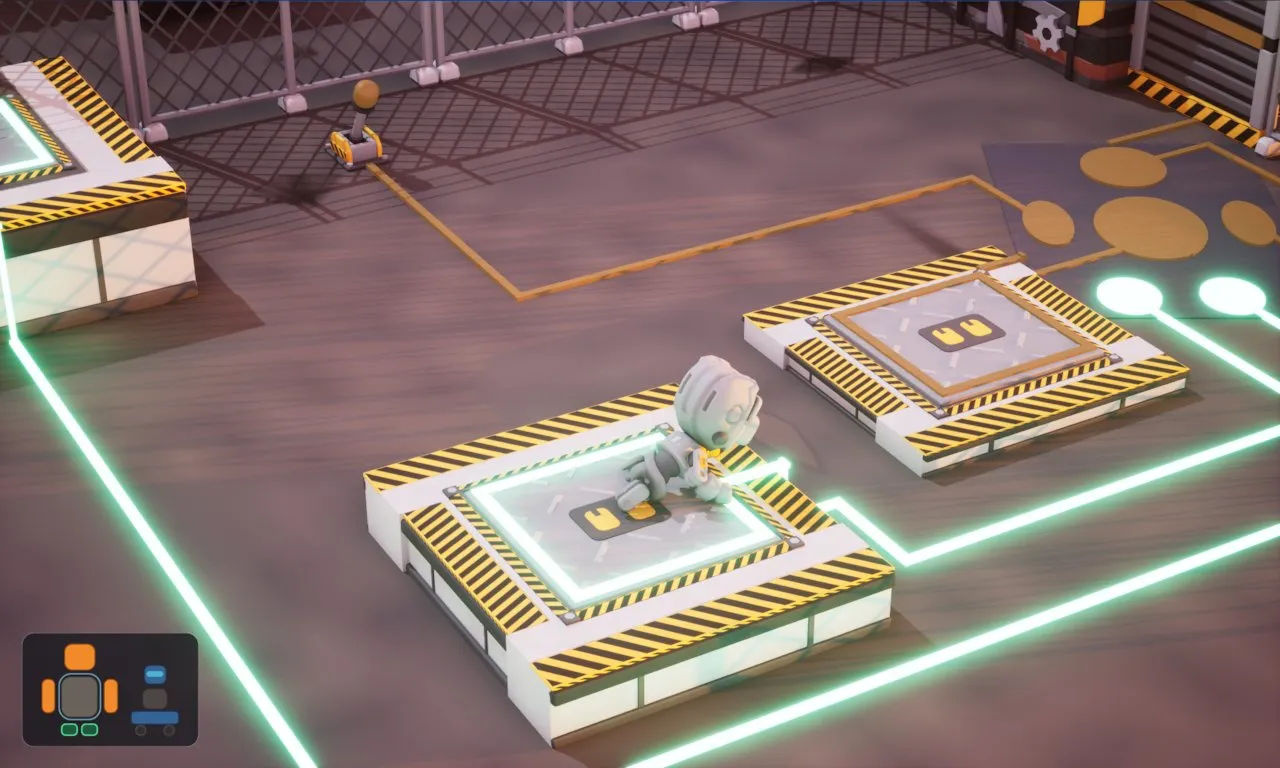
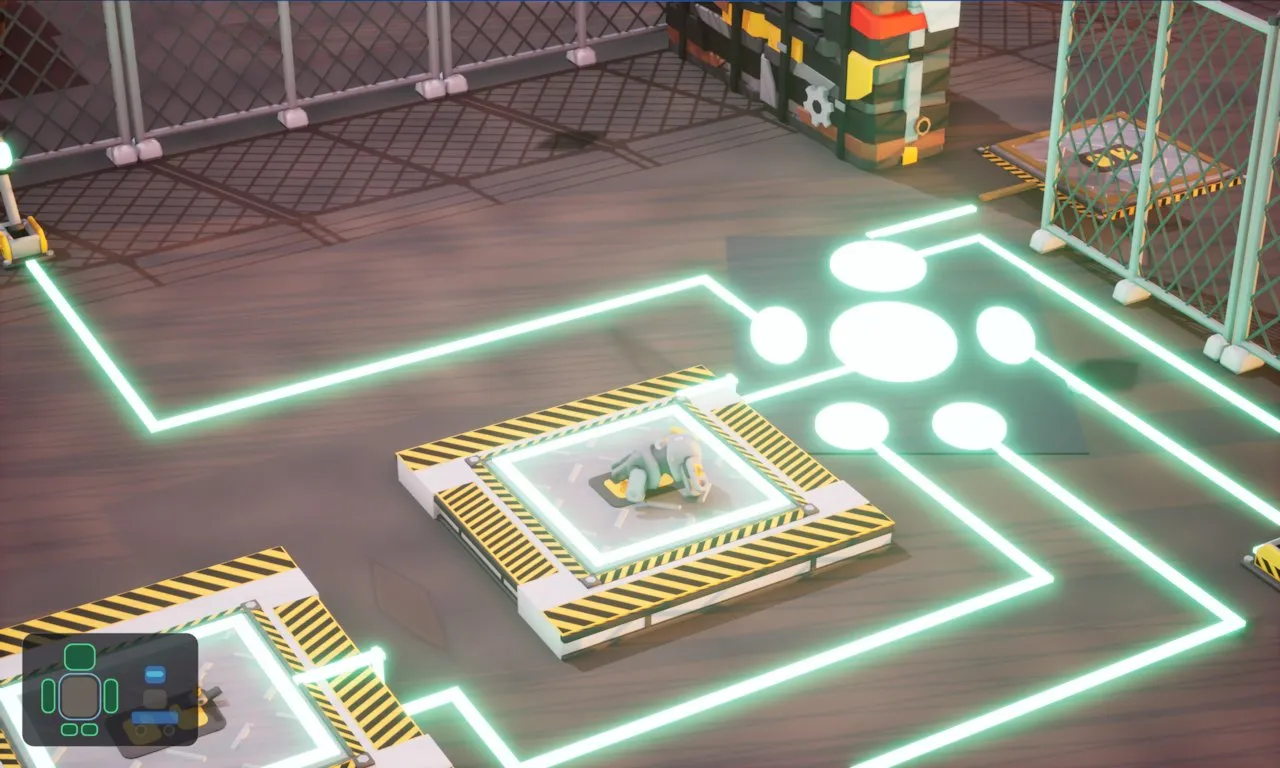
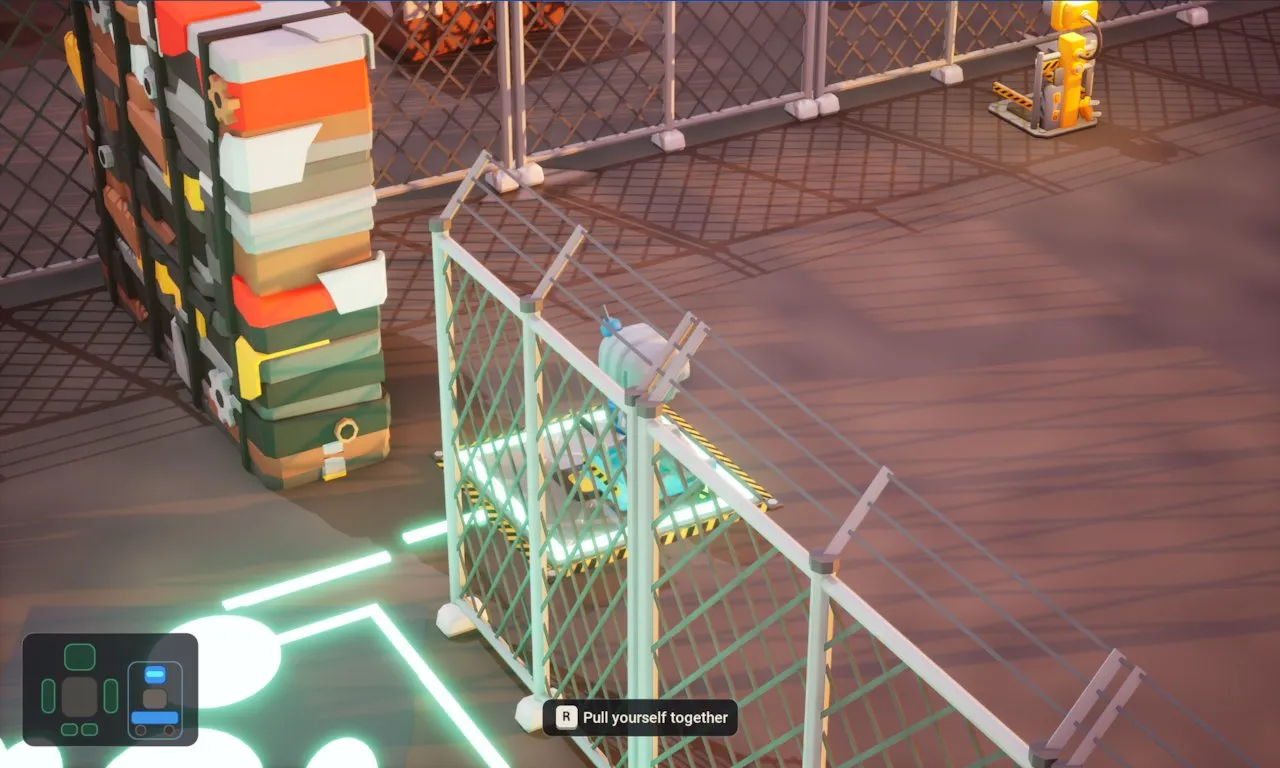
The Interlock. The agent built the room from the note’s own example before the reports were back: one gate, six lamps, open only while all six are lit. Then two of the reports arrived describing the same room, and one of them described a better one. We took three things from it. The six lamps became a figure of 01 on the floor in front of the gate: a head, two hands, two feet, a body. The three scales went to three heights: a ledge only a whole robot can jump up to, a platform it can hop up to on one foot, and a curb it can drag itself onto with nothing left. So 01 has to take itself apart from the top down, and the last weight on the last scale is 01 itself. And when all six are lit, 01 can’t move. 02 rolls through the gate alone, onto a scale that holds it open from the far side, and the words that come up are the first words of the game: “Pull yourself together”.
Up and Over. The second room came from the report on new devices, which noticed that a lift is the first room’s gangway stood on end, with no new code at all. A fence whose gate is two meters off the ground. A lift on each side of it. The gate opens only while both lifts are up. 02’s weight on a truck scale sends both up, and 01 rides and walks through. Then 01, on the far side, has to do with two of its own pieces what 02 did with its weight alone: hold both lifts at once, one to bring 02 up, one to meet it and bring it down. It is the first place where neither robot can cross by itself.
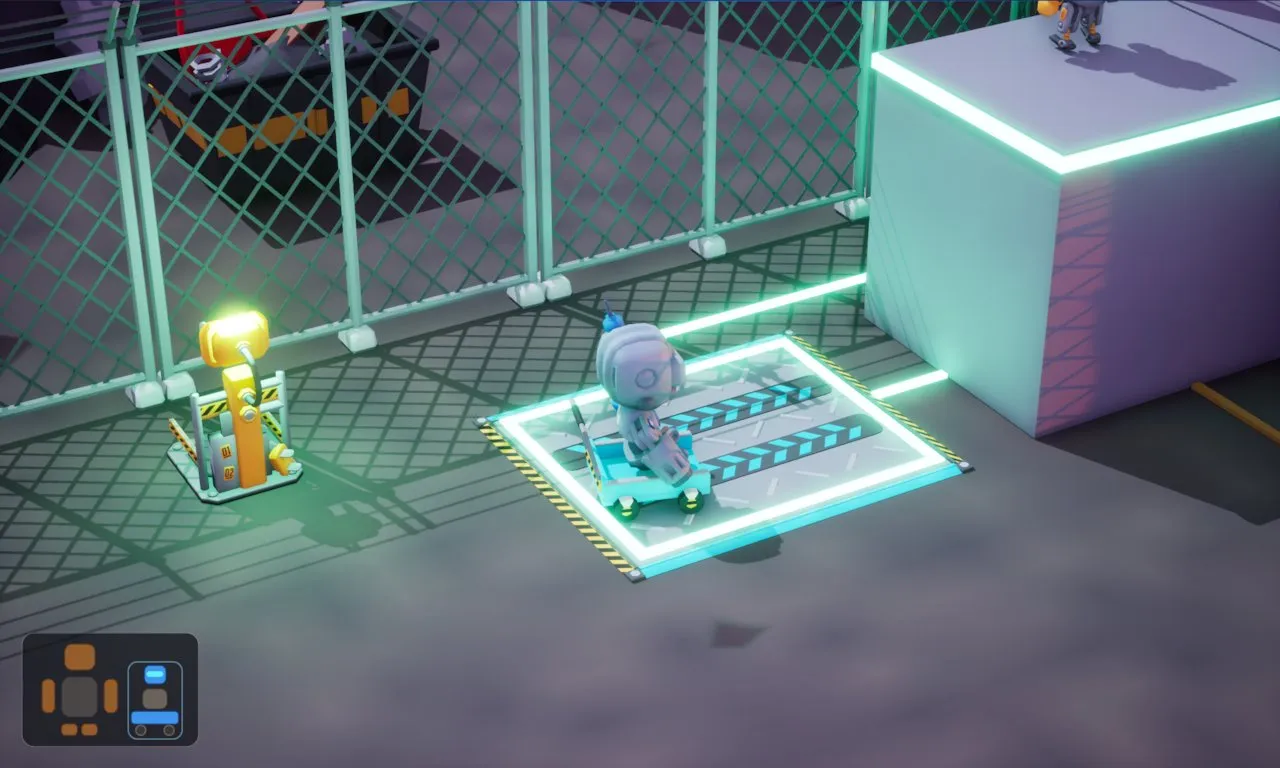
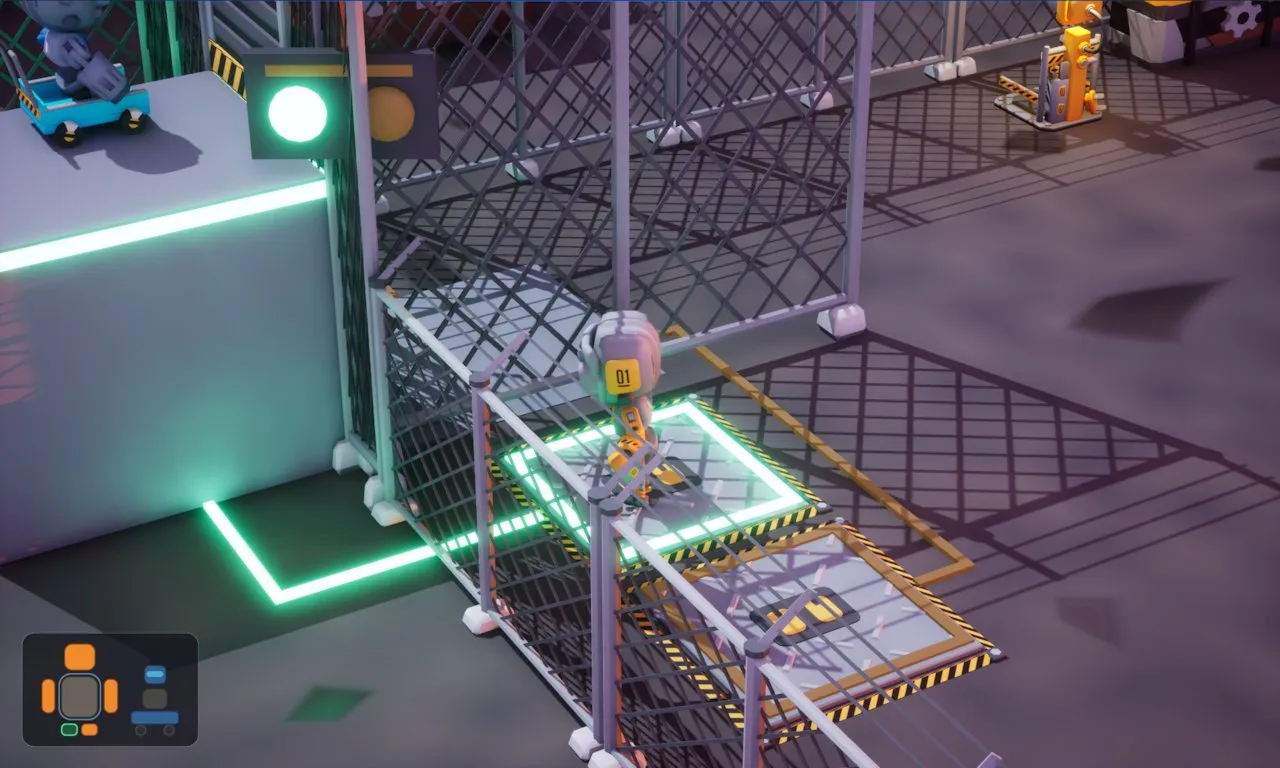
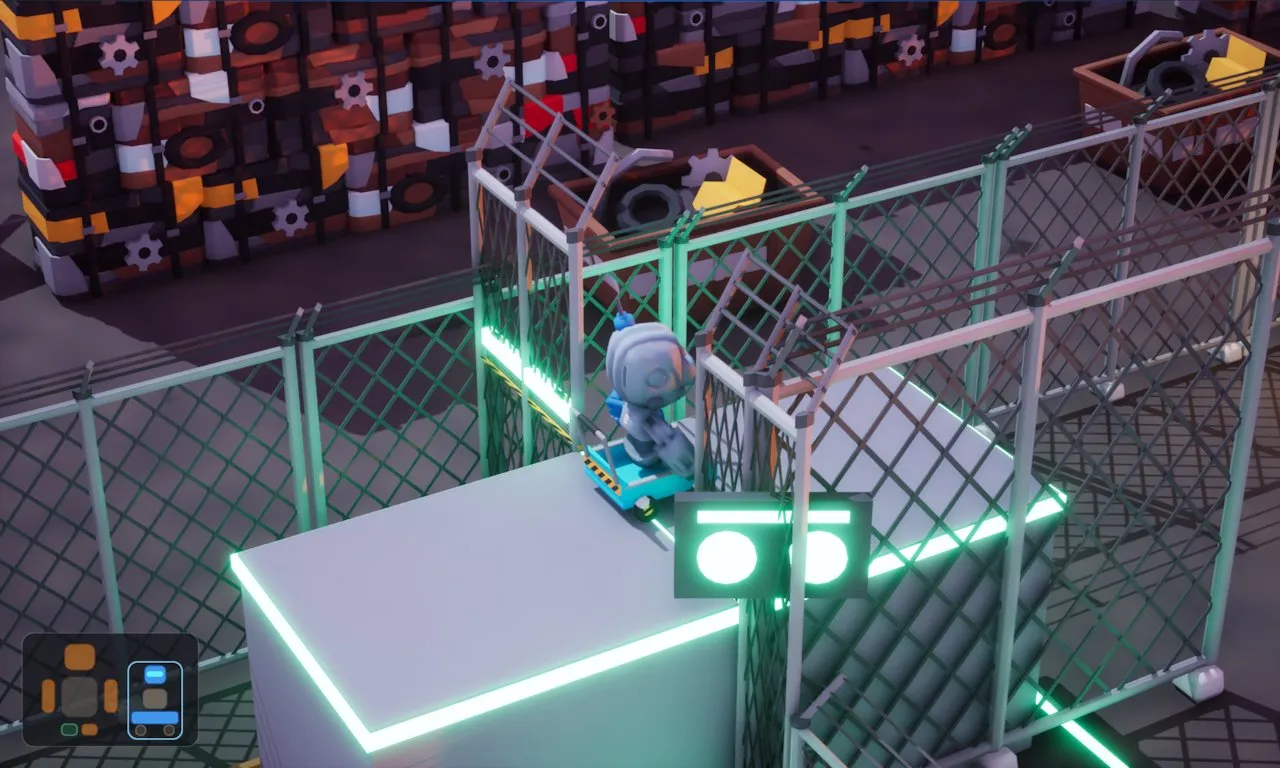
The first layout worked and read badly. Our camera follows whichever robot you steer and looks one way, and the first time 02 rolled onto the truck scale, 01 rose out of the top of the picture. On the far side the small scales stood behind a full fence, and the lifts they worked were off the left edge. The room was laid out again around what the camera sees from each place where you press something: the thing that answers has to be in the same picture.
A cart hanging on a fence. Up and Over had been built, checked, committed, and packaged with a fault. Its first version had a low fence with no gate; the raised lifts met above it. The agent had tested lowering the lifts with the cart parked dead center over the fence four times. Each time, it slid off and rode down.
An hour later, it tried parking just short of the fence, where a player might stop. The lift descended while the cart hung two meters up, resting its rim on a fence top four centimeters wide. That happened four tries out of four. Making the fence top impossible to stand on fixed the hanging but let the cart slide across without raising the far lift.
The low fence was replaced with a gate. A cart on one raised lift could no longer reach the fence. Testing dead center had happened to test the one position that worked.
Reading the engine. While the agent reproduced the hanging cart in play, the fifth reviewer found it in the engine’s movement code. The body the engine moved sat 20 centimeters ahead of the visible robot, so the supposedly centered test had been 13 centimeters off.
It also found a possible route back for 01: jump onto the far lift as it sank, then jump over the fence. That alone was harmless. But if 02 continued through the next room’s gate first, 01 could return and strand them on opposite sides of a fence neither could cross alone. The far lift was enclosed in a cage with its exit on the far side, and the fence around the gate was raised beyond jumping height from a lift.
Preventing one trap exposed another. Once 01 couldn’t return, a player could leave a hand on the lever two rooms back, send 01 over on the lifts, roll 02 back through the held gate, and recall the hand. The reviewer had identified this consequence too.
The first time 02 used the truck scale to lift 01 across, the ramp and gate behind them were made to open permanently. A player would only see that if they went back. Sunday morning’s changes revisited this solution.
Getting caught under the gate. The third review of Up and Over found that its new gate was 16 centimeters thick on a 4-centimeter sill, overhanging each lift by 6 centimeters. If 02 parked against the fence before raising the lift, the gate caught the cart’s top while the lift kept rising.
The agent reproduced it: 02 ended up at ground level inside the raised block, unable to move, with an open gate above it. That fault was in a build we’d just been asked to play. The gate was reduced to 4 centimeters thick. The cage doorway could cause the same problem, so the cage was replaced with one length of fence and a rule that kept the gate shut while a lift moved.
One room took four rebuilds in an afternoon, each responding to something found after the previous version had been called checked. The final fix simplified the room.
Using the head as a doorstop. The seventh review was the first review of Up and Over to find no way to trap a robot. It did find that a head could hold the raised gate open. Gates wait for anything standing in them, and the head counts. Park it on the fence’s 4-centimeter top, lower the lifts, and 02 could cross using one weight instead of two.
The reviewer worked from the gate code and fence width; the agent played its eight moves and confirmed each one. A 2-centimeter ridge replaced the flat top so the head would slide off. Testing to a hundredth of a centimeter still found a permanent balance point within about half a millimeter of the ridge’s center. The usable ledge had narrowed from 4 centimeters to about one millimeter.
Asked whether that ridge was safe, the reviewer found a faster version: arrange the moves so the head only needs to stay there for a second and a half. The agent tried it and succeeded on the first attempt. We kept it as a harder alternate solution that trapped nobody. No later team feedback asked to remove it.
Dropping a foot during a jump. The fourth reviewer calculated another bypass in The Interlock. F leaves a foot where 01 is, even in the air. Jumping from the platform on both feet, then dropping one onto its scale, preserved enough of the original jump to reach the high ledge. That activated the scales in the wrong order. The calculated jump covered 230 cm and needed about 200.
The platform was moved to 370 cm from the ledge, and the agent’s test jump landed 150 cm short. The reviewer also found that a one-footed hop from a lever’s base came within a centimeter of reaching the ledge, so the lever moved. Two help lines were appearing for players who were solving the room correctly; each was restricted to a robot that had removed its parts in the wrong order.
A robot that can’t jump says so. One of the design reports pointed out that when 01 has no feet, or no head, the jump key did nothing at all, and nothing told that apart from a key that hadn’t been pressed. Now it dips and thuds.
How long was it now? The same scripted run, with every answer known, completed ten rooms without falling: a little under six minutes of play, about seven and a half from Start to the card.
At this stage, we hadn’t played either new room or heard their sound.
Both rooms stayed. Our notes on Saturday do not say which build each of us played, but Jacob’s describe The Interlock, and nobody asked for either room to come out. His notes on The Interlock were about what it shows, not what it asks. All three small scales had footprints painted on them, though 01 has two feet and the third scale wants its body, which he thought “could confuse players into thinking they need three feet”. The body’s scale is plain now. He also found the walk from that room to the last steps “a little empty”, rated 1 out of 3, and that was left as it is. The one note that names Up and Over came in the third round: the board that says which lift is up was cutting through the fence, and it was remade and moved onto the fence’s face. Nobody has said anything about the second way through Up and Over, so it was left as it was.
Saturday afternoon: three people play, and the notes become a build
By Saturday afternoon, all three of us had played and brought back 64 notes, each rated out of 3. The agent organized them into two lists. I accepted both and moved the feature freeze to Sunday morning so it could work through them without us. The first list contained five large items, built in one sitting from about 3:20 to 5:15 PM. We hadn’t played that result yet; this section describes what was built and checked.
Moving around each other. Jacob rated the robots walking through each other as a bug at 3. We’d allowed it so neither could block the other in a doorway. I accepted a solution that preserved that protection: steering one robot into the other makes it move around the side. If it keeps pressing with no way around, it can pass through after half a second.
It took three tries. The first made the cart dither from side to side. The second passed every check the agent wrote, but an independent reviewer built a small model of the rule and found a missed case: a robot parked slightly off-center in a gateway could send the other sliding along the wall outside it. The fix checked whether there was room to get all the way around before starting. The named cases were then tried in play, followed by a full title-to-card run.
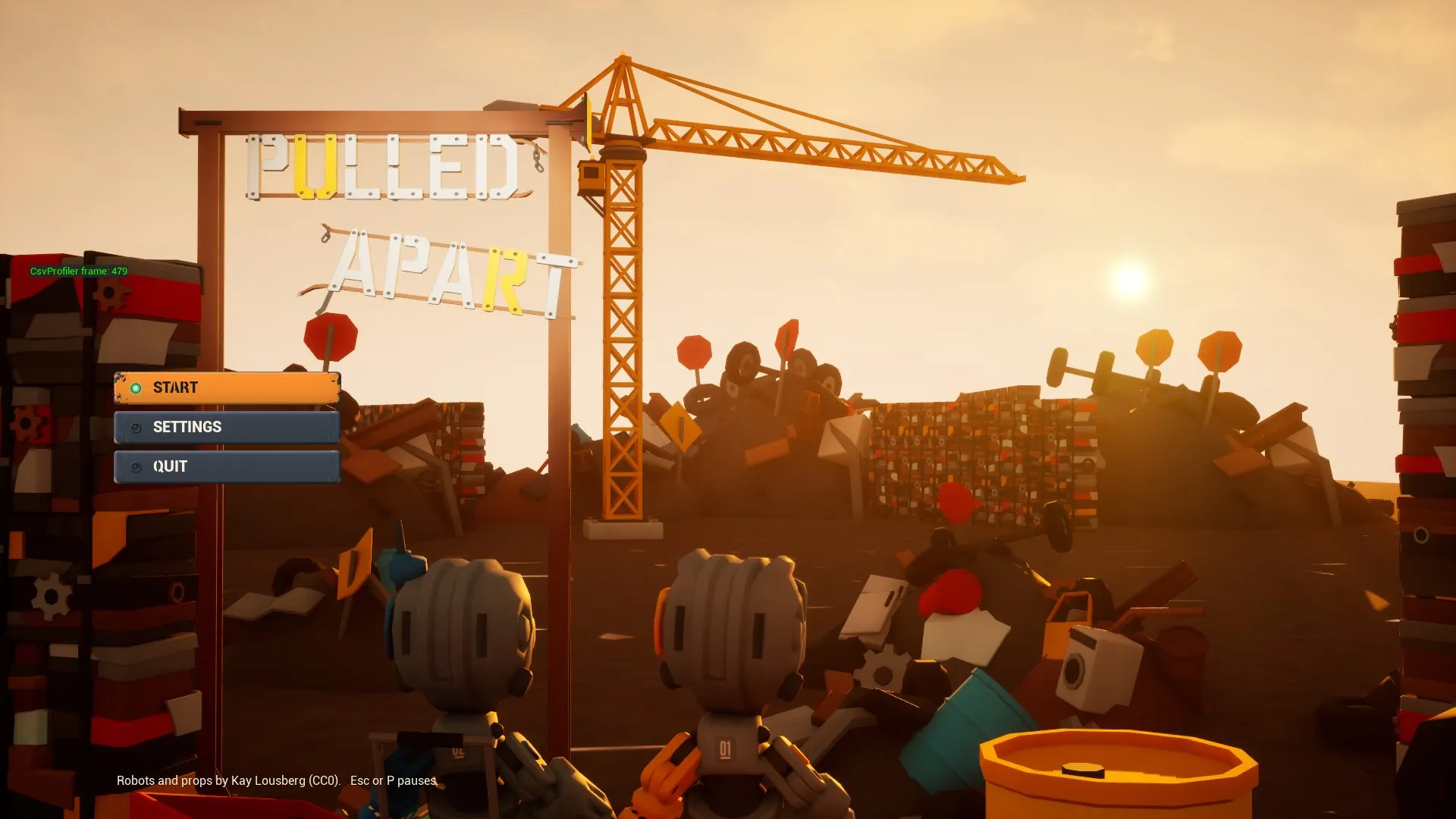
Making the title part of the yard. I wanted the title, menus, and buttons to feel like they belonged in the game. The title became cut steel letters on a sign gantry, with PULLED still up and APART hanging askew. The letters were built from geometry rather than a font. Menus became painted plates with stenciled words and a lamp on the selected button. Settings persisted between launches, and keycaps grouped the controls by robot and part.
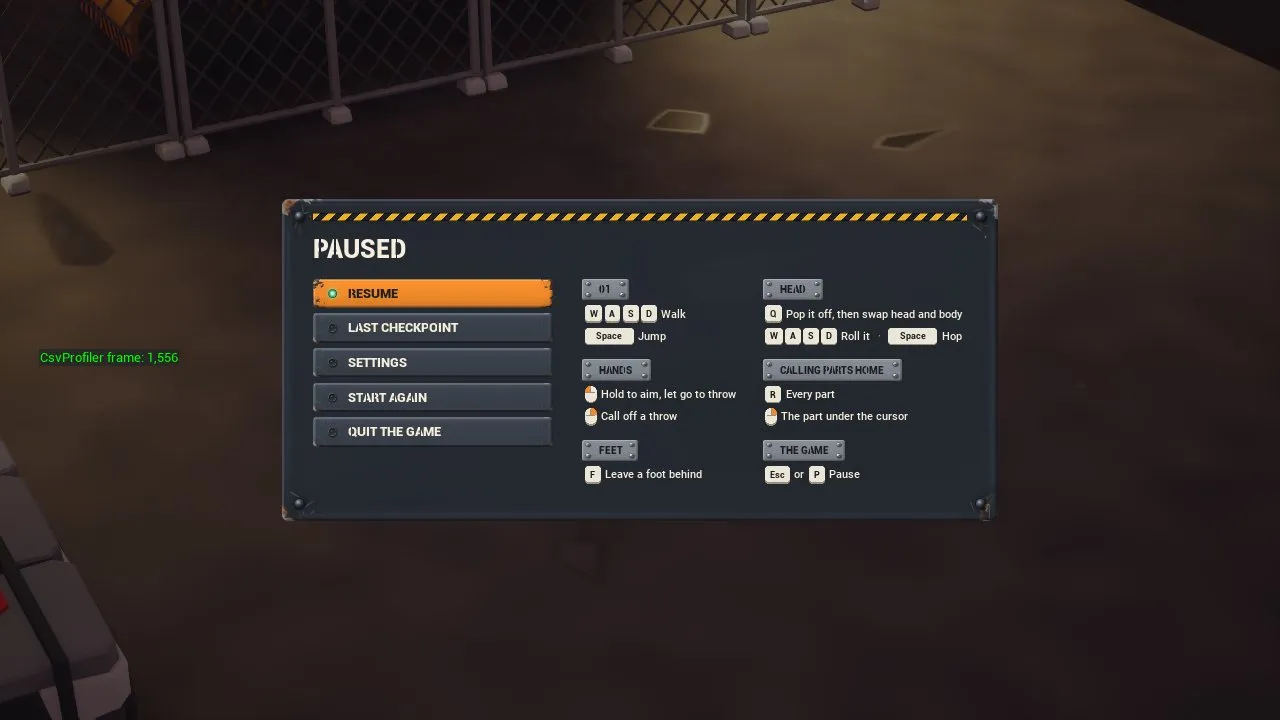
Hints in the robots’ voices. Hints moved beside the robot under your control and took its color. The words arrived a few letters at a time with blips in that robot’s voice. Story prompts used the same box. The parts display was rebuilt from pictures of 01’s actual parts.
Missing movements. Left-hand throws now used the left arm, and the head followed the cursor. Without its head, 01 walked upright with its arms out, feeling its way. Without feet, it stopped sliding while throwing.
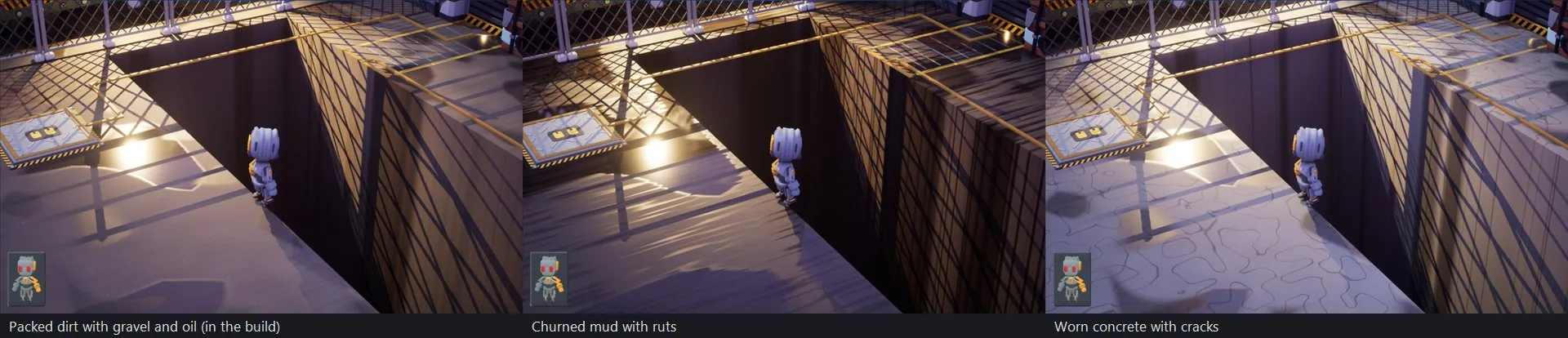
Choosing the ground. Jacob asked to compare surfaces before settling. Three versions could be switched with one call, and the agent made a side-by-side still. With nobody awake to choose, it used packed dirt and documented how to change it. Junk mountains and stationary cranes were added north of the belt and beyond the gate. The sky wasn’t finished.
How the work was split: the main agent wrote the code and did the editor work; four sub-agents made, from written briefs, the wordmark’s models, the interface’s textures, the pictures of the robots’ parts and three new clips; a fifth did the review. The agent cannot hear, and says so wherever a sound is involved.
Saturday evening: checking the title. I played the result and sent individual notes. The first was that the title “looks great, but is still a bit too small and hard to read.” I asked for it to be bigger or closer. Moving it closer would put the sign at the edge of the first room, visible during play, so the agent checked the robot’s possible positions and made the sign farther away and larger. A second support would have appeared to grow out of a robot’s head, so the sign used one post with an arm.
The agent also measured the stills and found that the lit white letters were as bright as the sunset sky. Turning off their lamp made them read as tan against it. That went beyond my note and was recorded as a choice I could reject.
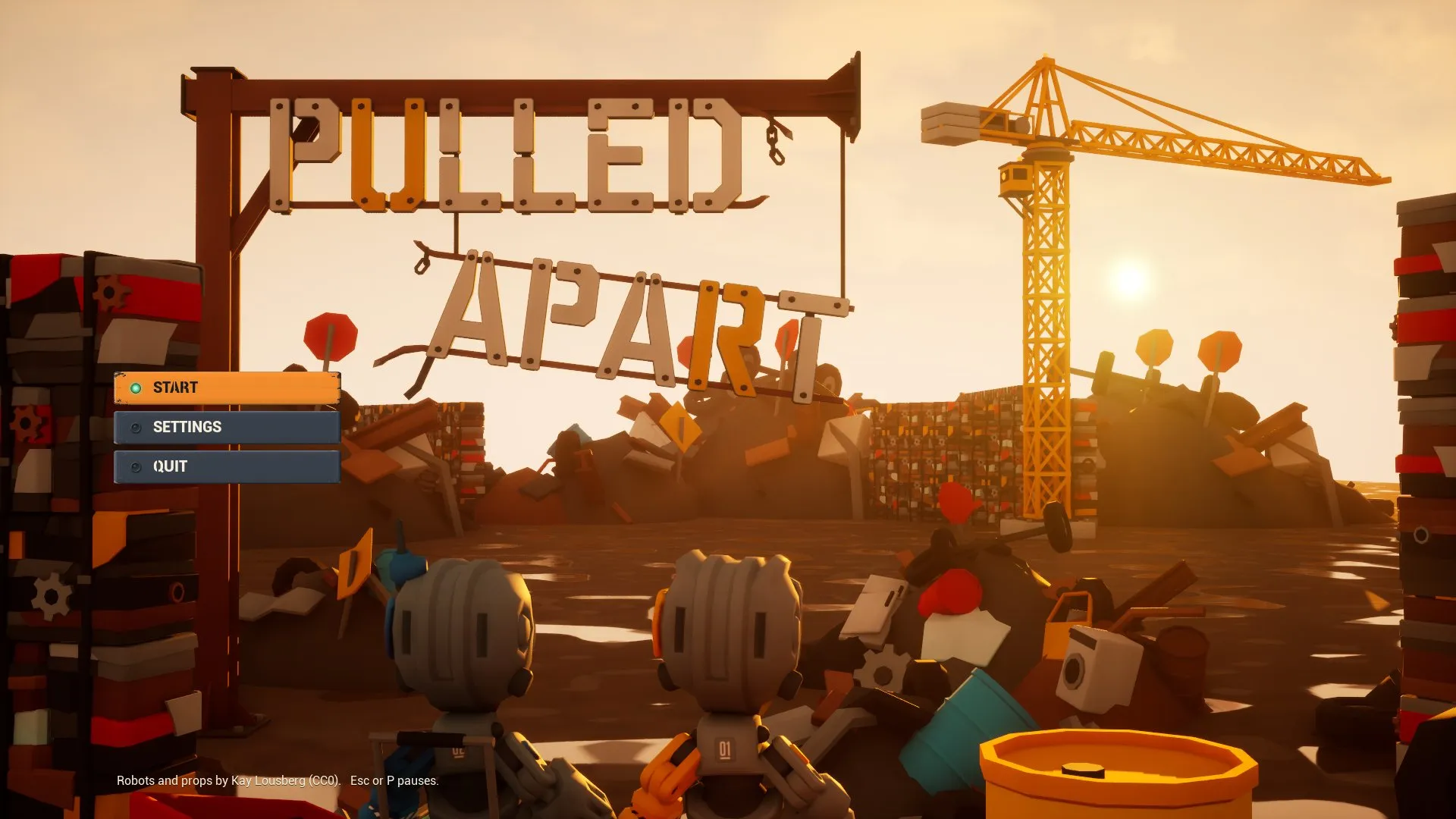
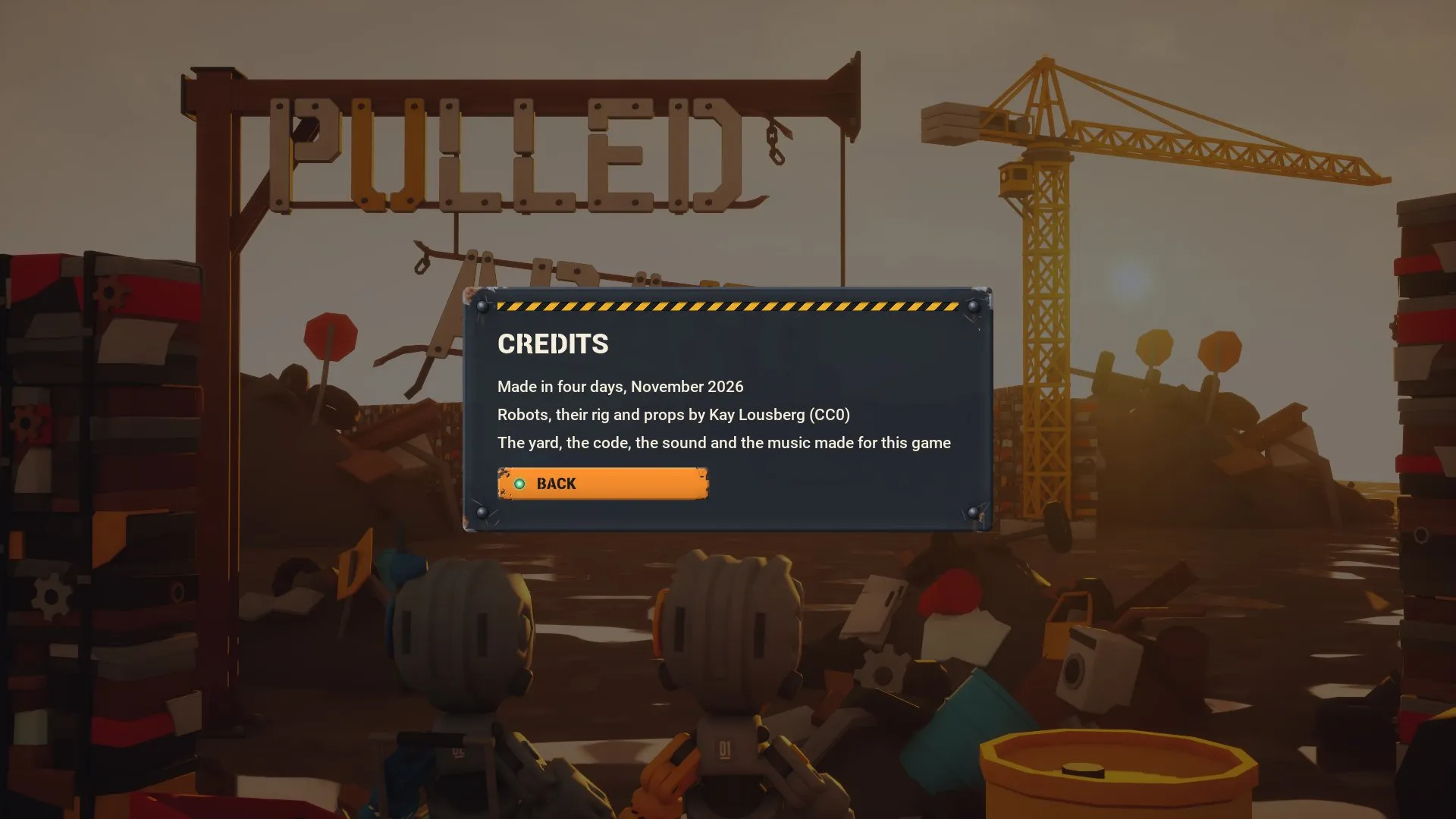
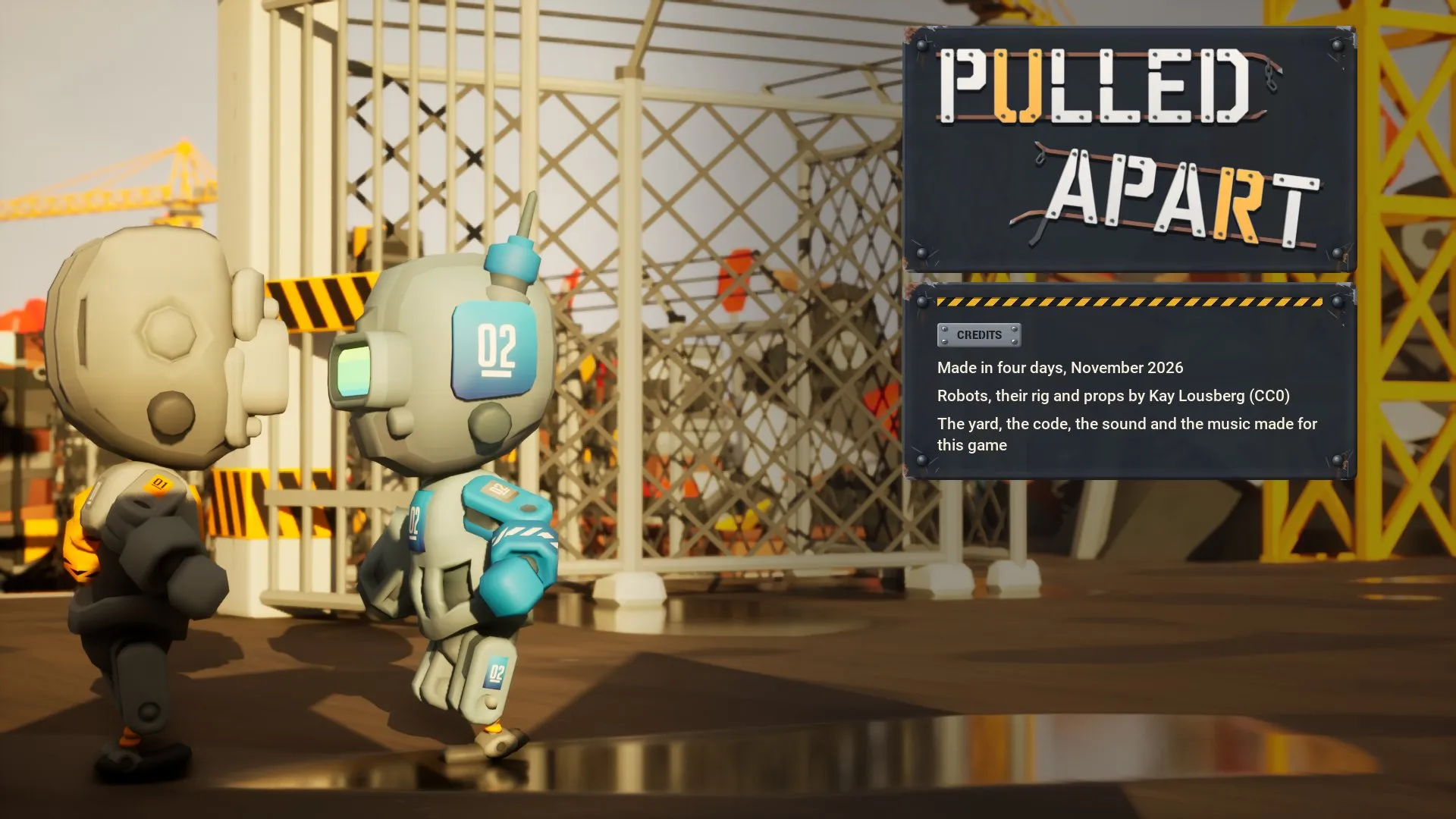
My second note asked for the same wordmark at the ending and legible credits. A third, sent while that was being built, suggested a Credits button on the title. The agent rendered the ending wordmark from the same two models and tested three treatments: white on the bare scene, which disappeared into the chain-link fence in a mock-up; tan over a darkened scene, which was still hard to read; and tan on a steel plate. The last went into the build, with credits on a second plate and the run’s statistics card taking their place afterward. The title got its Credits button.
The first credits-menu still showed only the plate’s corners and edges. An afternoon report of a “see-through card” had been dismissed as a possible mid-fade still and left unproven. It was a real editor-build fault: a newly loaded texture could briefly report a placeholder size, and the plate’s corners were calculated from it. The credit lines were still placeholders because we hadn’t supplied the team’s public wording yet.
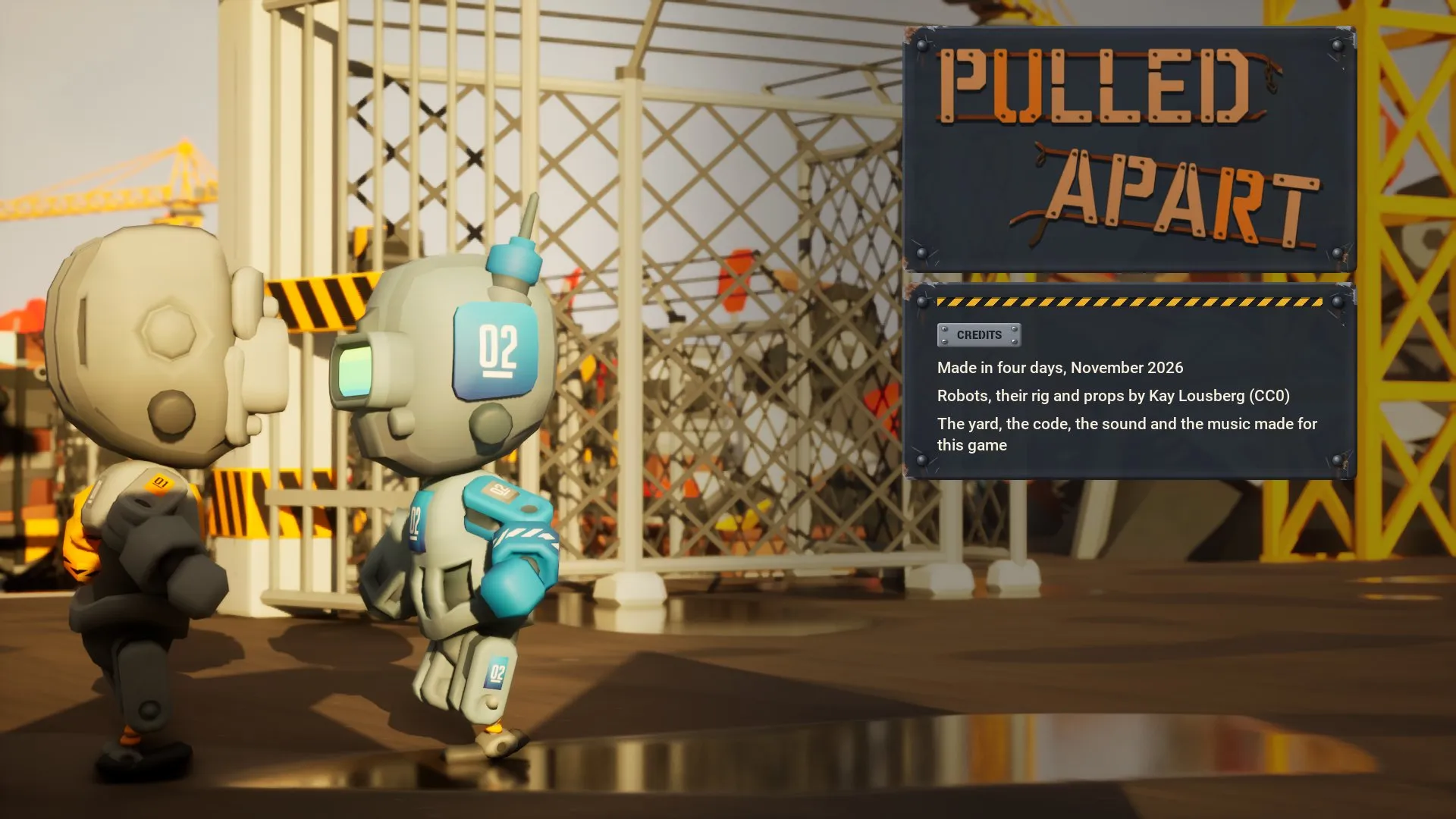
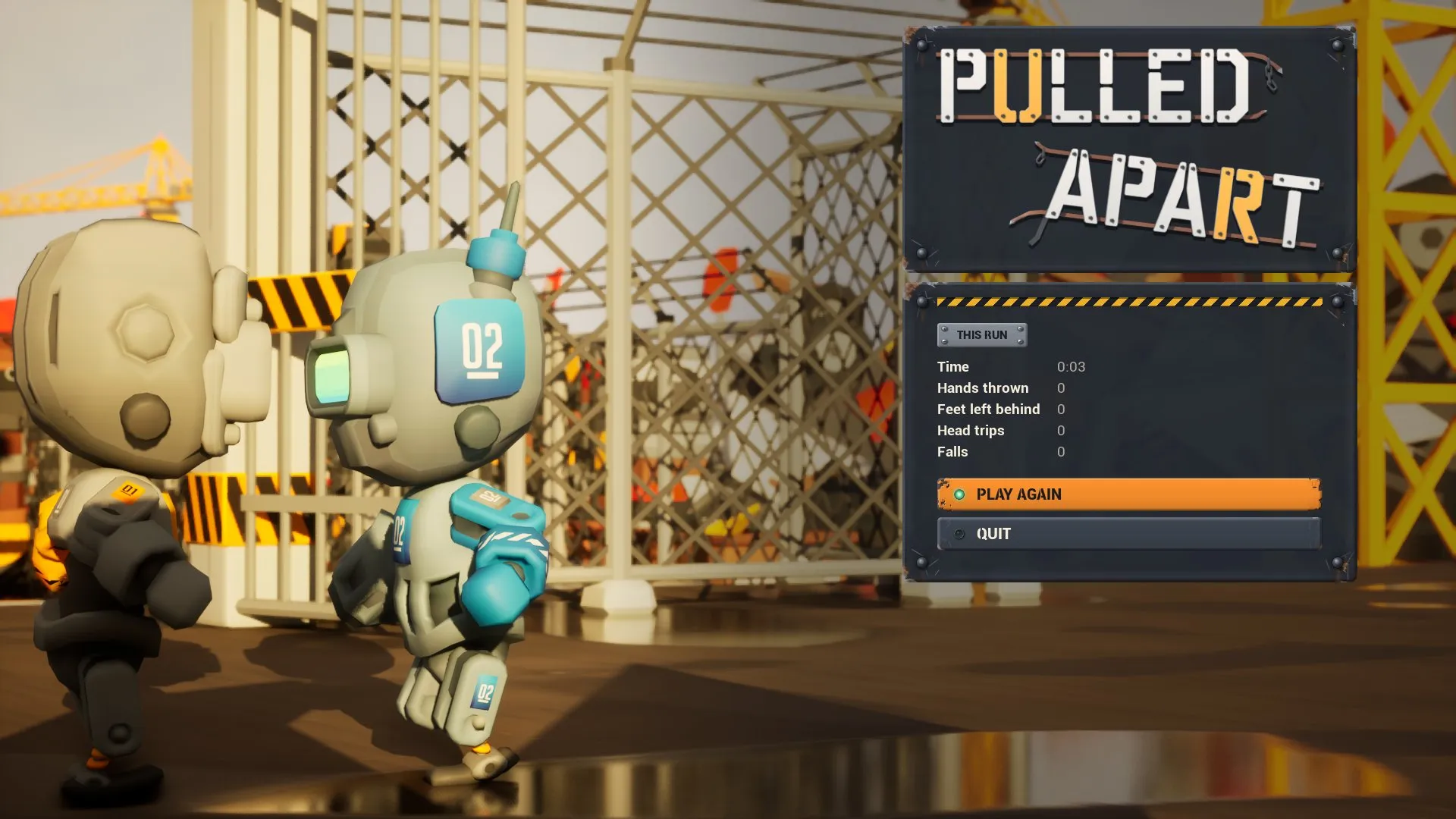
The tan didn’t last an hour. I asked why the ending wordmark looked orange. The agent had matched the color value, but tan against a bright sky looked quiet brown while the same tan on a dark plate looked orange. I had the tint removed, leaving the painted white and yellow.
A launch check then reached its time limit and closed another copy of the game too. That was the one I was playing. The check had stopped everything with the game’s name; it was changed to stop only what it started.
Saturday night: the second list, fifteen small things
The second list covered fifteen bounded items raised by more than one of us or rated highly, plus three more to do if there was time. A second agent session started on them at about 8:45 PM while we were away. We hadn’t played the result at this point.
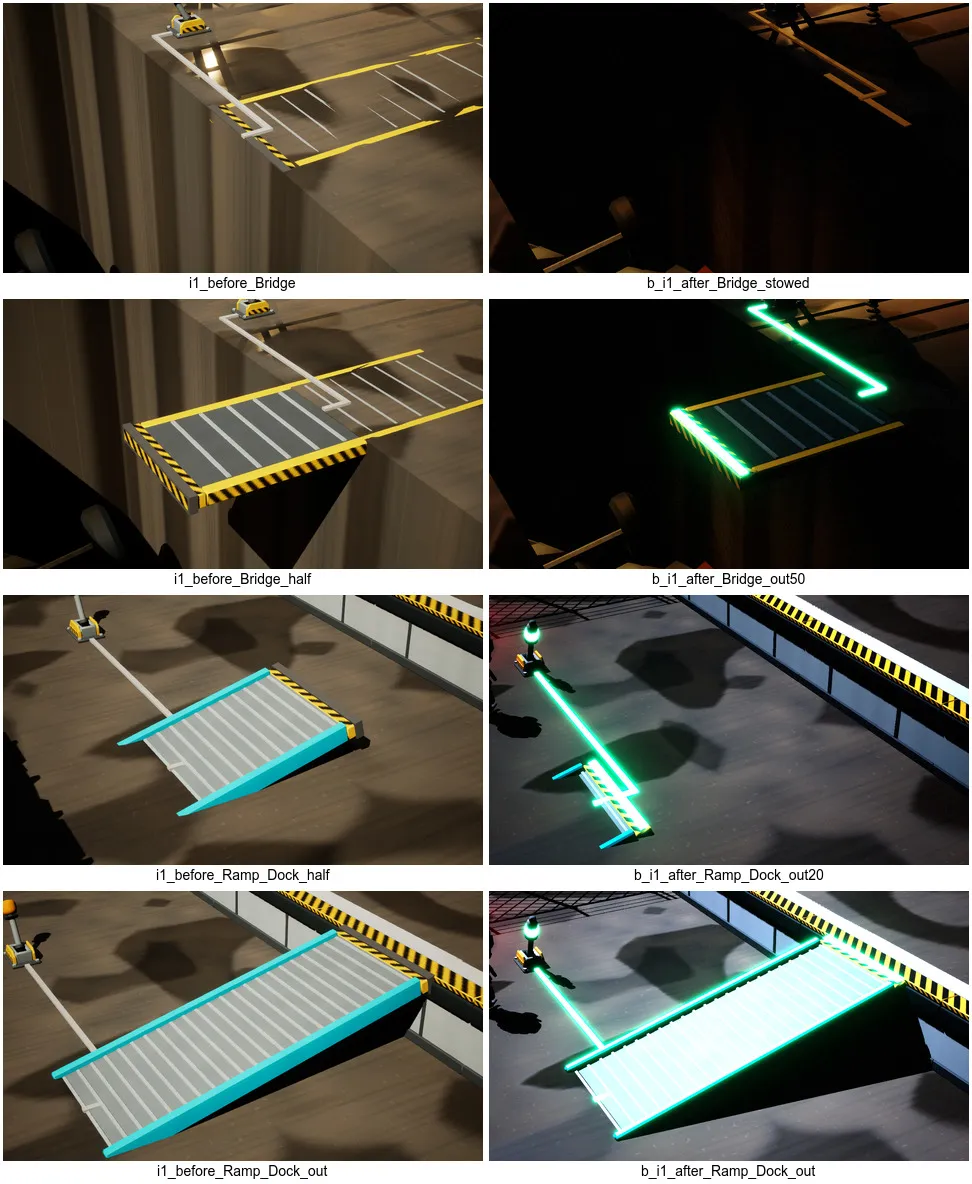
Most items made the visuals match the existing behavior. Gangway and ramp beams had flickered through the ground because their tops shared the floor’s plane. Their visible decks were moved slightly below the walking surface and hidden when fully retracted. Fences and gates between the camera and a robot began dissolving like bale walls, retaining a faint outline instead of dropping flat and looking walkable. The cart began sampling the ground under all four wheels so it leaned correctly across ramps at an angle. Sorting Line wires were routed around the pits on the front and back ground strips and flattened enough to keep wheels from cutting through them.
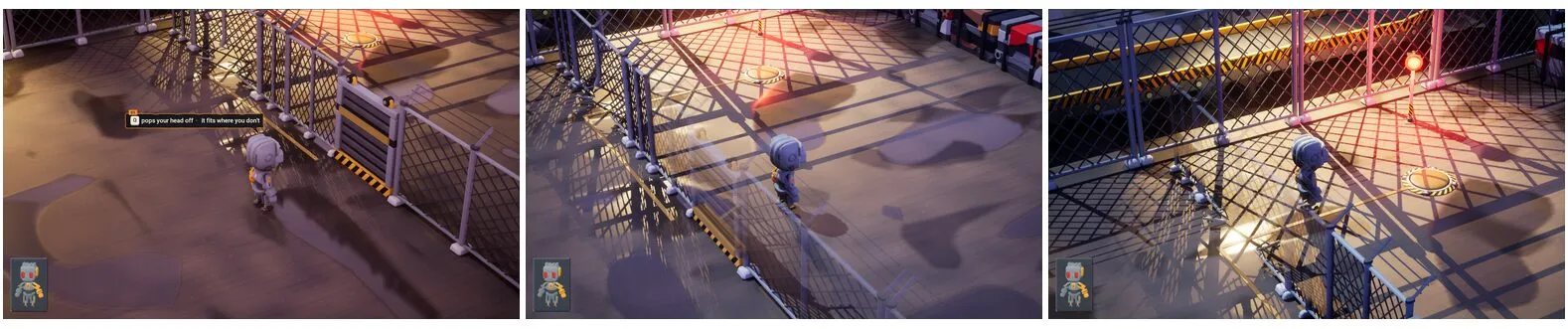
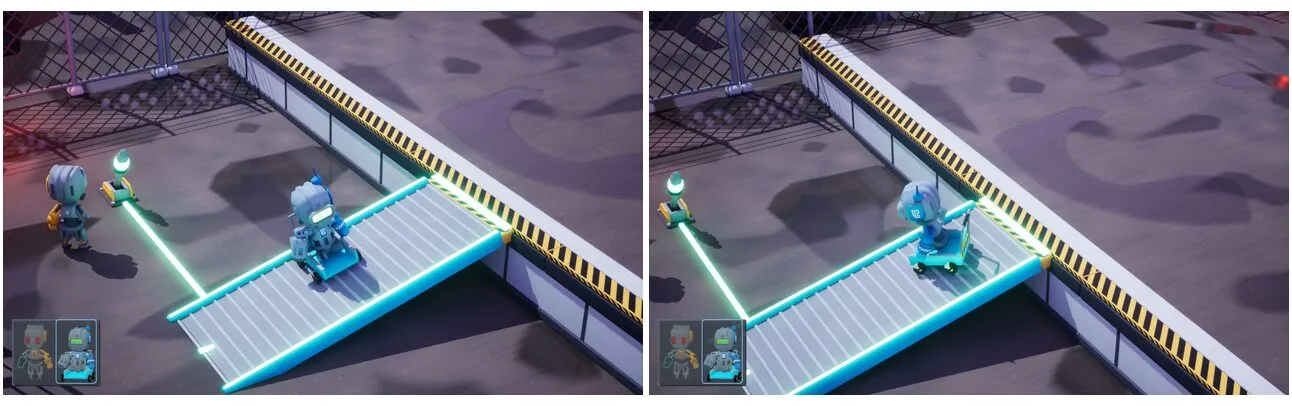
Other items improved the story scenes. The crane now turned 02 gradually through its swing rather than snapping a quarter turn when setting it down. At the crusher, 02 faced away and pushed against the belt with its wheels spinning until the machine stopped. The rescue’s first shot moved inside the strip beside the belt so the fence didn’t hide both robots. In the ending, 02 hopped up one tread at a time, keeping its new foot out of the stair risers.
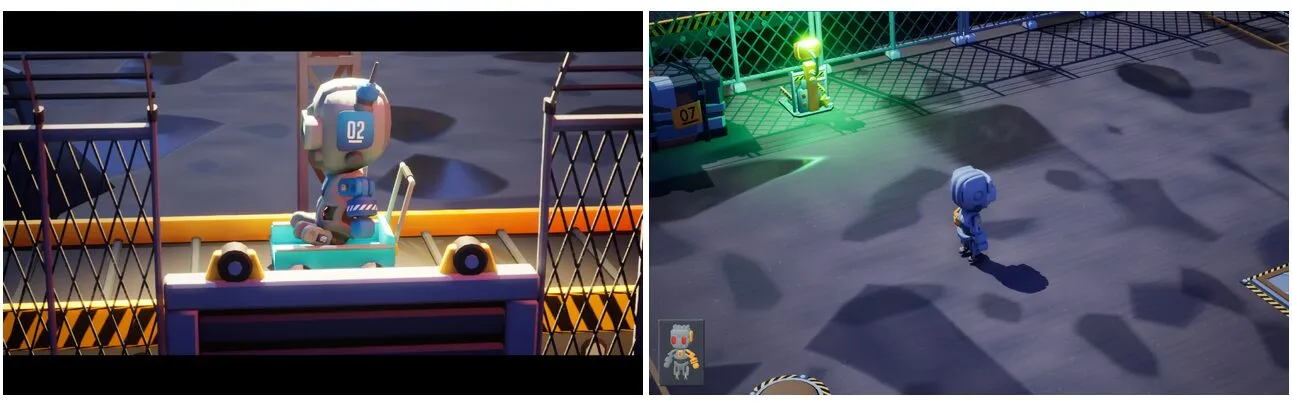
Two changes closed unintended routes. The opening’s junk piles got invisible collision boxes over their cores, tall enough to keep their tops from becoming walkable floors. A running jump followed by releasing the head could also clear a two-meter fence and skip a head passage. The agent confirmed that route in play every time it tried it.
The four fences protecting head buttons received invisible screens eight meters tall that blocked robots but let thrown hands through. An independent agent reviewed both changes from the scripts and code. It found no way to trap a player and three smaller issues, which were fixed.
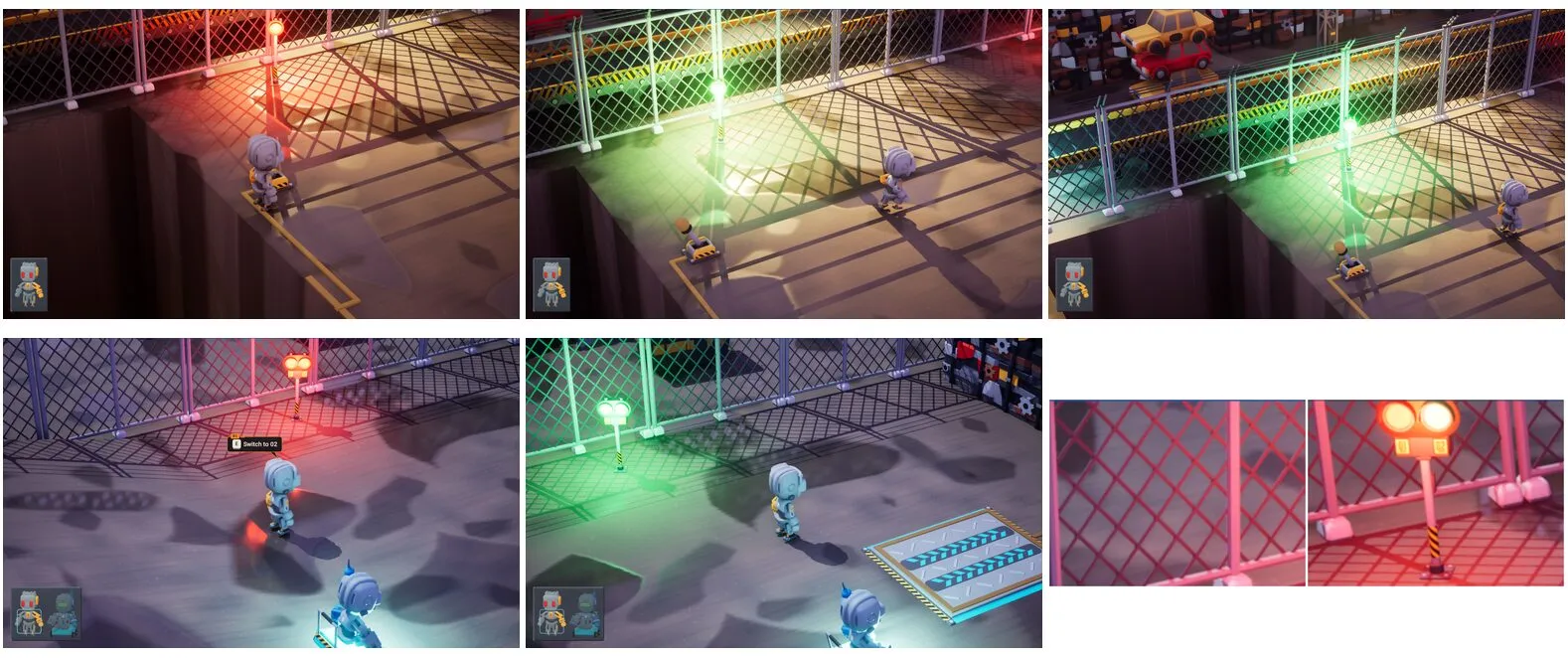
Checkpoints were easy to miss, so the charging stands became signal posts: red before activation, green afterward, with a flare and a new chime. Act 3 posts had a lamp for each robot. The first versions were too tall; their lamps left the camera’s view when a robot stood in the middle of the room, a problem caught by inspecting the stills.
Loading-ramp lanes got hatched markings, and a robot blocking a waiting ramp said who was in the way. Arrows beside the spare lever and scale marked the way back; those devices existed to prevent the pair from getting stranded.
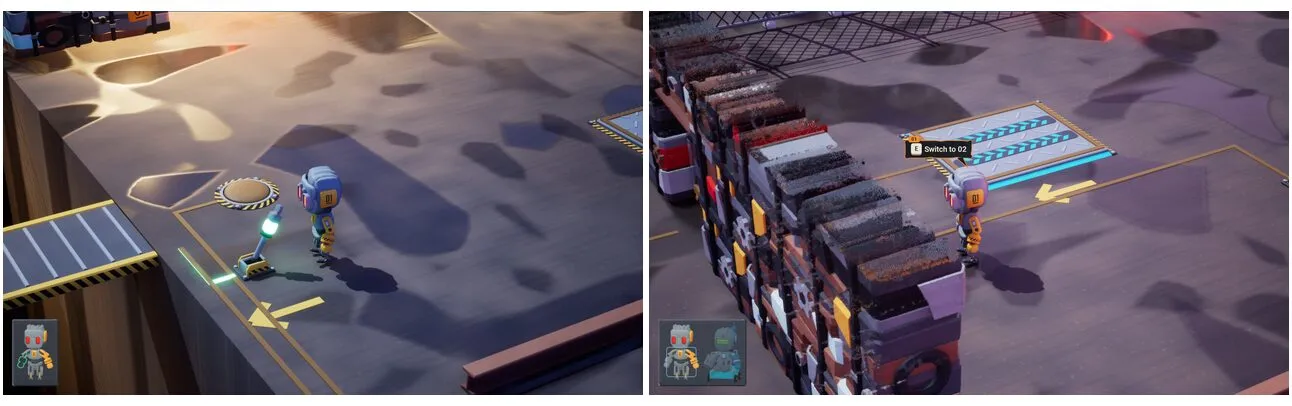
The three extra items were built too. Beside the “07” bale before the crusher, an F prompt let 01 stop, face the bale, and lower its head to one low note. A thrown hand that hit nothing now bounced once while tumbling, then settled. After a fall, the crane magnet visibly lowered the robot onto its checkpoint. The fall behavior itself stayed the same; the instruction for that night’s work was to change how it was drawn.
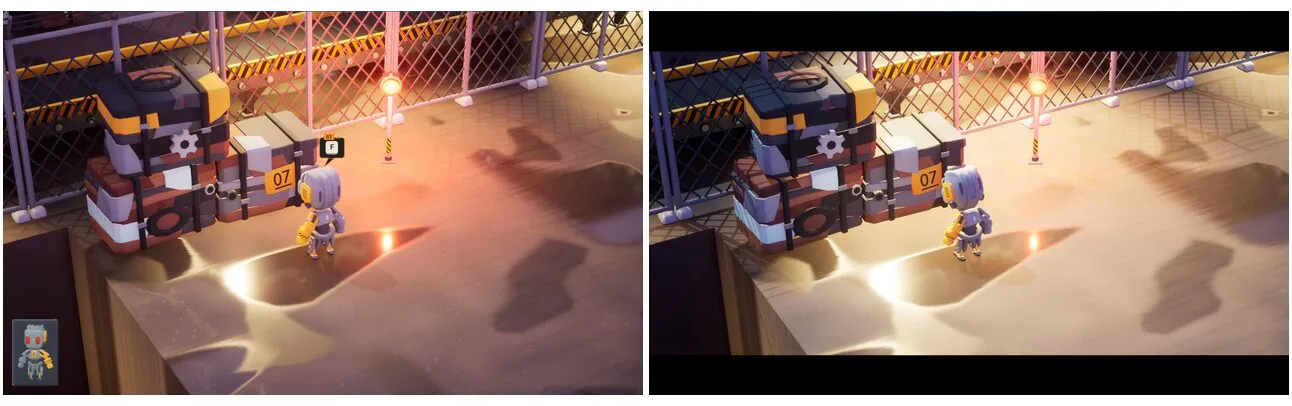
One item was inspected and left alone: Ron II’s “01’s ankle looks wrong where the foot was.” The detached part was the whole lower leg, so the remaining leg ended at the thigh. Close stills showed nothing broken. The agent left a question for Ron II instead of guessing at a change.
Saturday, near midnight: the third round, eleven notes
We played the second list’s build and sent eleven more notes. The agent kept their order in a third list and built the changes between about 11:45 PM and 12:15 AM. We hadn’t played that result yet.
Several notes needed closer inspection to identify the cause. “The floodlights are clipping” covered two faults: the middle lamp heads on every mast overlapped the top plate by ten centimeters, and one mast stood inside the crushed-cube pile. “The crushed cube overlaps another” referred to the press’s animated cube landing inside the pile’s first cube, so the pile moved a meter and a third east.
“The barrel and 02 hop into place” came from magnet sway. With nearly ten meters of cable and a degree and a half of sway, 02 was released 19 cm from its destination and snapped there in one frame. The sway was made to settle after the arm stopped turning; frame-by-frame checks showed neither object moving at release. “The doors’ lit portion drops” was a gate whose body dissolved in place while its lit strip still moved down to the stub.
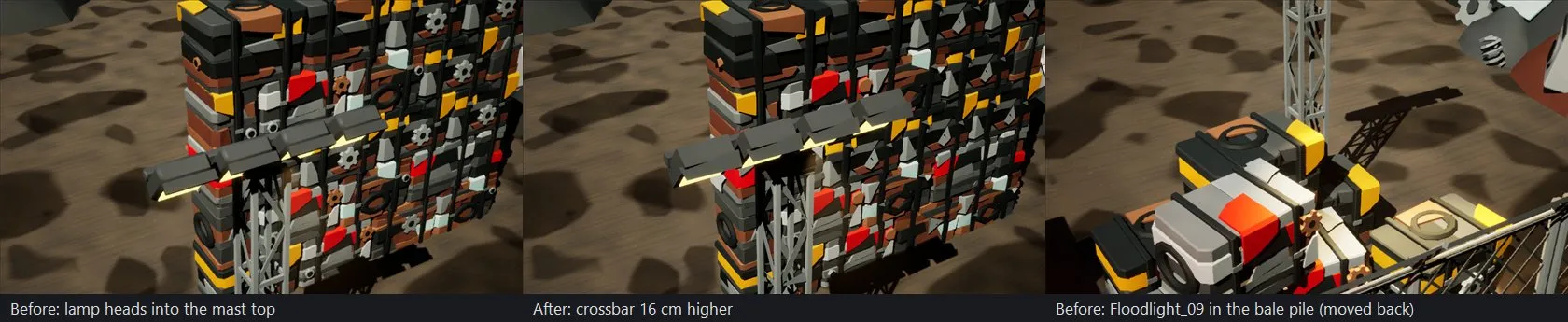
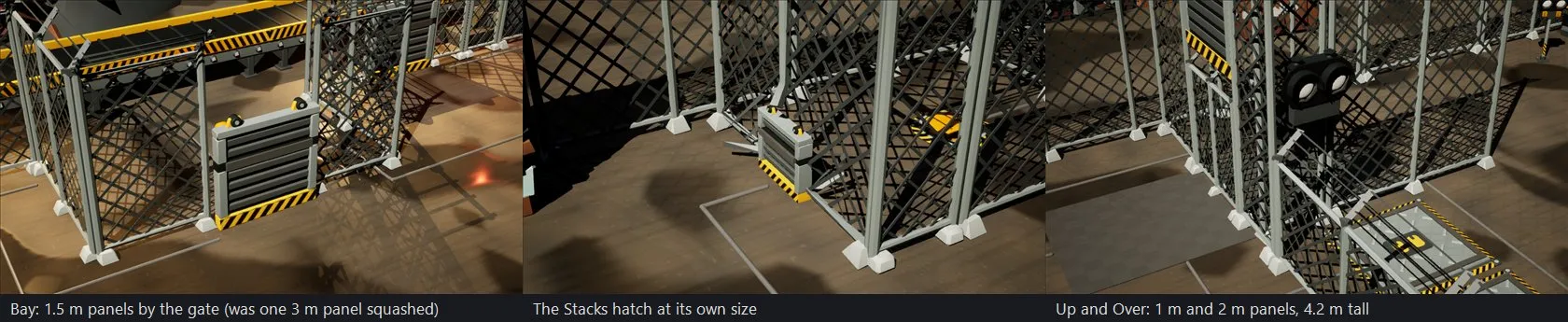
“Gate squashing” took the most work. One three-meter fence panel had been stretched to every length, sometimes down to a third of its width. One sliding gate had been stretched to every doorway, including The Stacks’ little hatch.
A sub-agent made thirty-two Blender models from a written brief: fence panels from half a meter to three meters long in four heights, four gates sized for the level, a repaired floodlight, and a signal head. Walls could then use whole panels and one shorter panel. Up and Over’s lift indicator was rebuilt from the checkpoint signal head and mounted on the fence’s face rather than through it.
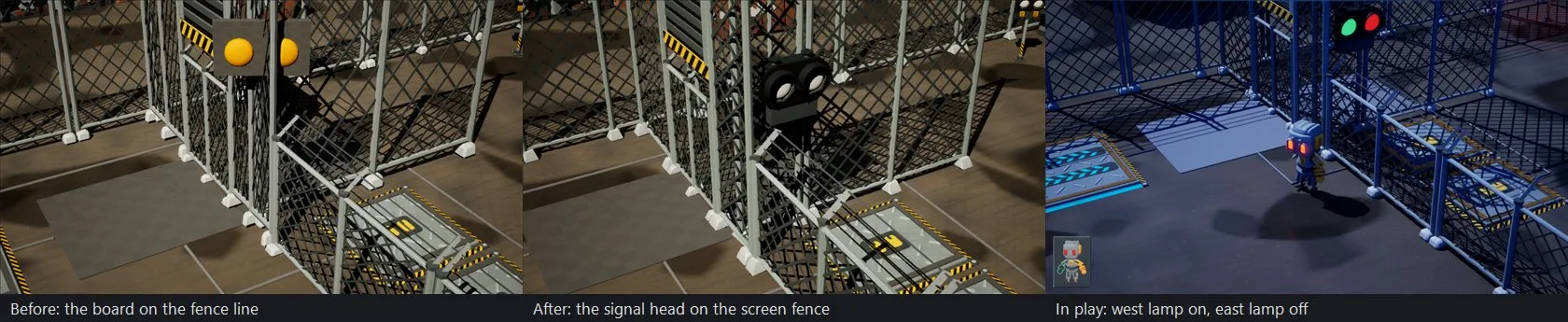
The remaining changes were about feel. 01 looked around at cursor height instead of down at the ground. Checkpoints became dimmer props rather than flares. The arrows were removed. At the crusher, 02 slowed into place, then pushed as fast as it could with its wheels matching the belt’s speed.
Wires became round gray cables with light pulses traveling from a device to whatever it operated. The first version still glowed along its whole length, so the glow between pulses was reduced almost to nothing.
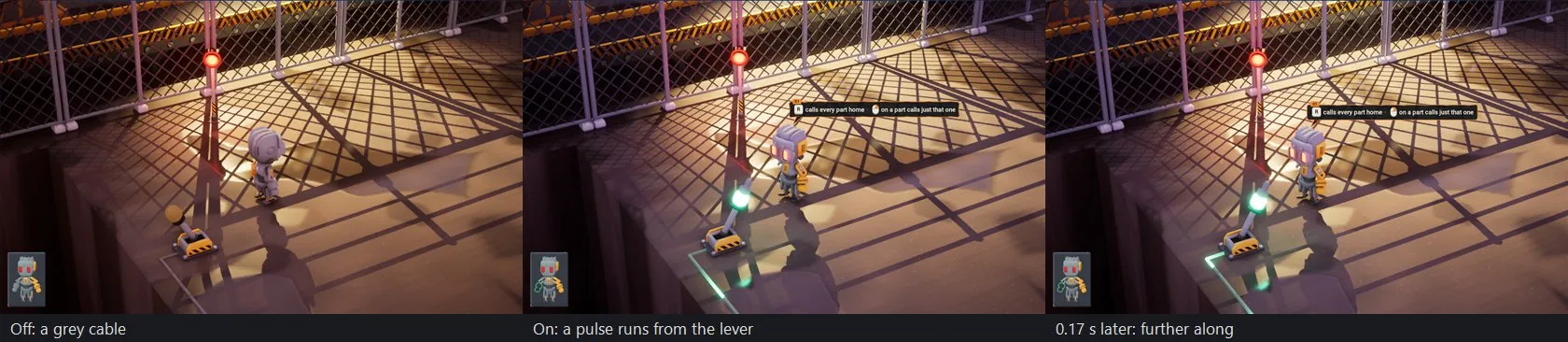
Sunday, after 1 AM: the fourth round, eight notes
We played the third list’s build and sent eight more notes, mostly about the story cameras. They were built overnight between about 1:30 and 3 AM, before we played again.
Two notes asked to remove things. “We don’t need a way back” referred to a second Sorting Line lever and a second Truck Scale plate. Both had deliberately survived the second list because each prevented the robots from getting stranded on opposite sides.
They were removed and replaced with routes that stayed open after completing the room: the gangway stayed extended once 01 crossed, and the gate stayed open once 02 passed. The two original traps were replayed with real key presses and no longer happened.
The reviewer found another: walk onto the gangway, turn back before its end, and recall the parts. The gate behind you could already have shut. It was made to wait until the point where the gangway stayed extended, and that case was played too.
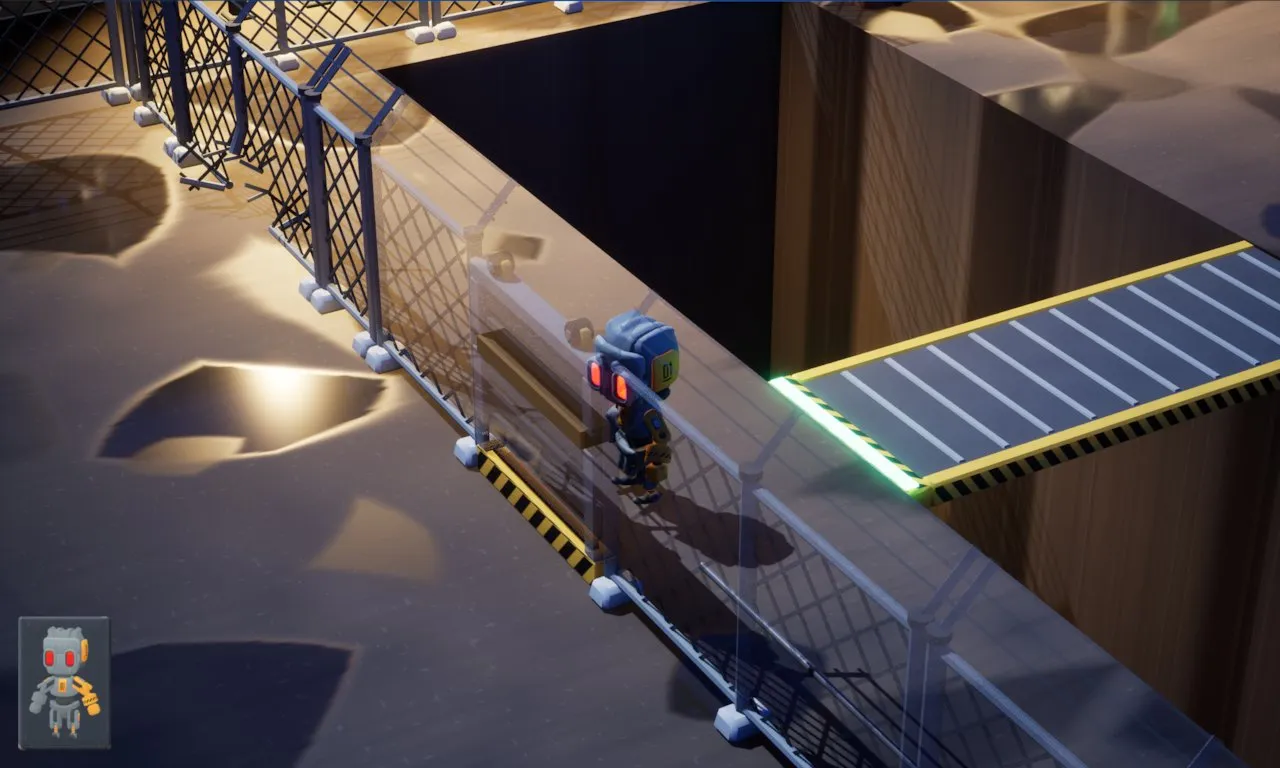
“The fist bump doesn’t connect” wasn’t a height problem. 01 sat two centimeters higher than 02, but their fists were 34 cm apart, one ahead and one behind. The clip had been authored standing and played over a sitting pose with leaned-back hips and a twisted spine. That changed where the arms landed. The standing version at the ending connected.
The camera notes led to changes in every story scene. Moving shots kept their target on a steady path instead of swinging past it. Held shots could drift a few centimeters per second and settle, and shots could follow moving objects such as the crane’s barrel.
The opening moved from the wide shot to eye height behind the robots, then cut to their front for the fist bump. Sunset lit their faces, and 02’s visor lighting up was visible. The camera stayed in front as the crane collected the barrel, with the magnet descending behind 01’s head.
Two attempts were discarded: following the barrel upward tipped the robots out of frame, and following 02 toward the crusher moved the camera into a chain-link fence.
02’s head also began following the cursor while under player control, and each robot watched the other. Robots without lower legs sat with their thighs flat instead of raised toward nonexistent knees: always for 02, and for 01 with no feet. A Blender sub-agent rebuilt the cart as one tub with a continuous rim rather than five boxes, a bent handle, supported axles, and rounder tires.
Sunday morning: no way back, for real
The next morning, we noticed that the gangway before 07’s bale stayed extended after 01 crossed and recalled every part. The overnight fix was working as designed, but it still left a way back. We removed the permanent completion flags and made routes wait only while closing them would trap somebody.
The gangway now stayed out while 01 or its head was on it or the strip beside the fence, with an amber blinking edge like a waiting gate. After 02 had passed the Truck Scale gate, it stayed open only while the robots were on opposite sides. Before that first crossing, it behaved like any gate, requiring them to hold it for each other. Cross and recall the parts, and both routes closed behind you.
The independent review found no way to get stuck, but it found one more permanently open route left from Friday. The Loading Dock ramp stayed extended once 02 used Up and Over’s truck scale, preventing 02 from getting stranded below while 01 was over a fence it couldn’t cross back alone. Before the noon freeze, that changed too: once 02 had reached the dock, the ramp waited only while one robot was above and the other below.
The agent replayed both old traps, the reviewer’s turn-back case, the morning’s reported case, and both arrangements at the dock with real key presses. It then ran the whole game from title to card again.
Sunday afternoon: a cover
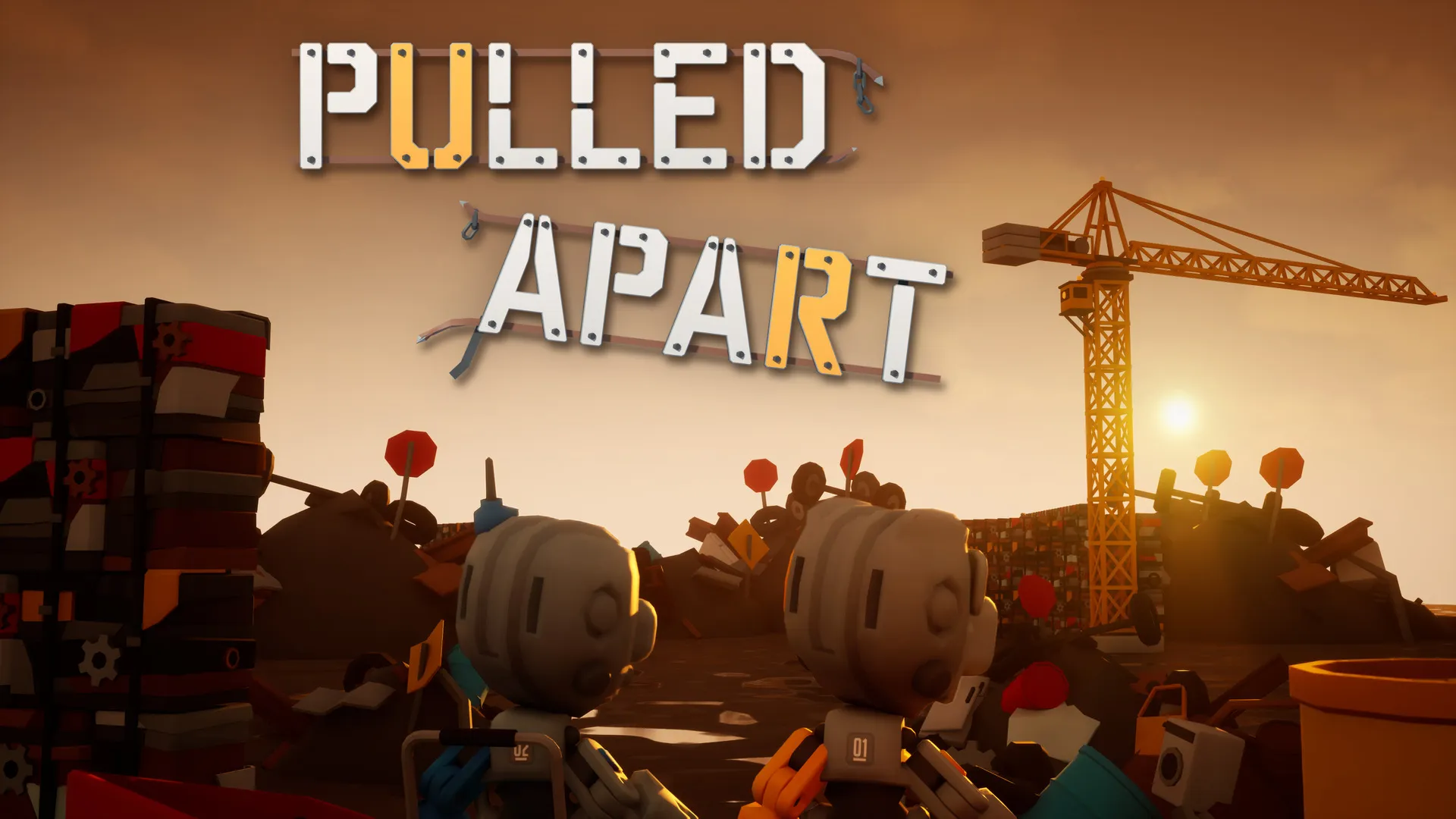
With the game built, I asked for an itch.io cover, a video thumbnail, and a web preview, each using the title’s wordmark over a backdrop the agent chose. It chose the two robots watching the sunset behind the crane. The title screen itself already contained the sign, and the cover needed much larger lettering.
The agent ran a hidden second copy of the game beside the editor I had open. Through its console, it hid the sign, moved the camera down behind the robots, and captured a still without the menu. It placed the ending’s wordmark over the sky and darkened the top slightly to separate the white letters. No new art was drawn.
My feedback on the first version was that the robots, lit from ahead by the sun, were too dark at listing size. To brighten only them, the hidden copy rendered depth twice from the same camera at the same paused moment, once with the robots and once without. The difference identified their pixels, and only those pixels were brightened.
Sunday afternoon: two last things
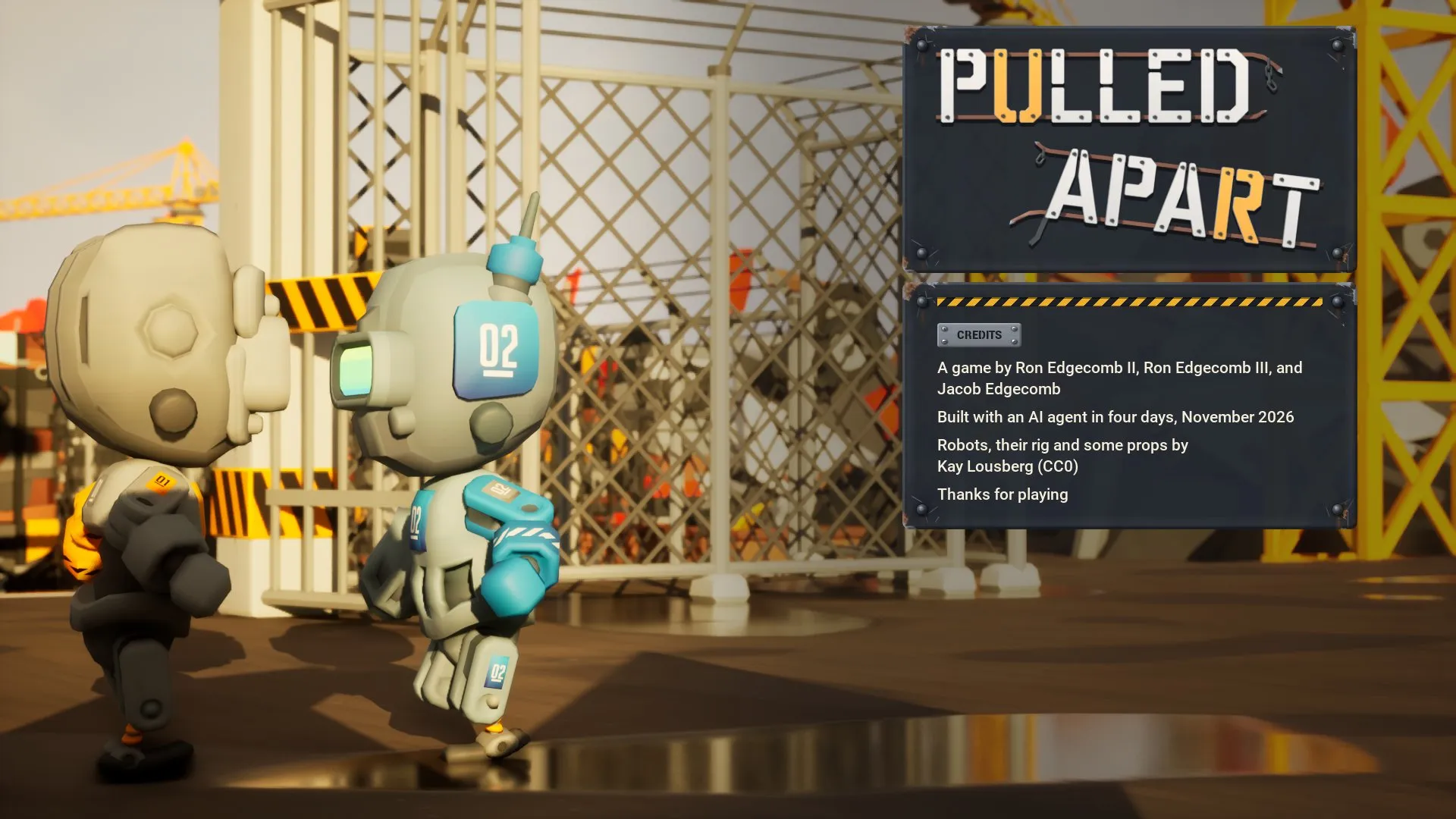
Before the final build, I had two more items. The credits had used placeholders since Thursday while we decided how to name the team. The agent offered three versions, and we chose the plainest: our three names, “Built with an AI agent in four days,” Kay Lousberg’s robots and “some props,” and a thank-you. I corrected the props wording because most of the yard was made for the game.
The other item was the cart disappearing when 02 stood up at the ending. It was actually being moved 230 meters back to the world’s origin. A Saturday-night change redrew the cart every frame without accounting for 02 leaving it. After the fix, it stayed empty at the foot of the gate’s steps.
Checking the new build also closed my browser. The launch check identified processes by IDs that Windows had since reassigned, and one now belonged to the browser. The check was tightened to stop only programs it had started from the game’s own folder.
Sunday afternoon: an icon and a minute of video
With the game finished, we spent the afternoon on the things around it. We also answered the devlog’s remaining questions together; those answers are included in the earlier sections.
An executable icon. I asked for one more small change. The executables still used Unreal’s icon, and I wanted a head-on view of 01’s head in the style of the parts display at the bottom left of the screen. The agent estimated a new build and another full set of checks would take about three quarters of an hour. It proposed keeping the game unchanged and set a cutoff after which we’d drop the icon and upload the earlier build.
A sub-agent used the parts display’s rendering script with the camera moved directly in front of the head. I reviewed the picture and approved the build. The game files came out byte for byte identical to the earlier build; only the two executables changed. We didn’t need the fallback.
Recording the video. My first idea was to record a build playing itself and have the agent cut it to a minute. The agent pointed out that its whole-game playthrough script lived in the editor. Making a packaged game play itself would mean adding code after the freeze, and the scripted play would look scripted.
I played it myself instead: one sixty-second take from the first room into the fourth, recorded at 2560 by 1440. The agent checked the file’s duration and size, inspected a still from every two seconds, trimmed 25 frames of 01 standing still from the start to bring it below sixty seconds by any clock, and encoded it to YouTube’s recommended settings.
What we checked and learned
The agent checked through the editor by pressing keys, calling game functions, reading positions and states, and inspecting stills. That could establish whether a mechanic worked. Judging whether it felt good still depended on us playing it.
What those checks caught on the first night:
- A throw into the pit landed on the floor. Aiming at a point deep in the pit threw the hand steeply down into the near edge. Throws are now aimed at the level the golem stands on when the cursor is over a drop, so the hand arcs out and falls, and anything that falls out of the room flies home by itself.
- An invisible box you could hit. The checkpoint’s trigger volume used an engine preset that sounded right (“overlap only pawn”) and still blocked everything else. The golem came back from a fall 160 cm in the air, and a thrown hand could have landed on thin air.
- The lever was off the edge of the screen. From the lip of the pit the thing you needed to hit was barely in view. The camera now leans towards whatever you are aiming at. The first version leaned so far that the golem itself slid into the corner.
- The editor crashed once. A script that built the new room copied the old map and loaded the copy in the same breath, which the editor treats as fatal. Nothing was lost, and the room was rebuilt a safer way.
- Two players, one keyboard. While the agent was running a scripted check, one of us was playing the same session. Both sets of input went into the same golem. The agent threw that check away and waited. The useful accident was that the real mouse and keyboard turned out to work.
What the checks caught on Thursday afternoon, in the story work:
- A slot in the ground. Taking out an old back wall left a gap 100 cm wide along the fence line. The golem fell through it on its way to 02 in the ending.
- Junk you could stand on. The heaps of junk in the first pit were placed as scenery that blocks nothing, and blocked anyway: Unreal quietly gives a placed mesh its collision back each time the level starts. A scripted walk off the heap and into the pit ended with the golem standing on the junk, a little above the depth where a fall sends it home. A player would have been stuck there. Seventy-two pieces had the same fault.
- A fault only the packaged game has. In the editor everything looked right. The packaged game’s log had one new line: a material was missing a flag, and “Default Material will be used in game”. The editor sets that flag by itself the first time it is needed, so the fault can’t be seen there. It was caught because every package’s log gets read.
- Two players, one keyboard, again. The agent started a play session in the editor to take stills, and one of us sat down and played it. The agent moved the golem twice before it noticed. It now checks whether anyone is at the keyboard first.
On Thursday morning the first packaged build went through in under a minute with no errors. It launched outside the editor and loaded the hand room. It is 1.1 GB unzipped, and a third of that is debug symbols the delivery does not need.
A separate agent reviewed Thursday morning’s code, records, and packaged builds. It found no serious defect but caught a mistake in the launch checks: stopping the small launcher hadn’t stopped the game itself. One copy ran hidden for two and a half hours while a team member was playing, despite records saying the checks had stopped after 40 and 25 seconds.
The records were corrected and the checks changed to stop the game process. The review also found that the head’s invisible body could catch a thrown hand in mid-air and that movement waited one frame for keyboard input. Both were fixed.
With the yard, clouds, and bounced light enabled, the packaged game took about 5 thousandths of a second per frame on the title and 4 while standing in the first room. Before the story work, it had been under 3. These measurements came from two stationary views on the development machine, which had a fast graphics card.
Every package was launched. Each packaged build was started outside the editor, hidden, and its log read. By Saturday that was one script of fourteen launches: the title, the settings and the pause menu at two sizes each, play in the first room and in the two harder rooms, the credits, the first build’s ending, the real ending at the gate played through to its card, and settings changed in one launch and read back in the next. The script looks for errors, for the faults only a packaged game shows, and for a game left running afterwards, and it takes frame times.
The whole game, by script. After most rounds of changes, and last after Sunday morning’s fix, the agent played from the title to the end card in one run using real key presses. That full run wasn’t repeated on the 2:15 PM build, which changed one condition in the cart drawing and the credits wording, or on the later icon build, whose game files were identical.
Independent reviews. Once the game had two robots, the most serious findings involved getting them stranded on opposite sides of something neither could open alone. The last game review, on Sunday morning, found no way to get stuck. The submission review found nothing disqualifying, but it caught an overstatement in our page draft: “played every build” and “all from our notes.” We reworded both claims.
The final build was packaged on Sunday at about 3:30 PM with no errors and no warnings. It was the 2:15 PM build with the new executable icons; the game files were byte for byte identical. The archive was 411 MB without debug symbols. The agent unzipped it to a fresh folder, compared its files with the package, and ran the fourteen launch checks from that copy. There were no errors. Median frame times ranged from 3.7 to 5.1 thousandths of a second on the development machine.
A second machine. On Sunday afternoon, I unzipped the archive on my laptop, running Windows 11 with an RTX 4070, and played it. It worked well with no issues. The laptop had neither Unreal nor Visual Studio installed. Windows asked once about the firewall, and that was all. This was the 2:15 PM build, an hour before the icon update.
We still hadn’t timed a first-time player. All three of us had played packaged builds since Saturday afternoon and sent four feedback rounds, but nobody who had never seen the game played it before submission.
The pre-jam checks were limited to the concept demo: a scripted playthrough, edge cases, and a real-input run. They helped us assess the idea; they didn’t test the Unreal game.
Play and credits
Find the game on itch.io.
Watch the gameplay video on YouTube for a minute of play from the first room into the fourth.
Assets
All sourced assets came from The Complete KayKit Collection v8 by Kay Lousberg (www.kaylousberg.com), released under CC0:
- Both robots, their character animations, and rig.
- Cars, the tool cart, and other small props.
- Color atlases used to paint the yard’s new models.
The detachable parts were adapted from the pack’s robot. Scripts in Blender made the yard’s bales, fences, heaps, belt, press, crane, and devices. The blocking shapes beneath walls and floors were Unreal’s basic shapes. Clouds came from the engine, and the yard’s materials used its noise texture and dithering function. The interface used the engine’s Roboto font, under Apache License 2.0. The “07” on the bale came from Blender’s built-in font. Every sound and all music were synthesized for the game.
Tools
Claude Code handled planning, research, pre-jam demos, all game code, asset adaptation, new animations, editor work, and the development records. The main agent used:
- Claude Fable 5.2 until Thursday morning, then Claude Opus 5.5.
- Claude Fable 5.2 again from Thursday afternoon to Saturday evening.
- Claude Opus 5.5 from Saturday night.
- Claude Fable 5.2 again on Sunday afternoon for cover pictures and submission.
Sub-agents used the same models for yard models, story sounds, new animations, the cart’s art pass, and independent reviews.
The other tools were Unreal Engine 5.9 and Blender 5.3, each driven through its editor connection (MCP); Git and Git LFS; Python with Pillow and NumPy for interface textures; ImageMagick; and PowerShell. We kept the full list in the asset record.